
Never Judge a Birding Spot by Its Cover: A Morning with Luis Trinchan in Mérida
Mérida, Yucatán — March 2026
There’s a lesson I keep relearning in the field: the best wildlife encounters rarely come with scenic overlooks or interpretive signage. They come from people who know exactly where to look — and have the patience to show you.
This morning was a master class in both.
Sandra and I spent several hours birding around Mérida with Luis Trinchan of Yucatán Birding Tours, and I’ll say it plainly: if you are visiting the Yucatán Peninsula and birds matter to you at any level, Luis is your guide. He’s a biologist by training, a full-time naturalist guide by vocation, and — this is the part that’s hard to manufacture — someone whose love for birds is genuinely contagious. Listening to him talk about a species, whether it’s its habitat preferences, its local name, or the particular perch it favors on a cool March morning, you understand quickly that you’re in the presence of someone who has spent years learning to read this landscape. Not just the birds, but the whole living system they inhabit.
He also knew exactly where to take us. Three sites. None of them looked like much. All of them delivered.
Site 1: A Rural Road Through Dry Scrub
The coordinates would mean nothing to you — a stretch of ranch road through dry forest north of Mérida, the kind of place you’d drive past without slowing down. No signage, no parking area, no obvious draw. We pulled over, stepped out, and within minutes the birds started appearing.
The final tally for this single stop was somewhere between 10 and 15 species, and the list reads like a Yucatán highlights reel: Bronzed Cowbird, Couch’s Kingbird, Least Flycatcher, Orange Oriole, Great Kiskadee, White-eyed Vireo, Plain Chachalaca, American Kestrel, and various swallows working the open sky above the scrub. But two species stood out.
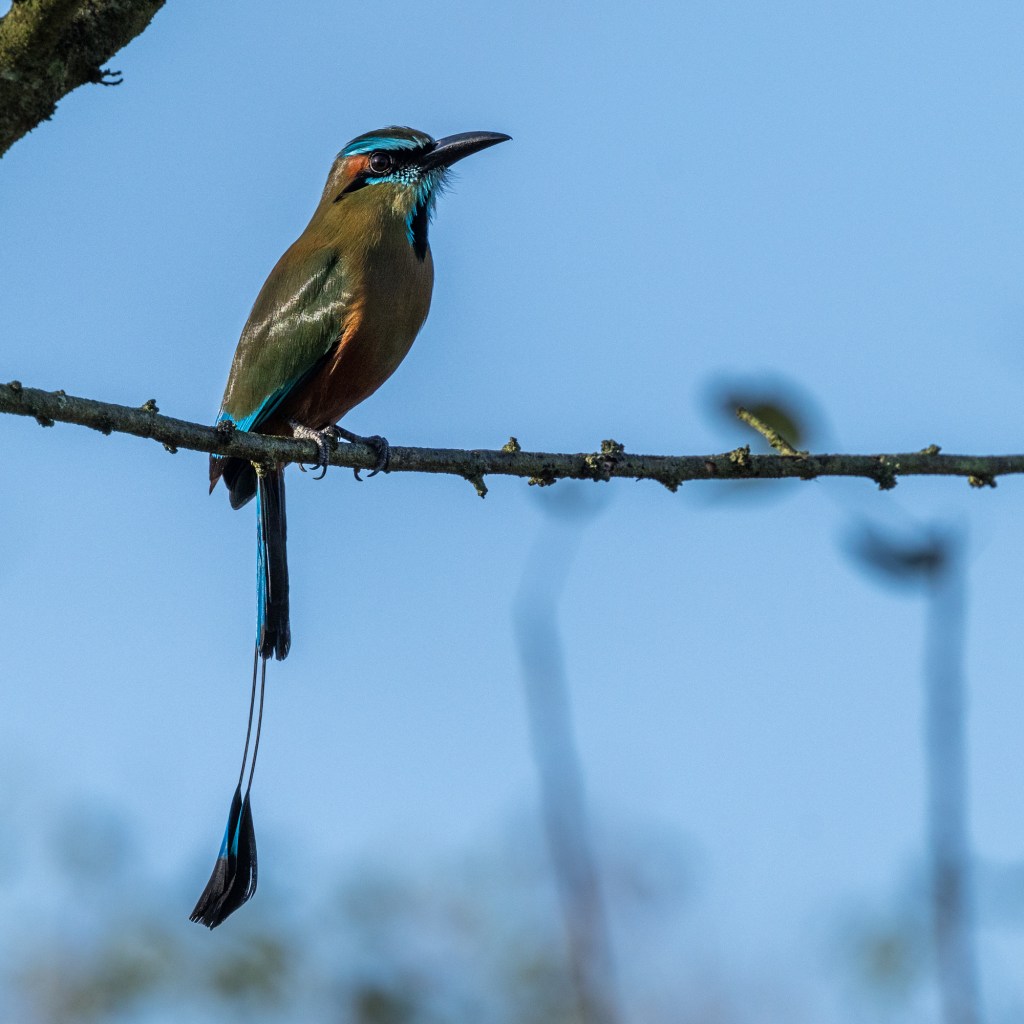
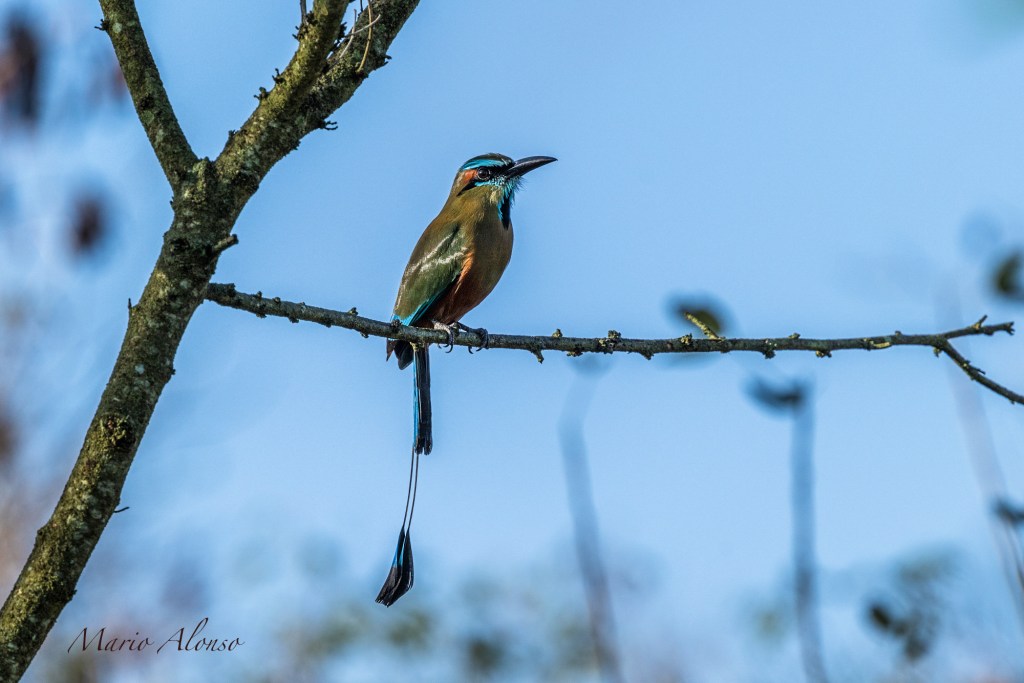
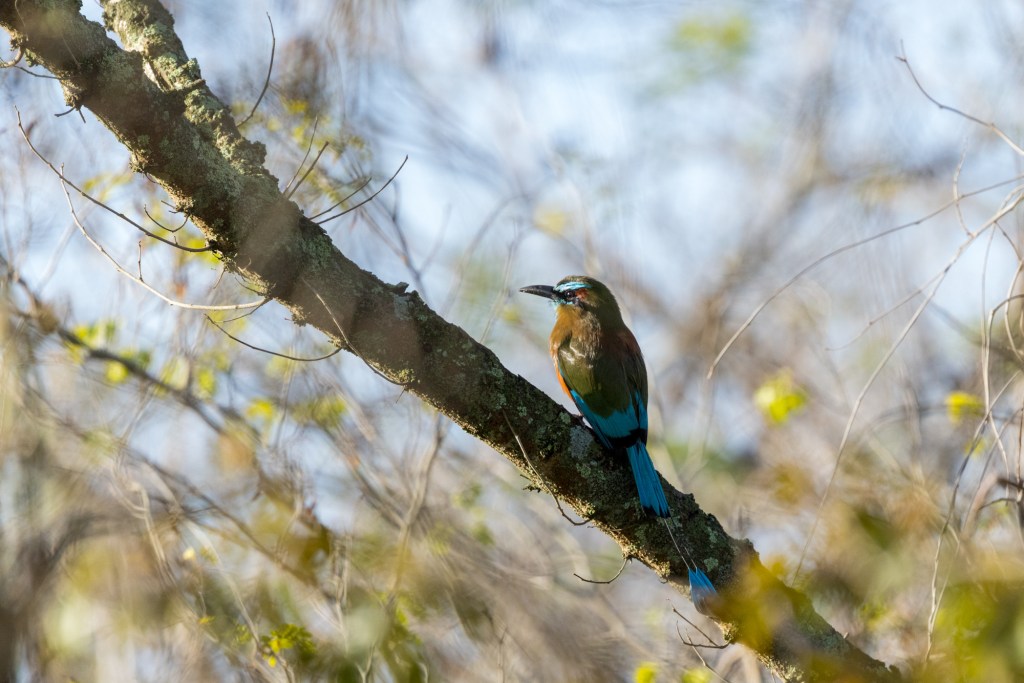
The Turquoise-browed Motmot (Eumomota superciliosa) is one of those birds that rewards patience with a genuinely unreasonable amount of beauty. Ours perched in the open on a bare branch against a clean blue sky — the racket tail hanging perfectly, the turquoise mask catching the early light. I was running the RF 100–500mm and had time to compose properly. The bird cooperated completely, moving slowly between branches, seemingly indifferent to us. The motmot is the national bird of both Nicaragua and El Salvador, and once you see one in good light, the choice makes sense.
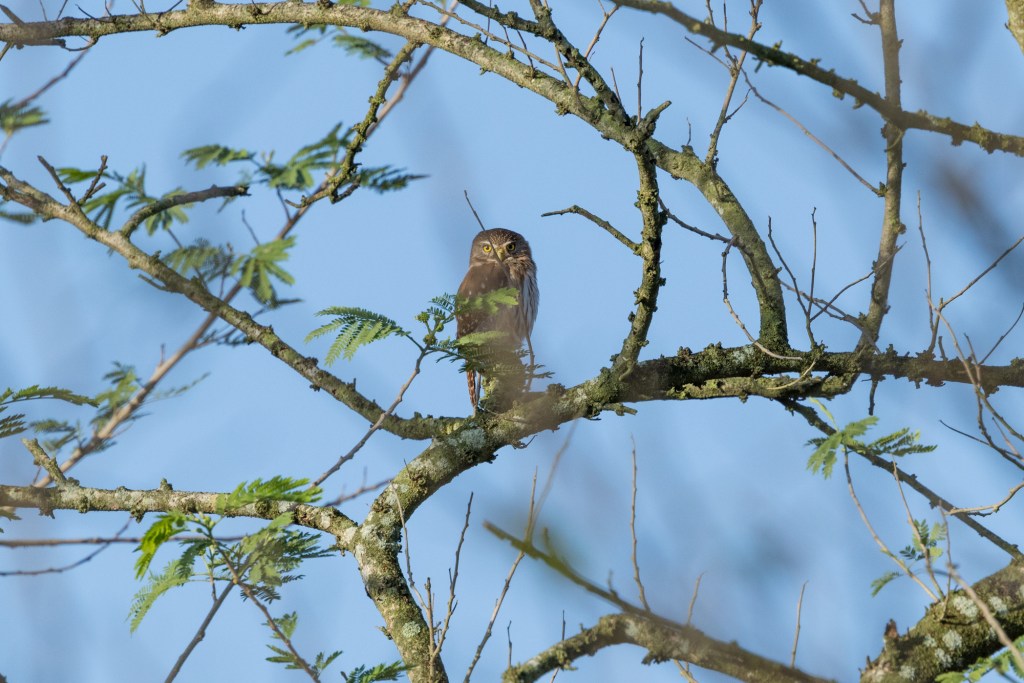
The other standout: not one but two Ferruginous Pygmy-Owls (Glaucidium brasilianum), seen at separate moments along the same stretch of road. This is a diurnal owl, small enough to fit in your palm, that hunts openly in daylight — which makes it photographable in a way that most owls aren’t. One was basking in the morning sun on a lichen-covered snag, the dead wood framing it perfectly against the sky. The other we found perched in a tree with leafing branches, those intense yellow eyes locked on us with the absolute confidence of an apex predator that happens to weigh less than two ounces.
Site 2: Chuburná Puerto — Hunting an Endangered Endemic
The second stop was the coastal village of Chuburná Puerto, a quiet fishing community on the northern Yucatán coast. The habitat here shifts — dry scrub gives way to coastal dune vegetation, salt flats, and mangrove edge. Luis brought us here for one specific reason: the Mexican Sheartail (Doricha eliza).
This is not a common bird. The Mexican Sheartail is an endangered hummingbird with one of the most restricted ranges of any species in Mexico — essentially confined to the northern coast of the Yucatán Peninsula. It doesn’t appear on most birders’ radar because most birders never find themselves in the right coastal scrub at the right time of year. Luis knew exactly where to look.
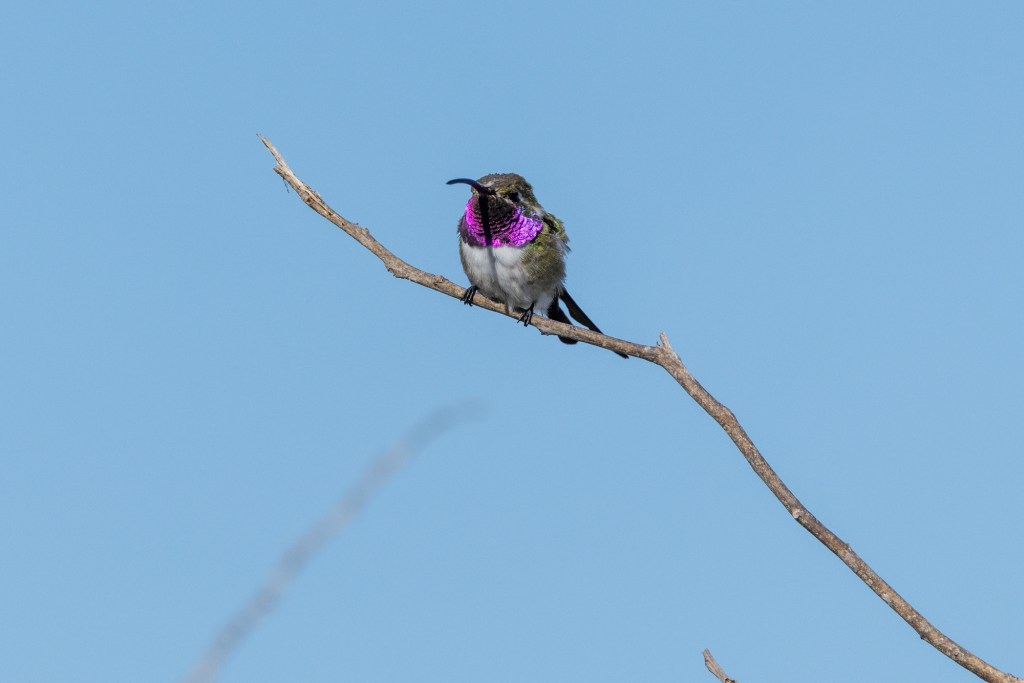
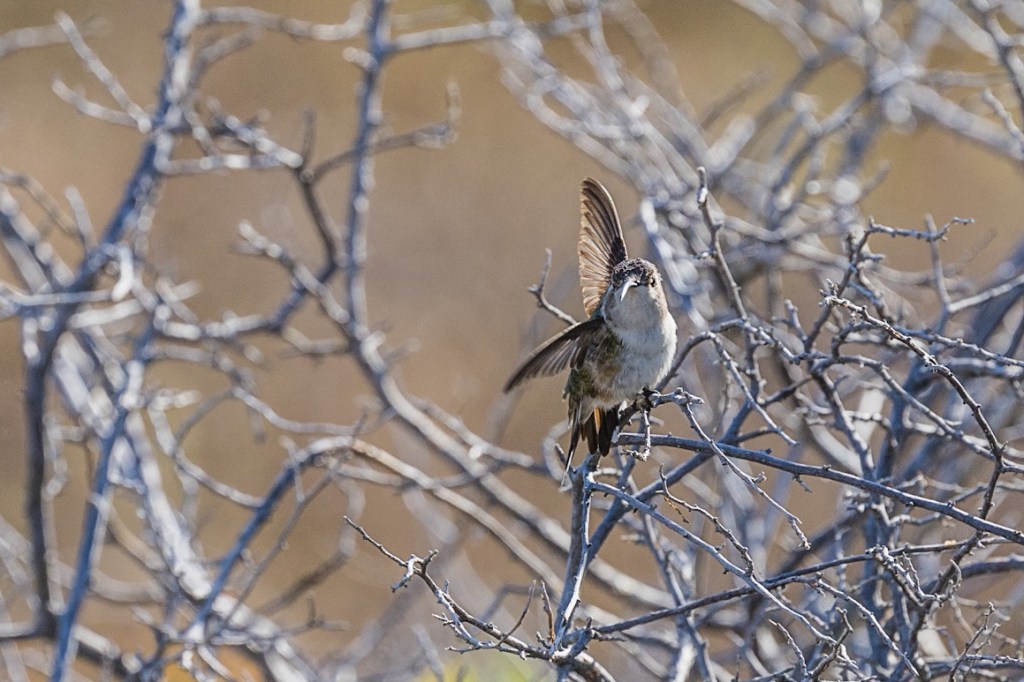
We found a pair. The male was everything the field guides promise — a blaze of magenta iridescence at the throat, perched on a bare diagonal branch against a pale blue sky, singing from the tops of the coastal scrub. Getting a perched hummingbird with the gorget lit up is a matter of angle and luck; we had both. The female (or immature) was more challenging — moving through the tangled dry branches, wings half-raised in what appeared to be a territorial or courtship display, visible only in glimpses. That shot tells its own story: this is a bird that makes you work for it.
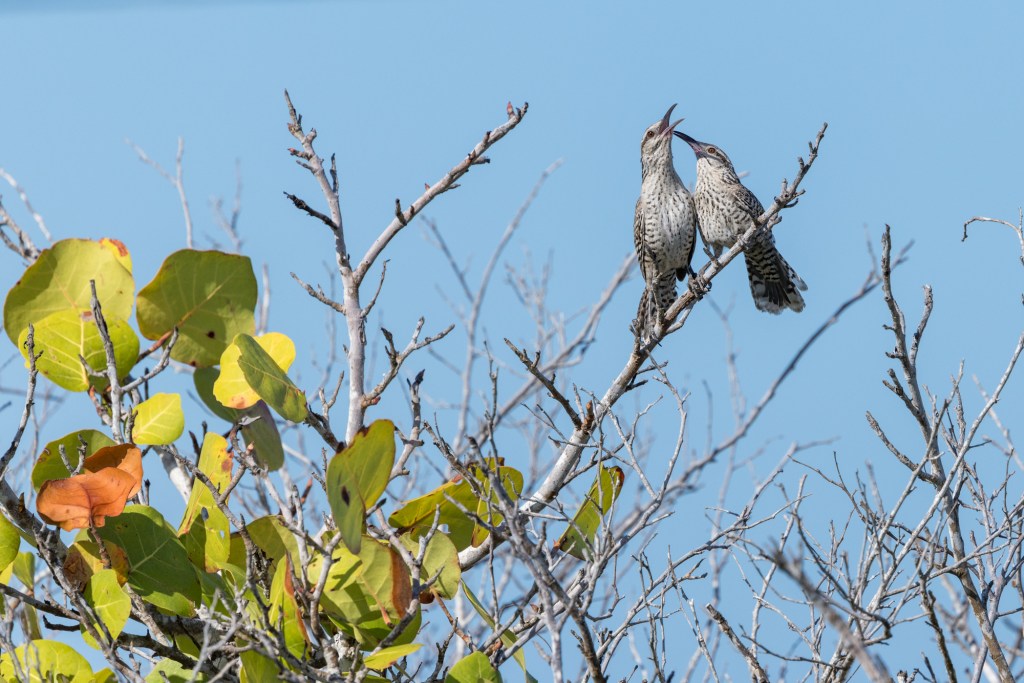
We also found a pair of Yucatán Wrens (Campylorhynchus yucatanicus) — another endemic, another species found almost nowhere else — singing from the top of the coastal vegetation. Bill open, wings slightly fanned, right out in the open. Some birds cooperate.
Site 3: The Government Building That Hides a Potoo
If Site 1 was a lesson in dry scrub diversity, and Site 2 was a targeted search for endemics, Site 3 was something else entirely: a small urban park tucked behind a government office building in the middle of Mérida. The kind of place that exists in every city and that almost nobody looks at twice.
Luis had a Northern Potoo (Nyctibius jamaicensis) staked out there.
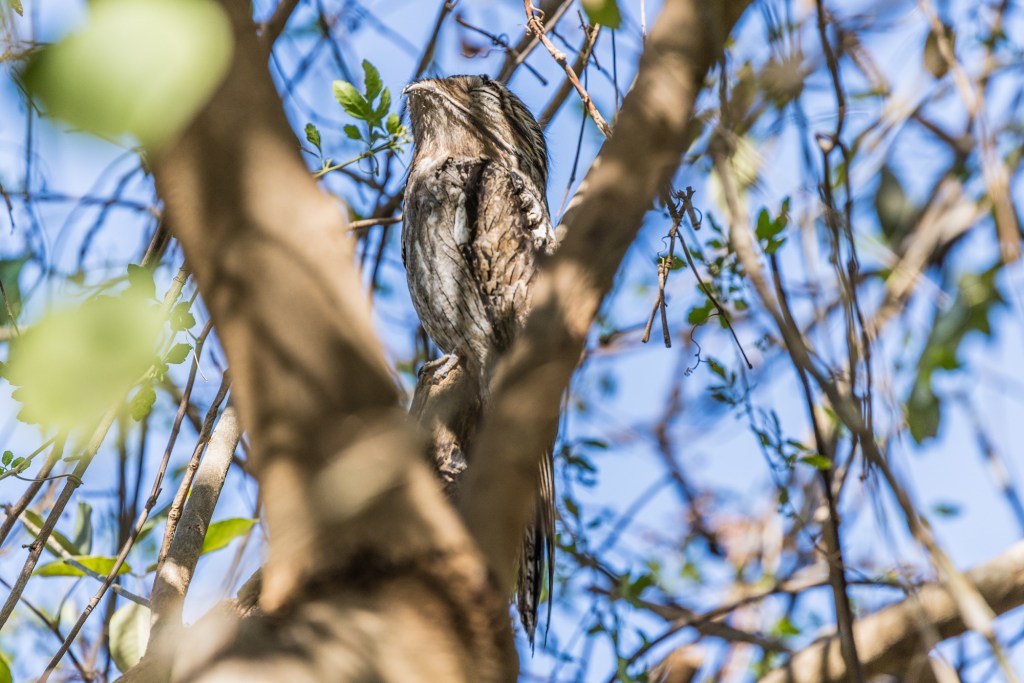
The Northern Potoo is arguably the most effectively camouflaged bird in the Americas. It roosts by day, motionless, on exposed dead branches — and its bark-patterned plumage is so precisely tuned to its substrate that the bird is effectively invisible until someone points directly at it. Locally it’s called pájaro estaca — the stake bird — which tells you everything about how it looks when it’s doing what it does best: impersonating a broken branch stub.
Even knowing it was there, finding it in the viewfinder took a moment. The bird was roosting in a tree canopy, eyes closed, absolutely still, its streaked gray-brown plumage blending into the branches with an exactness that evolution has spent millions of years perfecting. I shot through the canopy with the 100–500mm, working angles to get a cleaner frame. The best images are partially obstructed by branches — which is, honestly, the most honest representation of what it’s like to find this bird.
Behind a government building. In the middle of a city.
The Takeaway
Three sites, none of them scenic destinations in the conventional sense. A ranch road, a fishing village, an urban park. Between them: somewhere north of 20 species, including two Yucatán endemics, two Ferruginous Pygmy-Owls, a motmot in perfect light, and a potoo that spent the morning pretending to be wood.
The Yucatán Peninsula holds over 550 bird species — more than half of all species recorded in Mexico. That density is possible because the peninsula packs an extraordinary range of habitats into a relatively compact geography: dry forest, coastal scrub, mangrove, wetland, tropical forest. But knowing that number is very different from knowing where to be at 7 a.m. on a Tuesday in March.
That’s what a guide like Luis provides. Not just logistics — knowledge, pattern recognition, and a feel for the landscape that takes years to develop. If you’re going to spend a morning birding in the Yucatán, spend it with someone who knows it the way Luis does.
You can reach Luis at yucatanbirdingtours.mx.
All photographs: Canon R5 Mark II with RF 100–500mm f/4.5–7.1L IS USM. Mérida, Yucatán, Mexico. March 2026.
 Looking 4 Nature
Leave a comment