
When the Detour Becomes the Destination
Sisal, Yucatán — March 2026
The original plan was simple: drive to Sisal, spend the morning at the beach, and head to the mangrove in the afternoon. But plans in the Yucatán have a way of improving on themselves if you let them.
Sandra and I decided last minute to detour through Xcambó first, then drive to Sisal via Progreso along the northern coast. It turned out to be one of the better decisions of the trip — for reasons that didn’t fully reveal themselves until after 4 pm, when the sky above Sisal filled with pink.
Xcambó: Salt, Trade, and Iguanas
Xcambó doesn’t appear on most Yucatán itineraries, overshadowed as it is by Uxmal, Chichén Itzá, and the other marquee sites. That’s precisely what makes it worth visiting.
This compact archaeological site sits in the flat coastal plain north of Mérida, and its story is specific and fascinating: Xcambó was a major hub of salt commerce during the Classic Maya period, positioned to control the trade of one of the ancient world’s most essential commodities. Salt from the Yucatán coast moved through here on its way inland and across the peninsula — a trade network that connected this unremarkable-looking patch of low forest to the wider Maya world.
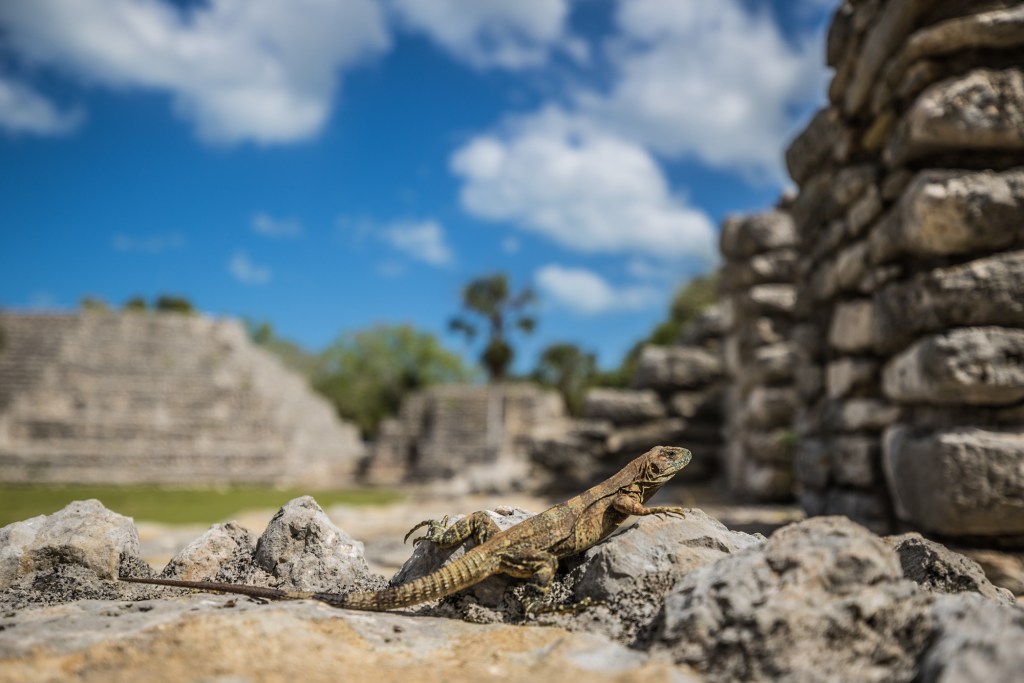
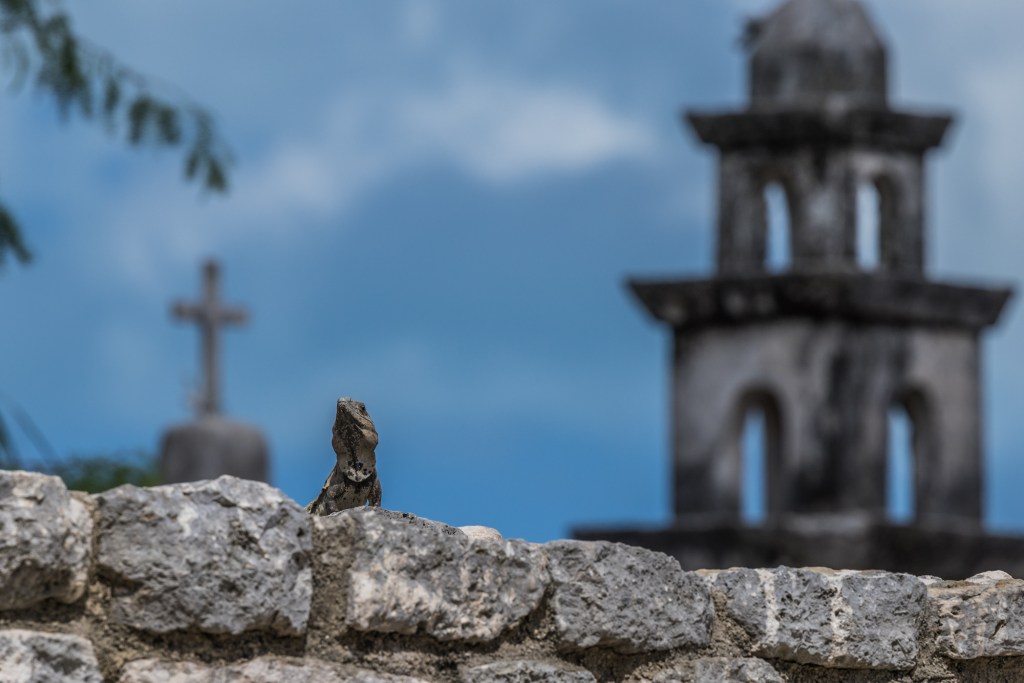
Xcambó rewards the curious traveler who doesn’t need a crowd to validate an experience. If you’re driving the northern coast, stop here.
Sisal: Lunch Worth the Drive
From Xcambó we continued west through Progreso and down the coast to Sisal, a quiet fishing village that retains the unhurried character that the more developed coastal towns have long since traded away.
Lunch was at Palapa de Soco, and I’ll say plainly: it was one of the best meals of the entire trip, in a trip that has not lacked for good food. I had a campechana — a chilled seafood cocktail that arrived loaded with shrimp, octopus and the brine of the Gulf — followed by a fish fillet al ajillo, the garlic and olive oil doing exactly what they’re supposed to do with a fresh catch. Sandra had the same fish and a cocktail de pulpo. A ramekin of habanero salsa arrived on the side, bright green, deceptively mild-looking, and ferociously hot — the right counterpoint to the cold seafood. The kind of meal that makes you sit and linger afterward just to extend it.
We spent time at the beach after lunch. The Gulf here is calm and the early afternoon light on the water is soft. Laughing Gulls worked the shoreline, Brown Pelicans cruised low over the surf, and Magnificent Frigatebirds hung overhead in that effortless way they have, barely moving a wing. It was pleasant enough to linger. Then around 3 pm the wind picked up sharply, blowing off the Gulf with enough force to lift the sand and sting our legs. We packed up and headed back toward the village earlier than planned. That decision, forced by the weather, put us in exactly the right place at exactly the right moment.
The Sky Turns Pink
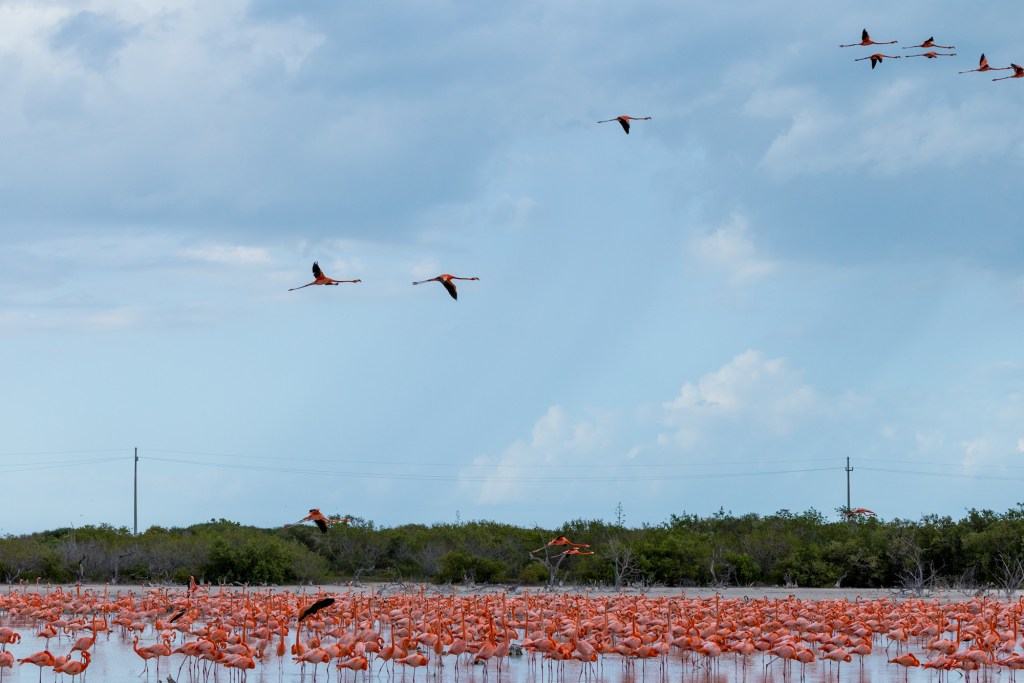
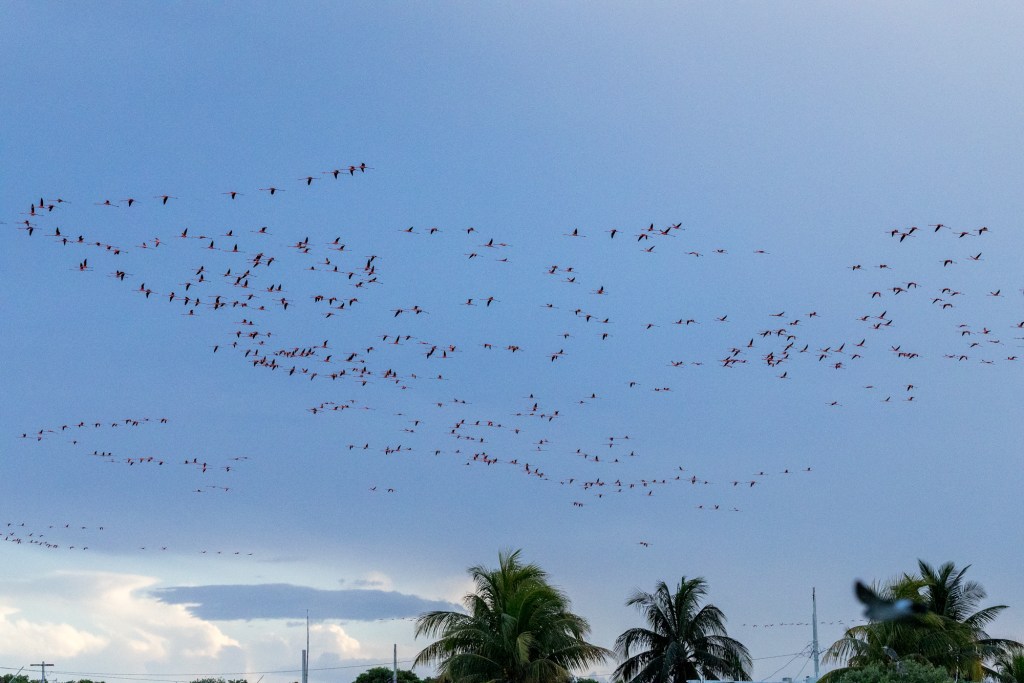
Around 3 pm, Sandra looked up…. Flamingos! Not a few — hundreds, then more hundreds, moving in loose formations across the sky above the village, heading toward the mangrove. The late afternoon light caught their wings in a way that made the entire sky seem to glow. A flock of flamingos in flight is one of those sights that the word “impressive” is inadequate for — the birds are large, long-necked, long-legged, and in flight they stretch out into something that looks like it shouldn’t be aerodynamically possible.
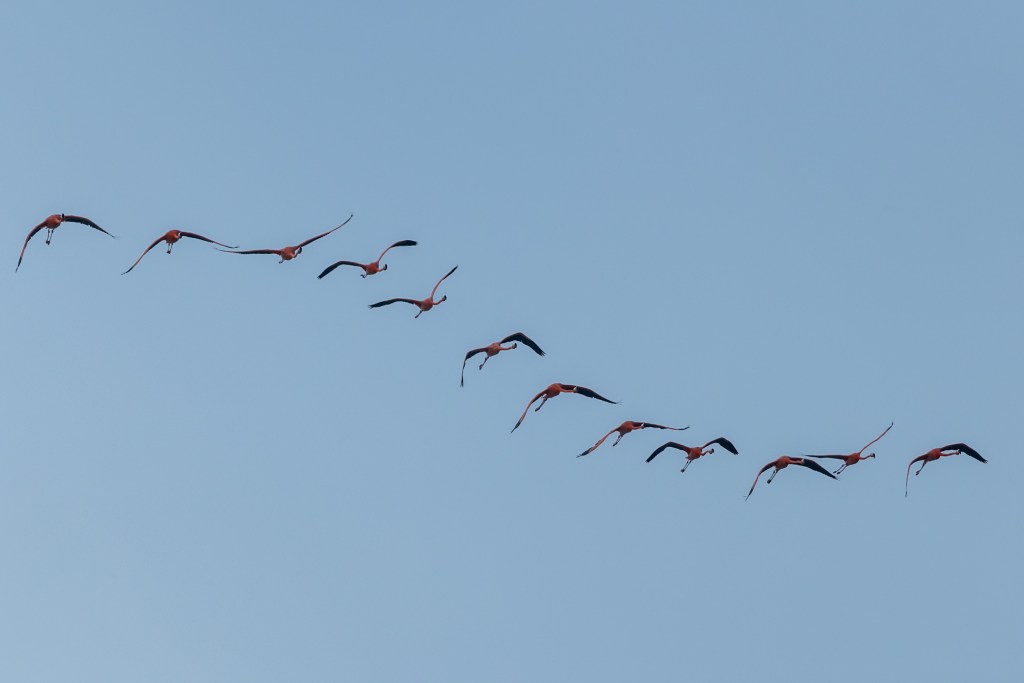
This was the second reason the morning detour had been a good decision. By spending the early hours at Xcambó and arriving at Sisal at midday rather than dawn, we had stumbled into the flamingos’ daily rhythm: they feed in the shallows during the day, and as the afternoon winds down, they return to the mangrove lagoon to roost for the night. We were in exactly the right place at exactly the right time — not by careful planning, but by the small accident of a changed itinerary.
Ziz-Ha: Flamingo Water
We joined a tour with the Cooperativa Ziz-Ha — the name itself is worth noting. Ziz is the Mayan word for flamingo; ha means water. The cooperative runs land-based tours: visitors ride out on a triciclo mototaxi, one of the three-wheeled motorcycle taxis common throughout the Yucatán, and then continue on foot along the edge of the pond. It is unhurried, close to the ground, and exactly the right way to approach a place like this.
This matters. The Yucatán’s flamingo habitats are under real pressure from coastal development, tourism, and climate-related changes to water salinity and food availability. Operations like Ziz-Ha represent a model where conservation and local livelihood are aligned rather than in conflict — where the flamingos’ continued presence is directly in the economic interest of the people living alongside them. We deliberately chose this cooperative over other operators precisely because of this, and we left feeling the choice had been right.
Our guide was knowledgeable, enthusiastic, and generous with context about the birds, the ecosystem, and the community. He explained that the cooperative’s work extends well beyond tours: they organize regular cleanups of the areas around the village, run dog sterilization campaigns to reduce pressure on wildlife, and actively manage how tourists approach and interact with the flamingos, maintaining distances that allow the birds to behave naturally. These are the kind of concrete, community-led conservation efforts that make a measurable difference.
The Pond
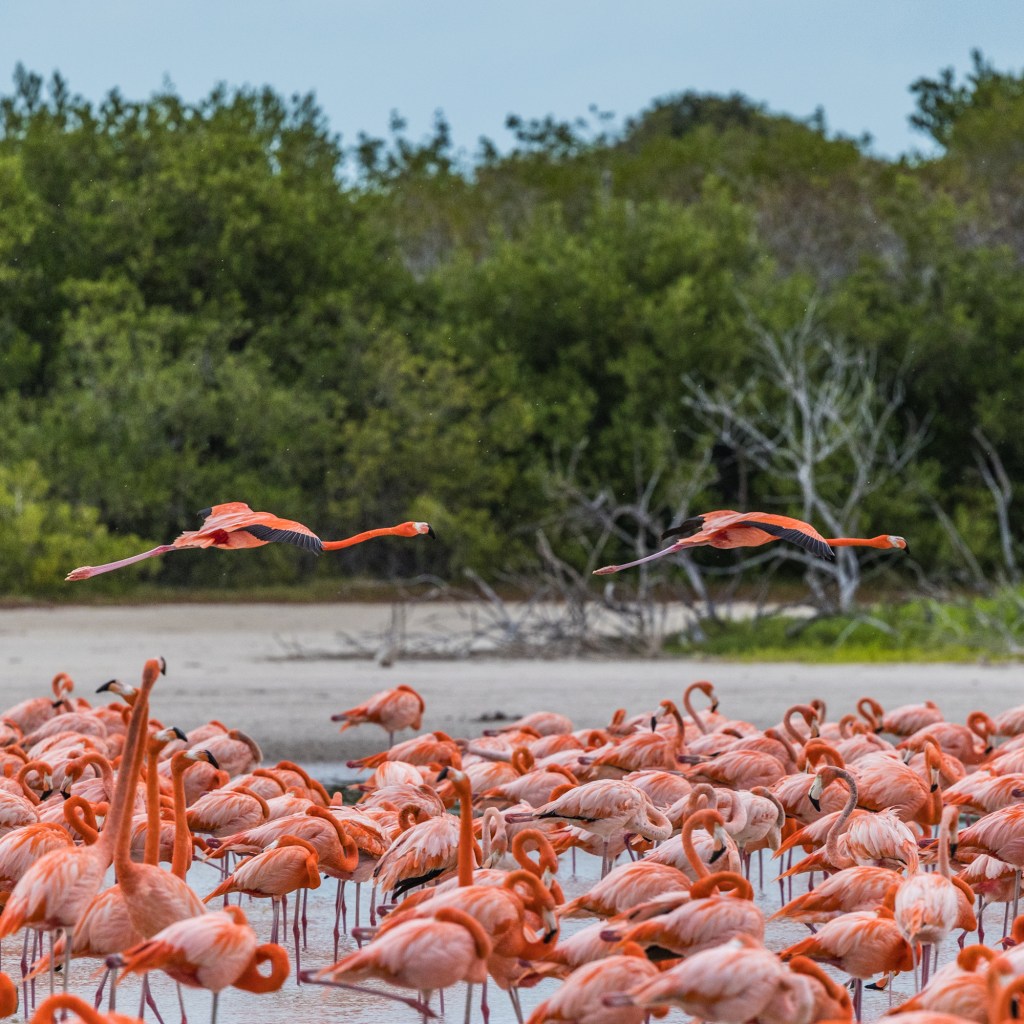
When we reached the lagoon, the scale of what we found was difficult to process at first.
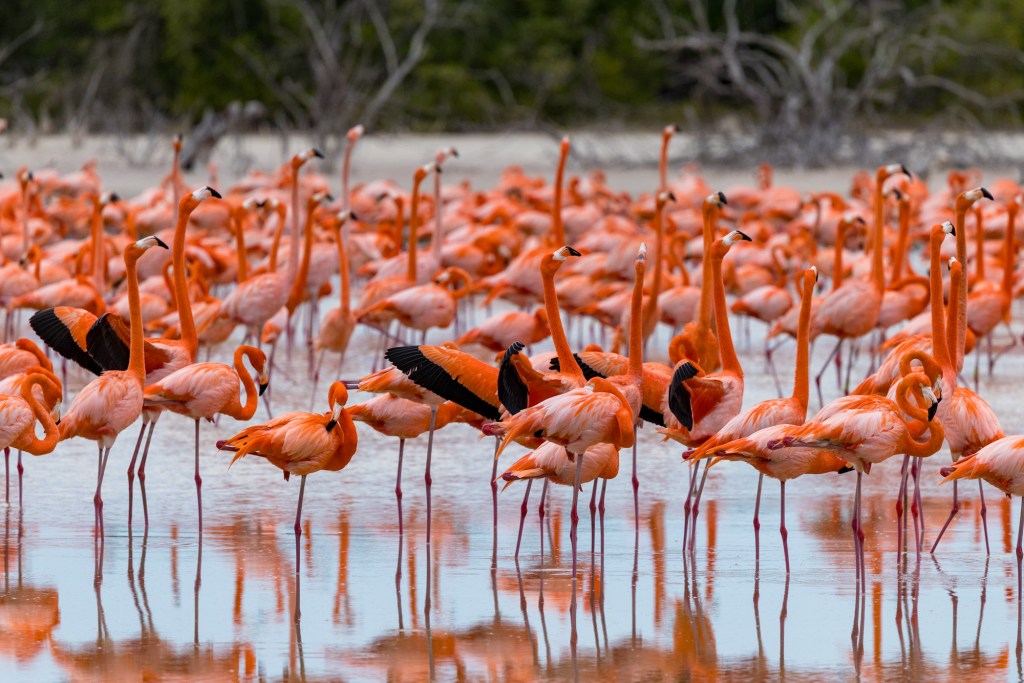
Hundreds of American Flamingos (Phoenicopterus ruber) stood in the shallow water — feeding, preening, settling, arriving. The sound was constant: a low, collective murmur punctuated by the sharp calls of birds coming in to land. The smell was the particular mineral sharpness of a productive coastal wetland, algae and brine and bird, which is not unpleasant so much as vivid — the smell of a place that is genuinely alive. More birds were arriving every few minutes, descending from the sky in loose lines and folding their wings as they touched down into the flock.
The American Flamingo’s color is entirely diet-derived. Carotenoid pigments from the algae and crustaceans they filter from the water accumulate in their feathers, turning them from the white-gray of juvenile birds to the saturated coral-orange of fully adult plumage. The birds in the lagoon ranged across this entire spectrum, and notably, our guide pointed out juveniles still carrying their white feathers, which he said was an unusual and encouraging sign at this particular site, suggesting recent breeding activity nearby. From white juveniles to deeply saturated adults that were nearly orange in the late afternoon light, the flock was a living record of the species’ life cycle. Up close, the impossible bend of the feeding bill, evolved to filter food while held upside-down in the water, is one of those anatomical details that biology explains but the eye still has to negotiate.
The photography conditions were not ideal — overcast, flat light, no golden hour. None of that mattered. When there are this many birds this close, doing this many things simultaneously, you point the camera and work.
A Note on How to Visit
If you’re planning to visit Sisal’s flamingo mangrove, a few practical notes:
Timing is everything. Arrive in the late afternoon, after 4 pm, when the flamingos are returning to roost. Alternatively, arriving at dawn allows you to see the birds walking up and departing to their feeding grounds.
Book with the Cooperativa Ziz-Ha. Beyond the conservation case for it, their guides are genuinely good and the format, mototaxi out and walking the pond edge, puts you at the right pace for the place. Support the people who are actually doing the work of protecting what you came to see.
Lens choice: The birds at the pond are close enough for the 100–500mm at moderate focal lengths. For the flight shots above the village, shooting wide captures the full flock in frame. You’ll want both if you have them.
The detour that started with a last-minute decision to see some Maya ruins ended with hundreds of flamingos settling into a mangrove lagoon as the sun dropped toward the Gulf. Some of the best days work that way.
All photographs: Canon R5 Mark II with RF 100–500mm f/4.5–7.1L IS USM. Sisal, Yucatán, Mexico. March 2026.
 Looking 4 Nature
Leave a comment