
Mérida, Yucatán — March 12, 2026
After the first birding tour with Luis had exceeded every expectation, I reached out to see if he had availability for another outing. He didn’t, but his brother Ramón — whom I had briefly met during that first tour — did. I told them I was interested in seeing a complementary set of birds to what we had already covered, and that the Yucatán Jay, the Chara Yucateca, was at the top of my list. They proposed Parque Ecoarqueológico Sihunchen. I agreed without hesitation.
I should mention that the previous night had caught up with me. The food in Mérida had been consistently excellent, and I had not been shy about it. I woke up that morning genuinely unsure whether I should go. In the end I decided to push through. It was the right call.
The Place
Ramón picked me up at 5:30 am and we drove for close to an hour southwest of Mérida toward Hunucmá. We arrived at a gate that was closed but not locked. Ramón contacted the owner, who told us to come in.
Parque Sihunchen is a private eco-archaeological property covering nearly 100 acres of forest southwest of Mérida, with approximately 8 kilometers of trails winding through the dry forest and around unexcavated Maya mounds. The owner, Alberto Mézquita, welcomed us at the entrance. I had not known what to expect, but within the first few minutes it became clear that Alberto is not simply a landowner who tolerates birders — he is a serious birder himself, a former guide, and a well-known figure in the Yucatán birding community. His property is his life project, combining birding, Maya archaeology and astronomy in a single place, and his enthusiasm for all three is immediately apparent.
The Trail
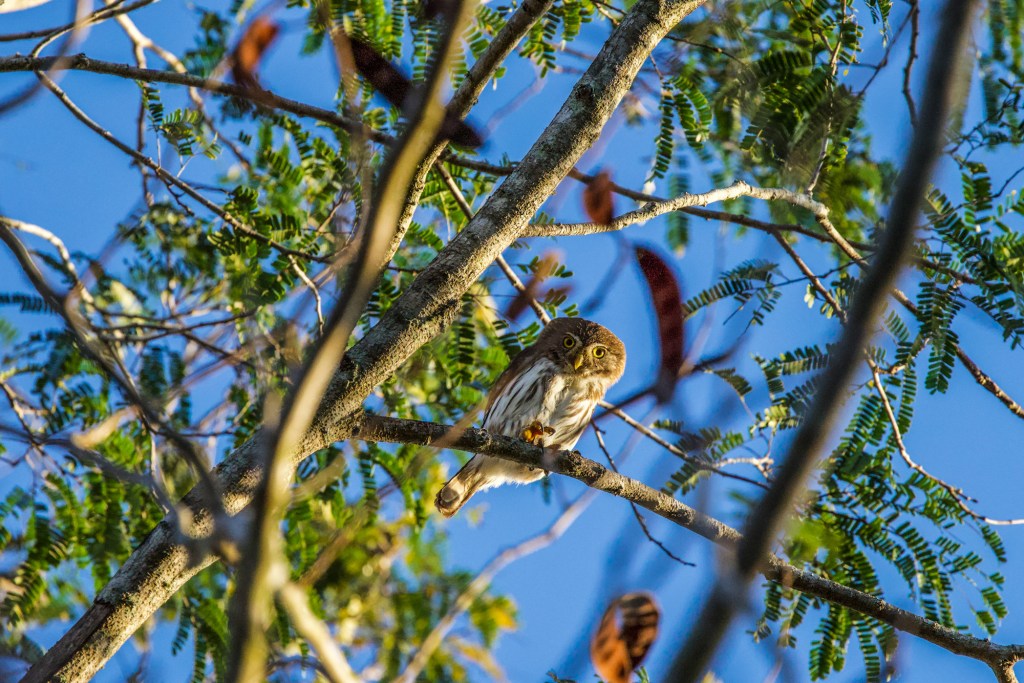
We started on one of the forest trails as the early light began filtering through the canopy. Ramón pointed to the top of a tree almost immediately: a Ferruginous Pygmy-Owl (Glaucidium brasilianum), catching the first warm rays of the morning sun. It was Ramón who had first spotted this species for me during the tour with Luis, and here he was doing it again — a reminder that his ability to find birds is not accidental. He and his brother share an intuitive understanding of bird habits and habitat that goes well beyond simply knowing where species occur. They anticipate the situation and put you in position before the bird even shows itself.
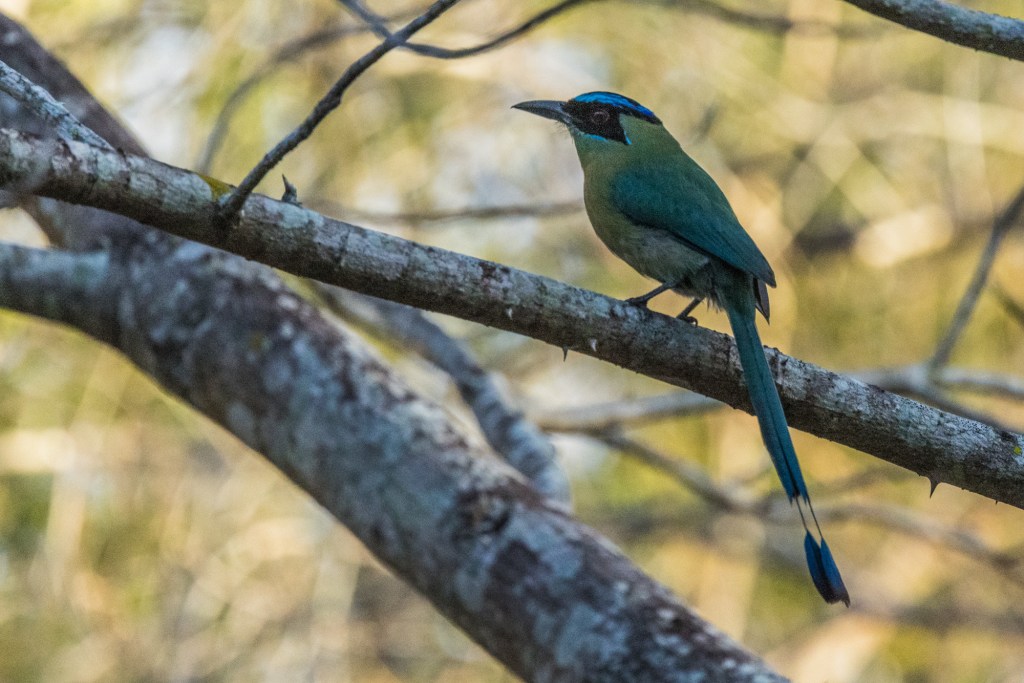
The trail produced a rich and varied list. Among the highlights: Great Kiskadee (Pitangus sulphuratus), Clay-colored Thrush (Turdus grayi), Ash-throated Flycatcher (Myiarchus cinerascens), Grayish Saltator (Saltator coerulescens), Black-and-white Warbler (Mniotilta varia), and a Lesson’s Motmot (Momotus lessonii) — a different species from the Turquoise-browed Motmot I had photographed earlier in the trip, quieter and more subdued in plumage, perched deep in the forest interior with its long blue-tipped tail hanging below the branch.
Two winter visitors from North America added a migratory dimension to the morning: Indigo Bunting (Passerina cyanea), in the streaked brown plumage of a non-breeding male, and Rose-breasted Grosbeak (Pheucticus ludovicianus). A group of Plain Chachalacas (Ortalis vetula) announced themselves loudly from the undergrowth but, true to form, refused to show themselves.
Somewhere along the trail my RF 100–500mm began fogging internally — a worrying development, consequence of a mishap the previous day at the beach, that I feared would end the morning’s photography. Ramón offered an immediate solution: use my memory card in his Nikon D5100 with a Tamron 100–400mm. The last set of shots from the morning were taken on his camera. I shoot Canon exclusively, in Manual or FV mode, so switching mid-session to an unfamiliar body with different controls was a challenge in itself. But it was that or miss the rest of the morning, and Ramón’s generosity made the choice easy.
Alberto’s Feeder Station
We made our way back toward Alberto’s house, where he had set up a feeder and a shallow birdbath in a shaded clearing. Alberto told us the Yucatán Jays typically showed up here in the morning and to be patient.
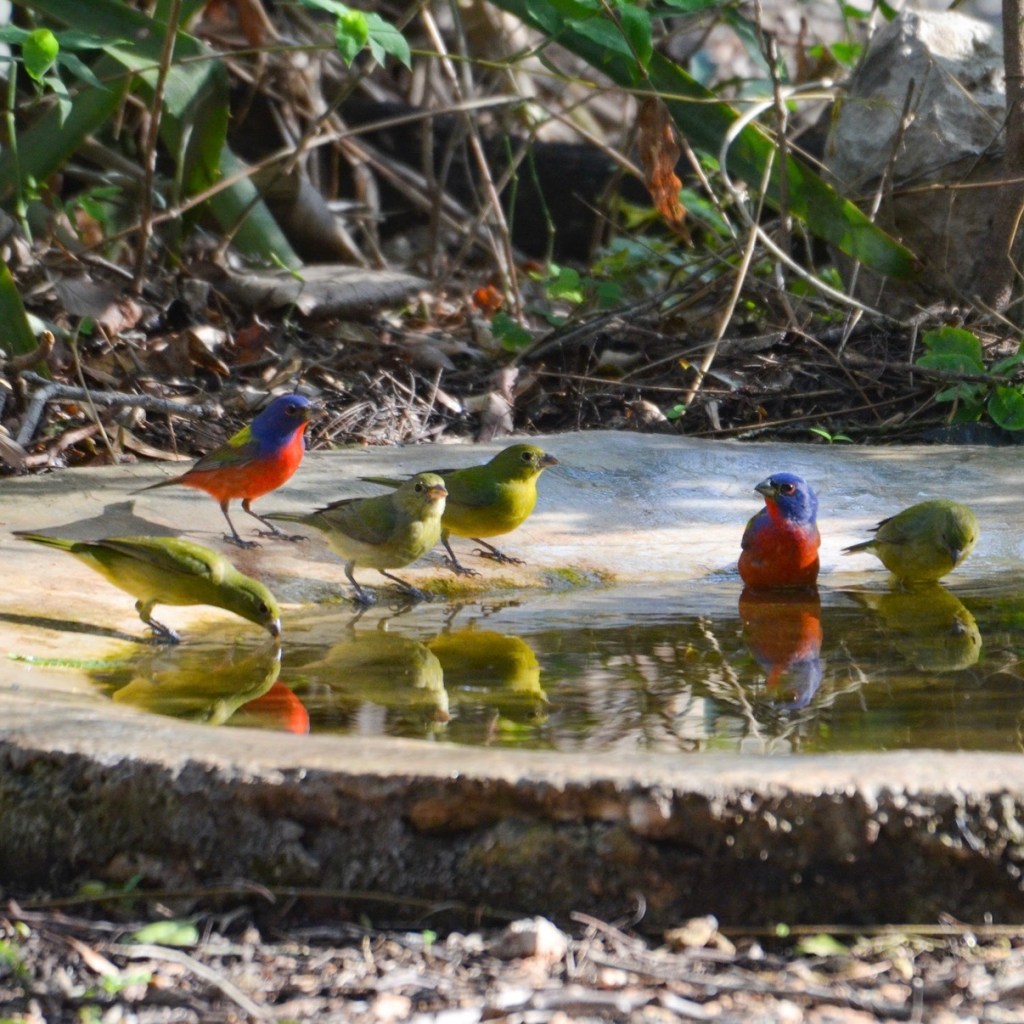
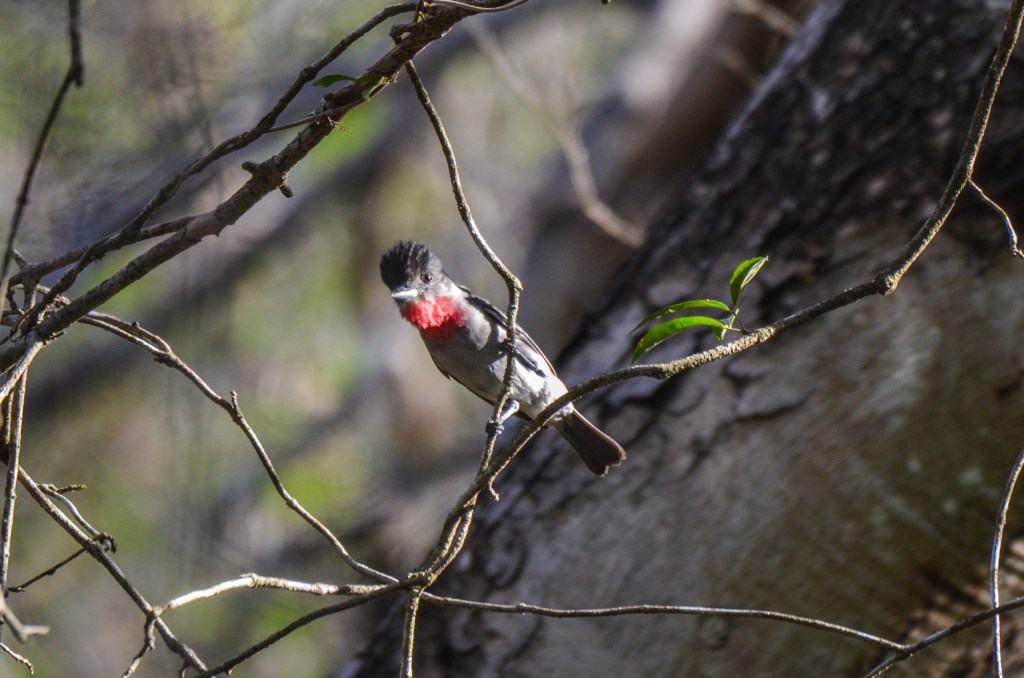
The birdbath did not disappoint while we waited. A Rose-throated Becard (Pachyramphus aglaiae) appeared in the tangle of branches nearby — a compact, striking bird with a dark cap and that distinctive flash of rose-pink at the throat. Then the Painted Buntings (Passerina ciris) arrived, and kept arriving. At one point there were at least two adult males and several females and immatures all drinking and bathing simultaneously, their reflections doubling the spectacle in the still water. The adult male Painted Bunting is one of the most extravagantly colored birds in North America — blue head, red underparts, green back — and seeing multiple individuals together at close range in good light is the kind of moment that reminds you why you set the alarm for 5 am. A pair of Golden-fronted Woodpeckers (Melanerpes aurifrons) worked the nearby trees, and Hooded Warblers (Setophaga citrina) and Melodious Blackbirds (Dives dives) rounded out the station list.
I was beginning to think about heading back. The stomach situation had not improved, the lens had fogged, and I had already seen far more than I had any right to expect from a single morning. And then the Jays arrived.
The Charas
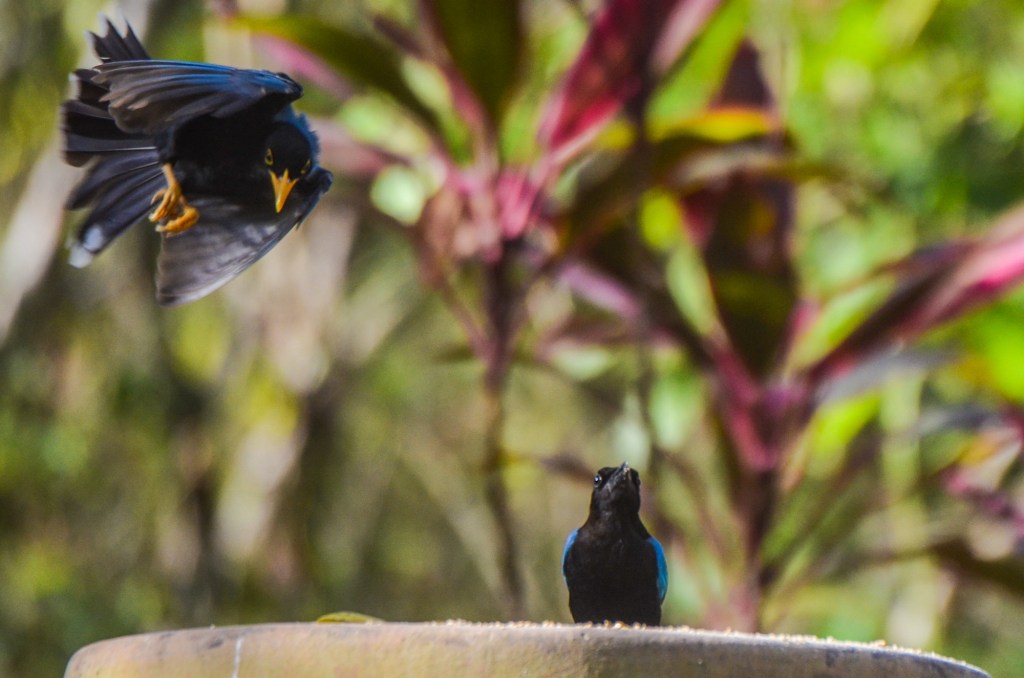
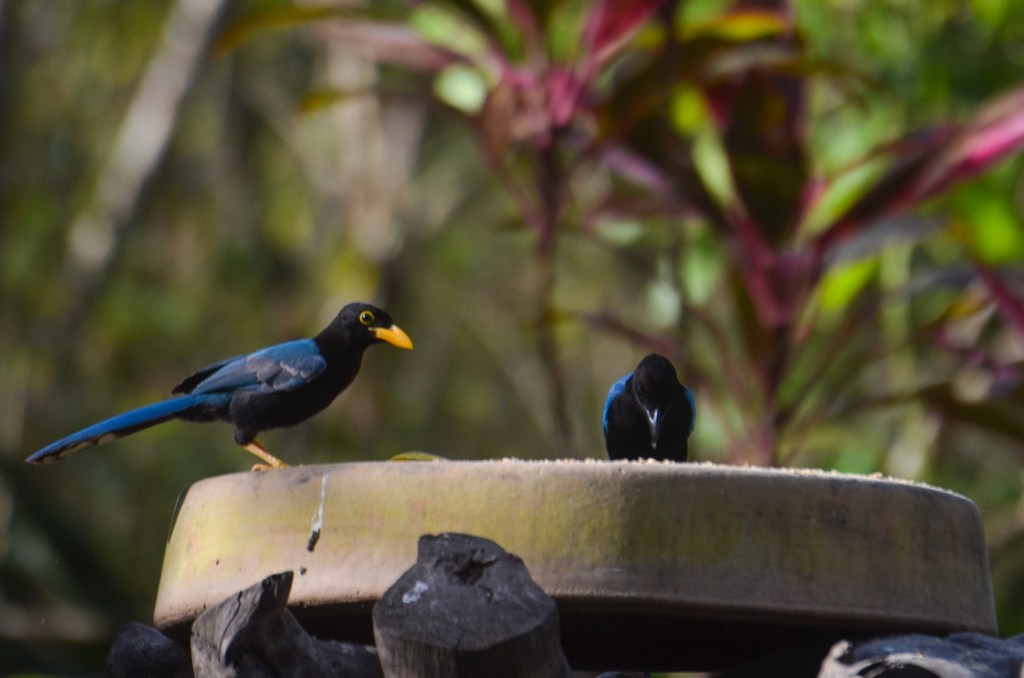
The Yucatán Jay (Cyanocorax yucatanicus) is one of eleven bird species endemic to the state of Yucatán — found essentially nowhere else on earth. A small group came into the feeder, and they did not disappoint. Deep blue-black plumage, that unmistakable bright yellow bill and eye ring, moving with the confident energy typical of corvids. After that, I was ready to head home.
A Note on YucatanBirdingTours
This was my second morning birding with the Trinchan family, and the impression from the first tour was fully confirmed. What makes both Luis and Ramón exceptional is not simply that they know where the birds are — it is that they understand how birds behave, where they will be at a particular hour in a particular habitat, and how to position you for the best possible encounter. They do not stumble upon birds. They anticipate them.
If you are visiting the Yucatán and birds interest you at any level, I would recommend YucatanBirdingTours without reservation. You can find them at yucatanbirdingtours.mx.
And if your visit takes you near Hunucmá, Parque Sihunchen is worth an early morning. Alberto Mézquita has built something genuinely special there, and the birds know it.
Photographs: Canon R5 Mark II with RF 100–500mm f/4.5–7.1L IS USM (early session) and Nikon D5100 with Tamron 100–400mm f/4.5–6.3 (late session, courtesy of Ramón Trinchan). Parque Ecoarqueológico Sihunchen, Yucatán, Mexico. March 12, 2026.
 Looking 4 Nature
Leave a comment