
Mérida, Yucatán — March 12, 2026
After the first birding tour with Luis had exceeded every expectation, I reached out to see if he had availability for another outing. He didn’t, but his brother Ramón — whom I had briefly met during that first tour — did. I told them I was interested in seeing a complementary set of birds to what we had already covered, and that the Yucatán Jay, the Chara Yucateca, was at the top of my list. They proposed Parque Ecoarqueológico Sihunchen. I agreed without hesitation.
I should mention that the previous night had caught up with me. The food in Mérida had been consistently excellent, and I had not been shy about it. I woke up that morning genuinely unsure whether I should go. In the end I decided to push through. It was the right call.
The Place
Ramón picked me up at 5:30 am and we drove for close to an hour southwest of Mérida toward Hunucmá. We arrived at a gate that was closed but not locked. Ramón contacted the owner, who told us to come in.
Parque Sihunchen is a private eco-archaeological property covering nearly 100 acres of forest southwest of Mérida, with approximately 8 kilometers of trails winding through the dry forest and around unexcavated Maya mounds. The owner, Alberto Mézquita, welcomed us at the entrance. I had not known what to expect, but within the first few minutes it became clear that Alberto is not simply a landowner who tolerates birders. He is a serious birder himself, a former guide, and a well-known figure in the Yucatán birding community. His property is his life project, combining birding, Maya archaeology and astronomy in a single place, and his enthusiasm for all three is immediately apparent.
The Trail
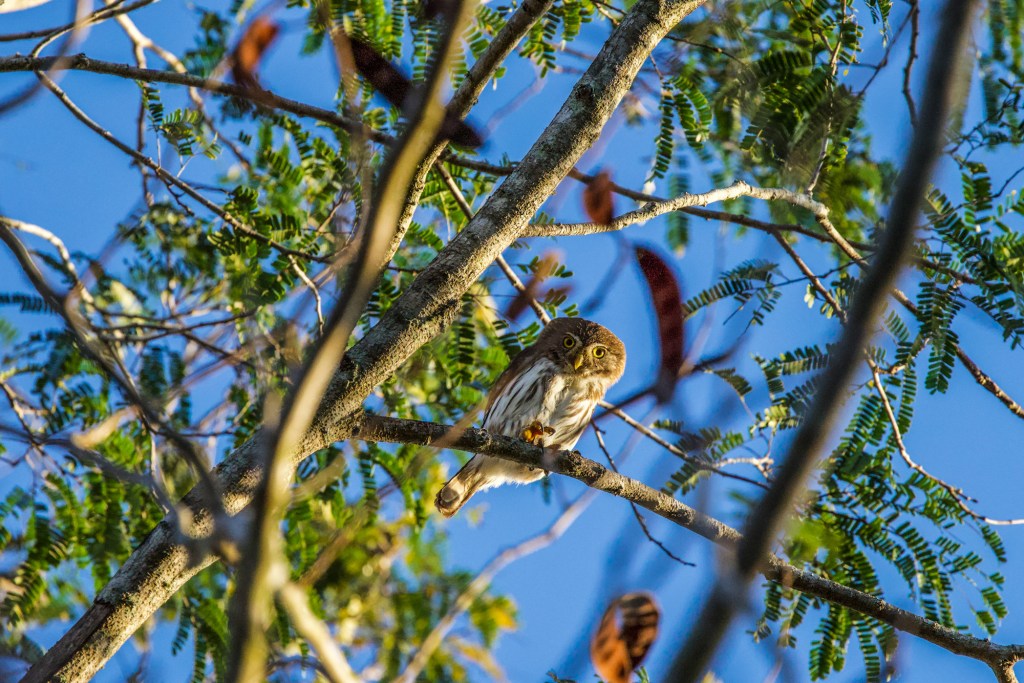
We started on one of the forest trails as the early light began filtering through the canopy. Ramón pointed to the top of a tree almost immediately: a Ferruginous Pygmy-Owl (Glaucidium brasilianum), catching the first warm rays of the morning sun. It was Ramón who had first spotted this species for me during the tour with Luis, and here he was doing it again. He and his brother share an intuitive understanding of bird habits and habitat that goes well beyond simply knowing where species occur. They anticipate the situation and put you in position before the bird even shows itself.
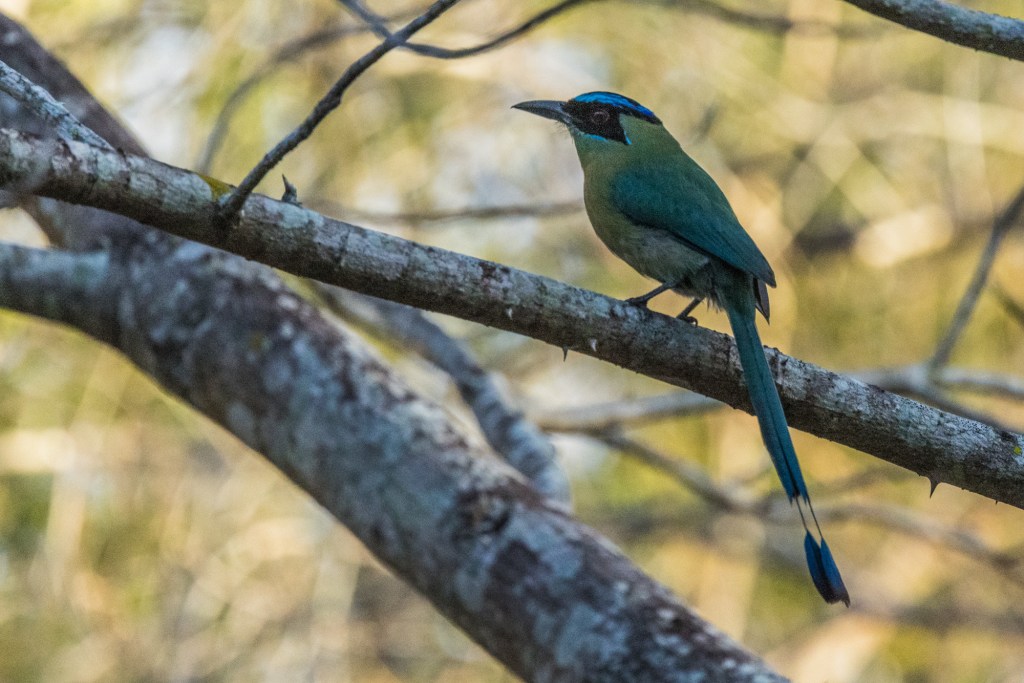
The trail produced a rich and varied list. Among the highlights: Great Kiskadee (Pitangus sulphuratus), Clay-colored Thrush (Turdus grayi), Ash-throated Flycatcher (Myiarchus cinerascens), Grayish Saltator (Saltator coerulescens), Black-and-white Warbler (Mniotilta varia), and a Lesson’s Motmot (Momotus lessonii) — a different species from the Turquoise-browed Motmot I had photographed earlier in the trip, quieter and more subdued in plumage, perched deep in the forest interior with its long blue-tipped tail hanging below the branch.
Two winter visitors from North America added a migratory dimension to the morning: Indigo Bunting (Passerina cyanea), in the streaked brown plumage of a non-breeding male, and Rose-breasted Grosbeak (Pheucticus ludovicianus). A group of Plain Chachalacas (Ortalis vetula) announced themselves loudly from the undergrowth but, true to form, refused to show themselves.
Somewhere along the trail my RF 100–500mm began fogging internally, a worrying development that I feared would end the morning’s photography. Ramón offered an immediate solution: use my memory card in his Nikon D5100 with a Tamron 100–400mm. The last set of shots from the morning were taken on his camera. I shoot Canon exclusively, in Manual or FV mode, so switching mid-session to an unfamiliar body with different controls was a challenge in itself. But it was that or miss the rest of the morning, and Ramón’s generosity made the choice easy.
Alberto’s Feeder Station
We made our way back toward Alberto’s house, where he had set up a feeder and a shallow birdbath in a shaded clearing. Alberto told us the Yucatán Jays typically showed up here in the morning and to be patient.
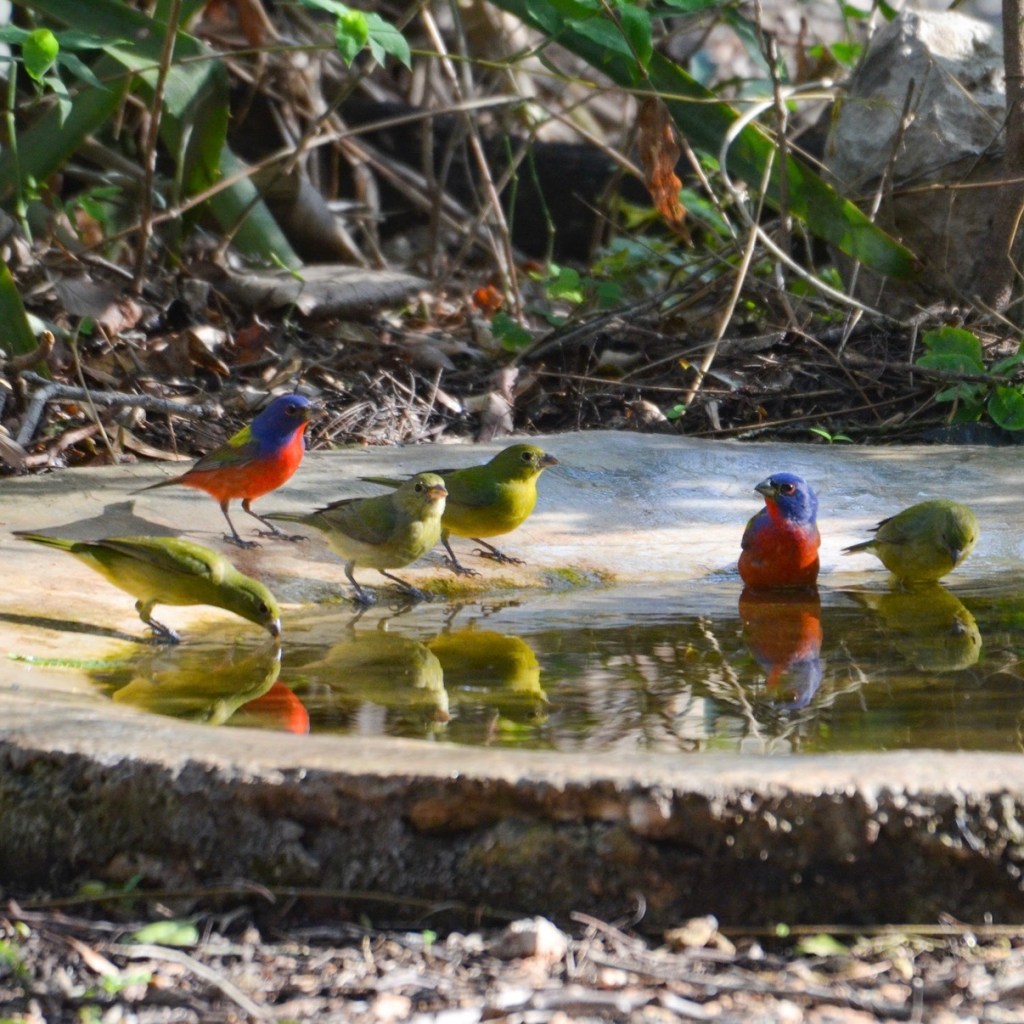
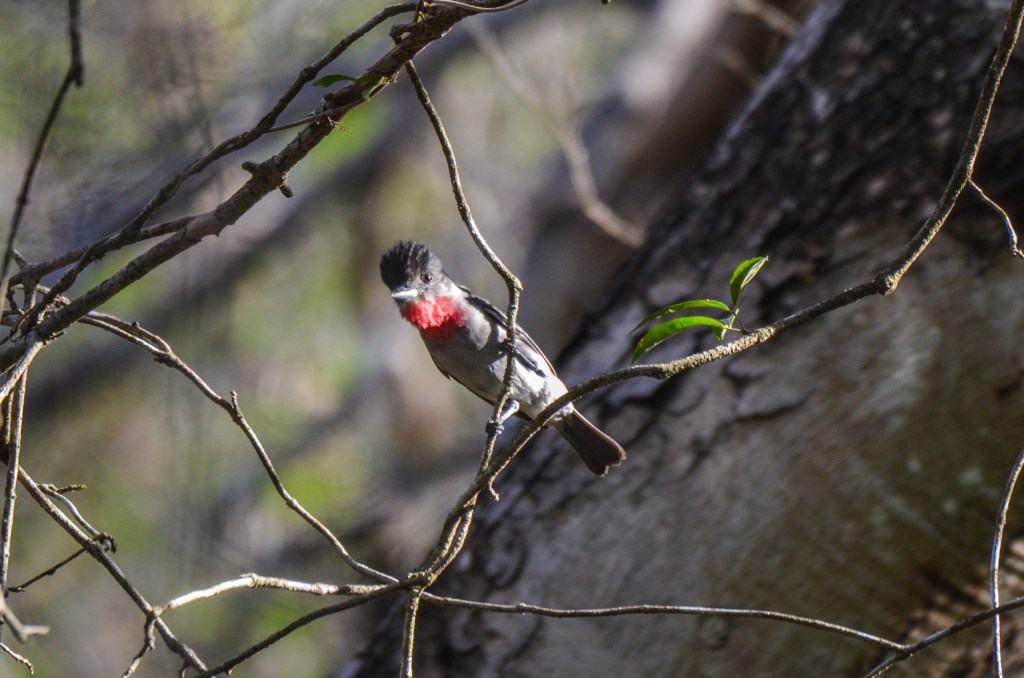
The birdbath did not disappoint while we waited. A Rose-throated Becard (Pachyramphus aglaiae) appeared in the tangle of branches nearby, a compact, striking bird with a dark cap and that distinctive flash of rose-pink at the throat. Then the Painted Buntings (Passerina ciris) arrived, and kept arriving. At one point there were at least two adult males and several females and immatures all drinking and bathing simultaneously, their reflections doubling the spectacle in the still water. The adult male Painted Bunting is one of the most extravagantly colored birds in North America — blue head, red underparts, green back — and seeing multiple individuals together at close range in good light is the kind of moment that reminds you why you set the alarm for 5 am. A pair of Golden-fronted Woodpeckers (Melanerpes aurifrons) worked the nearby trees, and Hooded Warblers (Setophaga citrina) and Melodious Blackbirds (Dives dives) rounded out the station list.
I was beginning to think about heading back. The stomach situation had not improved, the lens had fogged, and I had already seen far more than I had any right to expect from a single morning. And then the Jays arrived.
The Charas
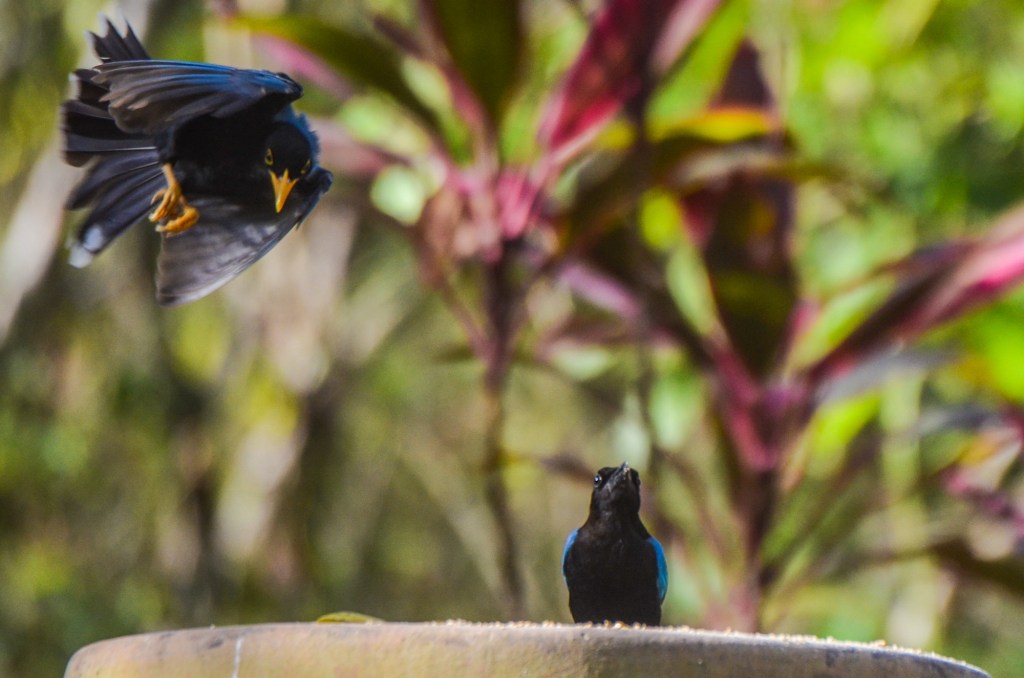
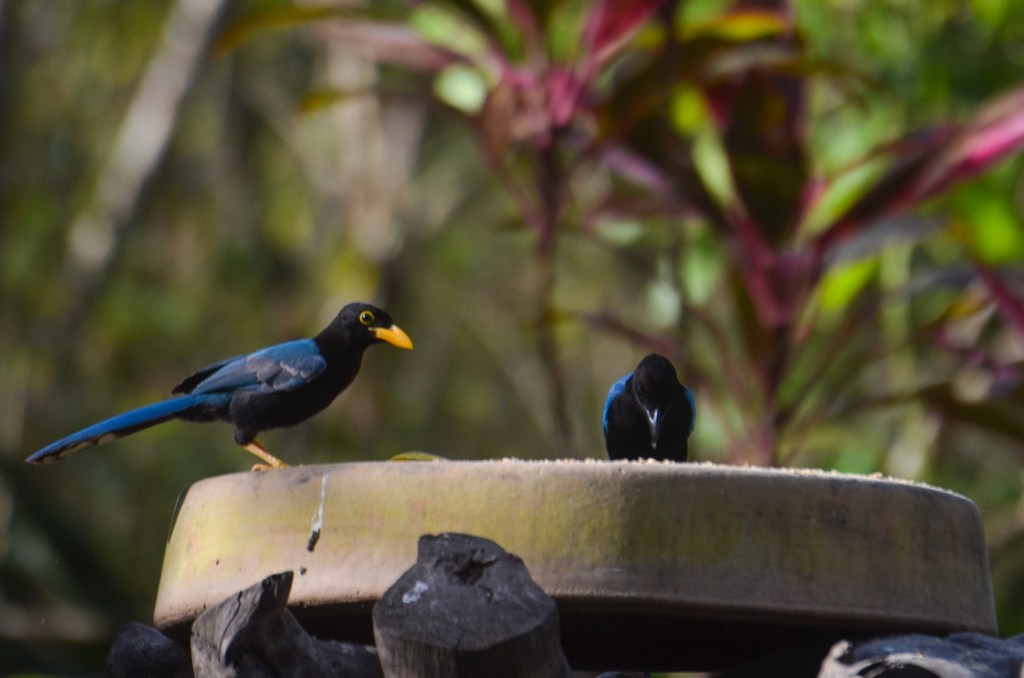
The Yucatán Jay (Cyanocorax yucatanicus) is one of eleven bird species endemic to the state of Yucatán, found essentially nowhere else on earth. A small group came into the feeder, and they did not disappoint. Deep blue-black plumage, that unmistakable bright yellow bill and eye ring, moving with the confident energy typical of corvids. After that, I was ready to head home.
A Note on YucatanBirdingTours
This was my second morning birding with the Trinchan family, and the impression from the first tour was fully confirmed. What makes both Luis and Ramón exceptional is not simply that they know where the birds are. It is that they understand how birds behave, where they will be at a particular hour in a particular habitat, and how to position you for the best possible encounter. They do not stumble upon birds. They anticipate them.
If you are visiting the Yucatán and birds interest you at any level, I would recommend YucatanBirdingTours without reservation. You can find them at yucatanbirdingtours.mx.
And if your visit takes you near Hunucmá, Parque Sihunchen is worth an early morning. Alberto Mézquita has built something genuinely special there, and the birds know it.
Photographs: Canon R5 Mark II with RF 100–500mm f/4.5–7.1L IS USM (early session) and Nikon D5100 with Tamron 100–400mm f/4.5–6.3 (late session, courtesy of Ramón Trinchan). Parque Ecoarqueológico Sihunchen, Yucatán, Mexico. March 12, 2026.
Versión en Español
Mérida, Yucatán — 12 de marzo de 2026
Después de que la primera salida con Luis superara todas mis expectativas, le escribí para ver si tenía disponibilidad para otra. No la tenía, pero su hermano Ramón, a quien había conocido brevemente durante esa primera excursión, sí. Les dije que me interesaba ver un conjunto de aves complementario al que ya habíamos cubierto, y que la Chara Yucateca encabezaba mi lista. Propusieron el Parque Ecoarqueológico Sihunchen. Acepté sin dudarlo.
Debo mencionar que la noche anterior me había pasado factura. La comida en Mérida había sido consistentemente excelente, y yo no había sido precisamente moderado. Esa mañana me desperté con dudas reales sobre si debía ir. Al final decidí hacerlo. Fue la decisión correcta.
El Lugar
Ramón me recogió a las 5:30 am y manejamos casi una hora al suroeste de Mérida, rumbo a Hunucmá. Llegamos a una reja cerrada pero no con llave. Ramón contactó al dueño, quien le dijo que pasáramos.
El Parque Sihunchen es una propiedad eco-arqueológica privada que abarca casi 100 acres de selva al suroeste de Mérida, con aproximadamente 8 kilómetros de senderos que serpentean entre la selva baja y los montículos mayas sin excavar. El dueño, Alberto Mézquita, nos recibió en la entrada. No sabía bien qué esperar, pero en los primeros minutos quedó claro que Alberto no es simplemente un propietario que tolera a los pajareros. Es un observador de aves serio, un exguía y una figura reconocida en la comunidad ornitológica de Yucatán. Su propiedad es el proyecto de su vida, que combina la observación de aves, la arqueología maya y la astronomía en un solo lugar, y su entusiasmo por las tres es inmediatamente evidente.
El Sendero
Comenzamos uno de los senderos del bosque mientras la primera luz empezaba a filtrarse por el dosel. Ramón señaló hacia la copa de un árbol casi de inmediato: un Tecolotito Bajeño (Glaucidium brasilianum), tomando los primeros rayos cálidos del sol de la mañana. Fue Ramón quien primero me mostró esta especie durante la salida con Luis, y aquí lo hacía de nuevo. Él y su hermano comparten una comprensión intuitiva de los hábitos y el hábitat de las aves que va mucho más allá de saber simplemente dónde ocurren. Anticipan la situación y te ponen en posición antes de que el ave siquiera se muestre.
El sendero produjo una lista rica y variada. Entre los más destacados: Luis Bienteveo (Pitangus sulphuratus), Zorzal Pardo (Turdus grayi), Papamoscas Cenizo (Myiarchus cinerascens), Saltador Grisáceo (Saltator coerulescens), Chipe Trepador (Mniotilta varia), y un Momoto de Lesson (Momotus lessonii), una especie distinta al Momoto Turquesa que había fotografiado antes en el viaje, más discreto en su plumaje, posado en el interior del bosque con su larga cola de puntas azules colgando bajo la rama.
Dos visitantes invernales de Norteamérica añadieron una dimensión migratoria a la mañana: el Colorín Azul (Passerina cyanea), con el plumaje café estriado de un macho fuera de época reproductiva, y el Picogrueso Pechirrosado(Pheucticus ludovicianus). Un grupo de Chachalacas Vetulas (Ortalis vetula) se anunció ruidosamente desde la maleza pero, fiel a su costumbre, se negó a mostrarse.
En algún punto del sendero mi RF 100–500mm comenzó a empañarse internamente, un desarrollo inquietante que temí pondría fin a la fotografía de la mañana. Ramón ofreció una solución inmediata: usar mi tarjeta de memoria en su Nikon D5100 con un Tamron 100–400mm. Las últimas tomas de la mañana fueron hechas con su cámara. Yo fotografío exclusivamente con Canon, en modo Manual o FV, así que cambiar a mitad de sesión a un cuerpo desconocido con controles diferentes fue un reto en sí mismo. Pero era eso o perder el resto de la mañana, y la generosidad de Ramón hizo la elección fácil.
La Estación de Alimentación de Alberto
Regresamos hacia la casa de Alberto, donde había instalado un comedero y un bebedero poco profundo en un claro sombreado. Alberto nos dijo que las Charas solían aparecer ahí por las mañanas y que tuviéramos paciencia.
El bebedero no decepcionó mientras esperábamos. Un Cabezón Degollado (Pachyramphus aglaiae) apareció entre las ramas cercanas, un ave compacta y llamativa con gorro oscuro y ese destello inconfundible de rosa-rosado en la garganta. Luego llegaron los Colorines Sietecolores (Passerina ciris), y siguieron llegando. En un momento dado había al menos dos machos adultos y varias hembras e inmaduros bebiendo y bañándose simultáneamente, sus reflejos duplicando el espectáculo en el agua quieta. El macho adulto del Colorín Sietecolores es una de las aves más extravagantemente coloridas de Norteamérica — cabeza azul, partes inferiores rojas, dorso verde — y ver varios individuos juntos a corta distancia con buena luz es el tipo de momento que te recuerda por qué pusiste la alarma a las 5 am. Un par de Carpinteros Cheje (Melanerpes aurifrons) trabajaban los árboles cercanos, y las Chipes Patilladas (Setophaga citrina) y los Clarineros (Dives dives) completaron la lista de la estación.
Empezaba a pensar en regresar. El malestar estomacal no había mejorado, el lente se había empañado, y ya había visto mucho más de lo que tenía derecho a esperar de una sola mañana. Y entonces llegaron las Charas.
Las Charas
La Chara Yucateca (Cyanocorax yucatanicus) es una de las once especies de aves endémicas del estado de Yucatán, que no se encuentran prácticamente en ningún otro lugar del planeta. Un pequeño grupo llegó al comedero y no decepcionó. Plumaje azul-negro profundo, ese inconfundible pico amarillo brillante y anillo ocular, moviéndose con la energía segura típica de los córvidos. Después de eso, estaba listo para volver a casa.
Una Nota sobre YucatanBirdingTours
Esta fue mi segunda mañana pajarera con la familia Trinchan, y la impresión de la primera salida quedó plenamente confirmada. Lo que hace excepcionales a Luis y a Ramón no es simplemente que saben dónde están las aves. Es que entienden cómo se comportan, dónde estarán a determinada hora en determinado hábitat, y cómo posicionarte para el mejor encuentro posible. No tropiezan con las aves. Las anticipan.
Si visitas Yucatán y las aves te interesan en cualquier medida, recomendaría YucatanBirdingTours sin reservas. Puedes encontrarlos en yucatanbirdingtours.mx.
Y si tu visita te lleva cerca de Hunucmá, el Parque Sihunchen vale una mañana temprana. Alberto Mézquita ha construido algo genuinamente especial ahí, y las aves lo saben.
Fotografías: Canon R5 Mark II con RF 100–500mm f/4.5–7.1L IS USM (primera sesión) y Nikon D5100 con Tamron 100–400mm f/4.5–6.3 (segunda sesión, cortesía de Ramón Trinchan). Parque Ecoarqueológico Sihunchen, Yucatán, México. 12 de marzo de 2026.


Leave a Reply