This is one of eight campground notes from a 48-day camper trip to Alaska and back. We traveled with Frida, our senior English Bulldog, and that shaped more of our decisions than the route did. See [Traveling with a senior bulldog: the ground rules] for the reasoning we applied everywhere.
What we made of the park
The Badlands are enormous and beautiful, and they delivered everything we came for except one animal.
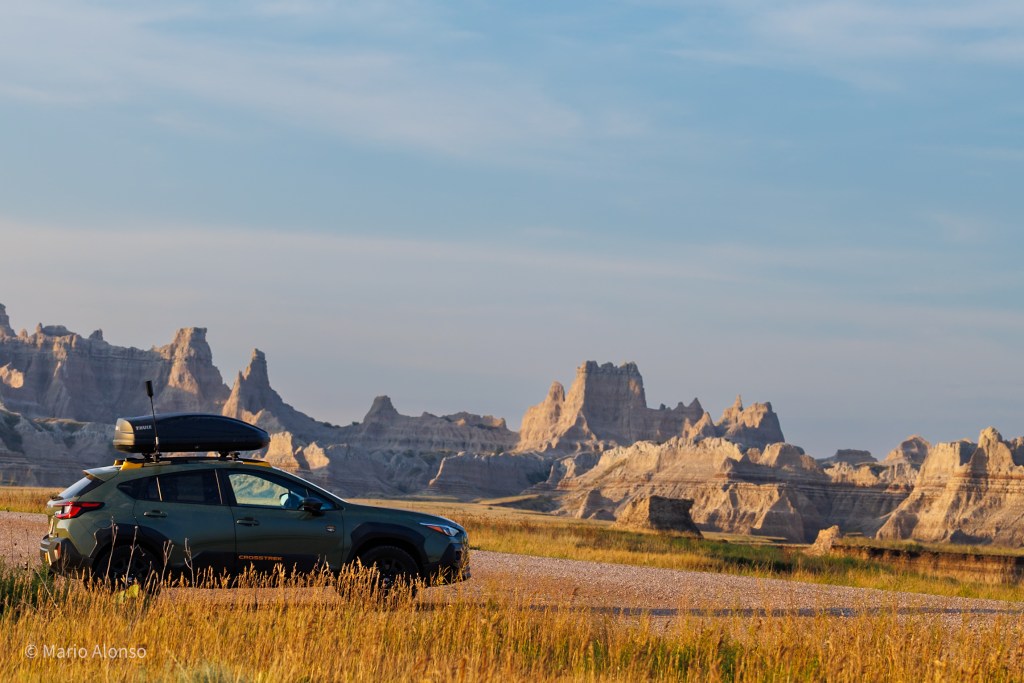
This was our first visit, and the landscape is genuinely otherworldly at golden hour: prairie and eroded rock in combinations that keep shifting as you move through them. The dawn hike on our second day was the highlight of the trip to that point, and the views from Pinnacles Overlook were spectacular. We came looking for Burrowing Owls and we found three, one of them close enough for real portraits. We left having met all our goals.
The two things standing between us and a perfect visit were the heat, which was insulting at 104°F, and the absence of any scheduled ranger-led Black-footed Ferret night hike, which is the practical way into the species and the one target we did not get. Neither is a reason to skip the park. Both are reasons to think carefully about when you come.
The stay
| Campground | Badlands / White River KOA Holiday, Interior, SD |
| Accommodation | Air-conditioned cabin |
| Nights | July 27 and 28, 2026 |
| Distance to park | 4 miles east of Interior on SD-44, about 5 miles from the park entrance |
| Cost | $238.23 for two nights |
| What we gave up | A reserved rustic site at Cedar Pass, inside the park |
The decision we made before we ever saw the campground
The plan had us inside the park at Cedar Pass, in a rustic site, with the Trillium and the solar EcoFlow handling the load. We pulled into the Badlands at 104°F.
That number made the decision for us. A rustic site at Cedar Pass has no hookup, which meant two afternoons of air conditioning running entirely off battery. On its own that is an interesting problem. With Frida in the trailer it stops being interesting. We let the reservation go unused and took a simple air-conditioned cabin at the Badlands / White River KOA instead.
Worth being clear about the arithmetic, because it is the same arithmetic every time. English Bulldogs cool themselves almost entirely by panting, and brachycephalic conformation makes panting inefficient. The UK VetCompass study of heat-related illness in dogs found Bulldogs among the breeds with significantly elevated odds, with age over two years an additional risk factor and a case fatality rate above 14 percent. Age matters again at the severe end: skull shape and age were both associated with fatal outcomes. A senior bulldog does not have a margin to spend on an experiment with battery capacity.
So the rule we ended up applying for the whole trip took shape here on day three. When the forecast high is above roughly 85°F, we do not camp anywhere the cooling depends on something that can run out.
Giving up a night inside a National Park is a real cost, and there is no version of a KOA four miles down the road that replaces waking up inside the Wall. We paid that cost knowingly and would pay it again.
Getting there
We came in from Sioux City, 350 miles, with a second morning coffee at Coffea Roasters. Dog friendly, and good enough to justify the stop on its own merits.
The sky was hazy across all of South Dakota, smoke from fires in Oregon plus what remained of the Canadian fires. It cleared as we got close to the park, which helped the photography and turned out to be a preview of a question that followed us for weeks.
The campground
Three stars, and the three stars are almost entirely location and electricity.
The setting is genuinely good. The KOA sits along the White River under hundreds of mature shade trees, which is more shade than exists anywhere inside Badlands National Park. Cedar Pass has no trees at all and no windbreak beyond the covered picnic shelter at each site. For a dog that cannot regulate its own temperature, trees are not scenery. They are infrastructure. There is a dog park, a pool, and the campground allows campfires, which most of the Badlands area does not.
The buildings are another matter. The cabins and the bathrooms are run down. The bathrooms next to the main office had no soap in the dispensers, which is a small thing that tells you something larger about how the place is maintained. This is not a one-visit impression: guest reviews through the same season repeat it steadily, citing showers in disrepair, cabins that arrived dirty, and bathhouses not cleaned daily.
The cabin ran $238.23 for the two nights, roughly $119 a night. Set that against what we walked away from: the rustic Cedar Pass site we had reserved goes for about $37 a night, and even an electric site inside the park is around $47. We paid something close to three times the in-park rate for a worn cabin, and the thing we were actually buying was an outlet.
So the honest summary is that we did not stay here because it was a good campground. We stayed here because it had shore power on a 104°F day, and that was the only variable that mattered.
The pool earned its keep for a reason worth naming. On day two we were back from the trail by 9 a.m. with the entire middle of the day unusable. The difference between spending a Badlands afternoon in an air-conditioned cabin next to a pool and spending it in a hot trailer is the difference between recovering for the evening and merely surviving until it.
Day one: a park that did not cooperate
The mandatory visitor center stop at Ben Reifel produced local wildlife intel and one disappointment: no ranger-guided Black-footed Ferret (Mustela nigripes) night hikes on the schedule. Badlands is among the more reliable places in North America to look for the species, and the ranger program is the practical way in. Without it we never ran the Sage Creek spotlight drive.
We bought souvenirs, because supporting the parks is not optional, and stopped at the post office in Interior to send a package to Penélope.
Lunch was late and light, on the cabin porch, while a thunderstorm moved through and took the temperature and the haze down with it. When it cleared we went out to hike and picked wrong. The Castle Trail toward the Fossil Exhibit opens with a steep climb, and after rain that climb is mud over slick rock. We turned back a few hundred meters in, mostly because the descent would have been worse than the ascent. We drove the area instead and had an early night.
Day two: the payoff
Up at 5 a.m., oatmeal and coffee first because we are not savages, and on the Medicine Root and Castle Trail loop before 6:30.
About six miles, and the best hiking of the trip to that point. The route alternates between open mixed-grass prairie and the eroded formations the park is known for, and dawn is the only hour that flatters both. This is also the only hour in late July when the trail is usable at all. By 9 a.m. it was already past comfortable and we went back to camp.
Frida spent the morning at the campground with us, in shade, near water. Then we left her in the air-conditioned cabin for the afternoon drive, which is the trade a dog like this makes: she gets the cool early hours and the evenings, and she sits out the middle of the day. It is not a compromise we resent. It is simply the shape of the day.
The afternoon was the point of the whole stay. We drove the Badlands Loop Road, which is not really a loop, working toward Roberts Prairie Dog Town. Pinnacles Overlook was spectacular.
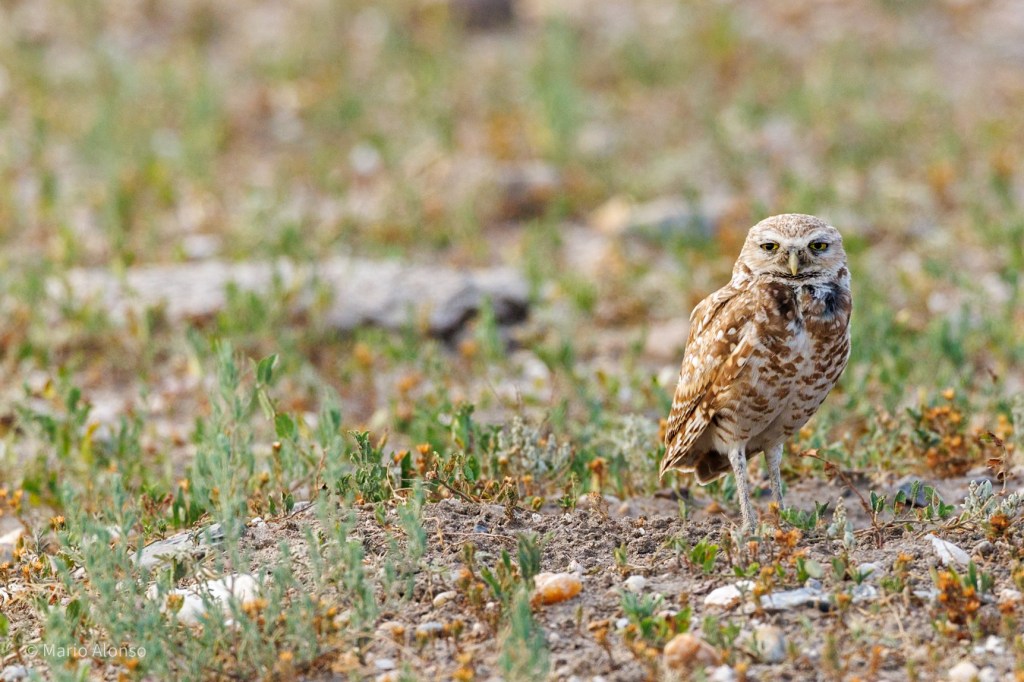
The drive produced Mule Deer (Odocoileus hemionus), Pronghorn (Antilocapra americana), a bighorn ram (Ovis canadensis), hares, Black-tailed Prairie Dogs (Cynomys ludovicianus) in numbers, and a good many birds. But the animal we came for was the Burrowing Owl (Athene cunicularia), and we found three.
Two were distant, well past 200 meters. Even with the RF600mm f/4 and the 2x extender that meant cropping hard to recover any detail. The third was about 20 meters off the road, close enough for real portraits. One target species off the list.
The one mechanical problem
The camper door went out of alignment on day two and would no longer close properly. It was fixed two days later in Billings by a shop owner named Kurt, who looked at it, produced a rubber mallet, hit the frame plate twice, and handed it back working. He would not take money. He got a very good Google review instead.
Traveling with Frida here
- Cooling: Cabin air conditioning on shore power. No dependence on battery state of charge. This was the whole reason we were here.
- Shade: Abundant. Mature trees throughout, along the river, and nothing comparable exists inside the park.
- Where she could come: The campground, the dog park, the early-morning and evening hours generally.
- Where she could not: Every trail in the park. Badlands restricts pets to paved and gravel roads and developed areas, so this is not a heat rule, it is the park rule, and it applies to every National Park we visited.
- Dog care: None needed. Both days were structured so one of us was always with her.
- The midday block: Roughly 10 a.m. to 4 p.m. was written off for all three of us. Planning around that window rather than fighting it is what made the two days work.
Verdict
Two nights is right for a first visit.
Inside the park or outside it depends entirely on what you are carrying and when you go. In late July, with a senior brachycephalic dog and no electrical hookup, outside was the correct answer and it was not close.
Cedar Pass has 96 sites and only 23 with electric service. If you want to be inside the park in summer, book one of those 23, because that is the version of this trip where you get both the power and the sunrise. If you cannot get one, the White River KOA four miles out will do the job. It is a worn property with tired facilities, and we would book it again anyway on a day like that one, for the outlet and the trees and nothing else.
What we did not get was the ferret. That one is unfinished business.
Practical notes
- Hike at dawn. By 9 a.m. in late July the trails stop being usable, for you and for the dog.
- Check trail surface after rain. The Castle Trail climb turns to slick clay and is worse on the way down.
- Confirm ranger night program schedules before counting on them. Ours were not running.
- Pets are restricted to roads and developed areas throughout Badlands NP.
- Cell coverage in the area is spotty. The campground has wifi.
See more
- Photos from Badlands National Park in the gallery
- Traveling with a senior bulldog: the ground rules, the reasoning behind every camping decision in this series
 Looking 4 Nature
Leave a comment