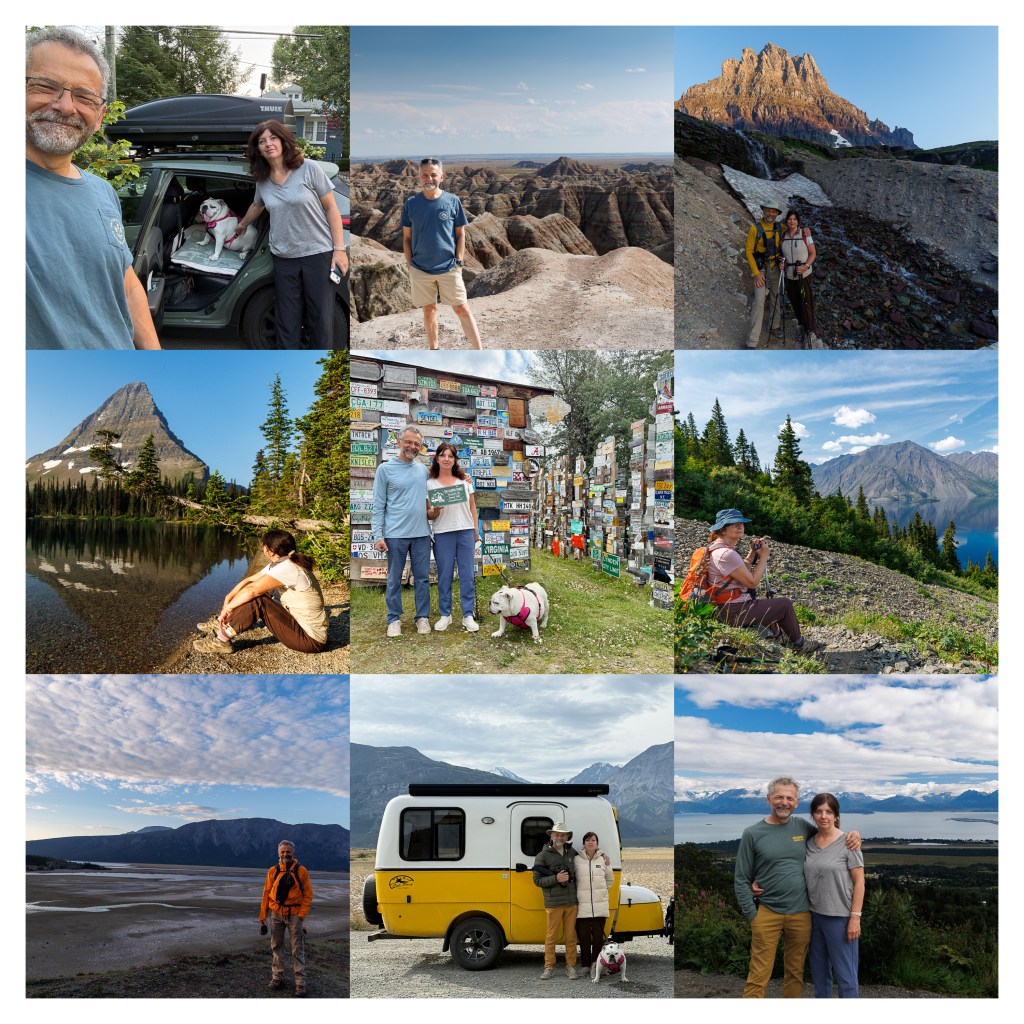
We left Cincinnati on July 25 and pulled back in on September 10. In between we drove to Alaska and back in a small camper, with Sandra, me, and Frida, our senior English Bulldog.
This is the overview. Each park has its own entry with the detail, and they are linked at the bottom.
By the numbers
| Days | 48, July 25 to September 10, 2026 |
| Miles driven | About 11,000 by the odometer |
| Of those, verified point to point | 9,653 across 36 travel legs |
| Longest single leg | 430 miles |
| Nights | 47, in 34 different places |
| Of those | 36 in campgrounds and RV parks, 7 in hotels and motels, 4 in B&Bs |
| States, provinces and territories | 11 |
| National Parks | 9, in two countries |
The number that tells you the most is 34 places in 47 nights. This was not a trip where you settle in anywhere. It was a trip where you learn to set up and break down fast, and where the three-night stops feel like a holiday.
The mileage gap is worth a second look too. The itinerary accounts for 9,653 miles of driving between stops. The odometer says something closer to 11,000. That missing 1,300 or so is all the driving that never appears on a plan: the loop road at dawn, the drive back out to the trailhead, the second pass at a pullout because the light changed. If you are budgeting fuel for a trip like this, add fifteen percent to whatever your route planner tells you.
Seventeen months of planning, and an app that came out of it
I retired at the end of February 2025, and by then we were already planning to drive to Alaska the following year. The formal planning started in earnest around June 2025. So by the time we pulled out of the driveway, this trip had been in progress for well over a year.
The detail came in waves after that. In-park campgrounds in the US and Canada release on rolling windows six months out, which sets a hard floor on when you can commit. By February we had a general journey laid out and were booking specifics: campsites, a guided photo tour in Jasper, a bear-viewing flight out of Homer, a dog sitter in West Glacier for a single morning five months in the future.
All of that lived in a Word document, and the Word document stopped coping.
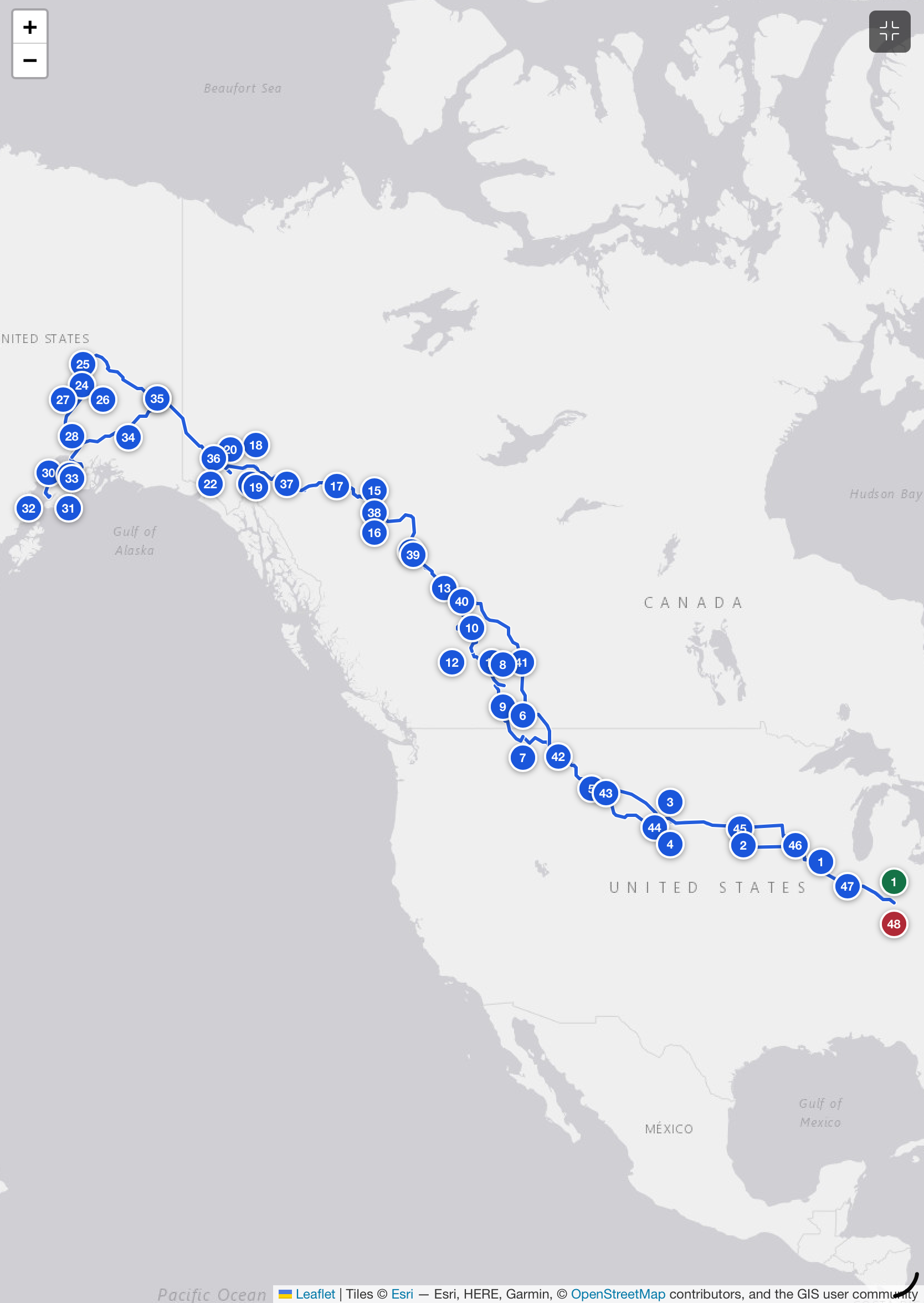
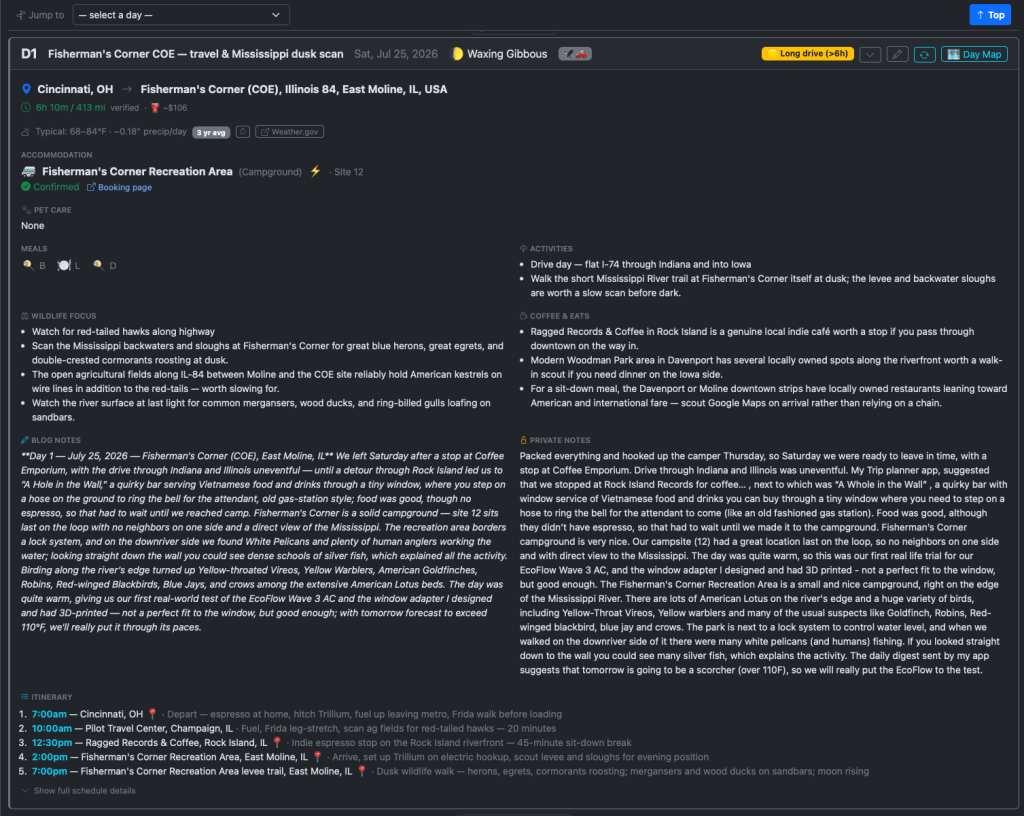
So I built a replacement. TripPlanner is a Flask app running on Render, written with Claude Code over the months before we left, now at version 1.84. It does the obvious things: days, routes, drive verification against Google Directions, weather by day part, a trip map, packing lists, exports. It does a few less obvious ones too. It pulls recent eBird notable sightings and iNaturalist observations near each destination, so the wildlife focus for a day starts from what has actually been seen there. It emails a digest every evening for the following day, with the drive, the weather, sunrise and golden hours, the moon phase, and whether tomorrow is a shopping day.
The part that matters for this blog is smaller than any of that. Every day carries two notes fields, one private and one for the blog. I wrote in the private one most nights, usually badly, usually tired. Those notes are what these park entries are made of.
I will not pretend the tooling was flawless. Claude’s geography in thinly mapped country is unreliable, and at one point it proposed a fifteen-hour driving day and a route that doubled back on itself. An unpinned dependency let a rebuild move the app to a newer Python and a newer SDK mid-trip and broke two things in Yukon, which is a poor place to debug anything. Both are written down in the backlog.
The shape of it
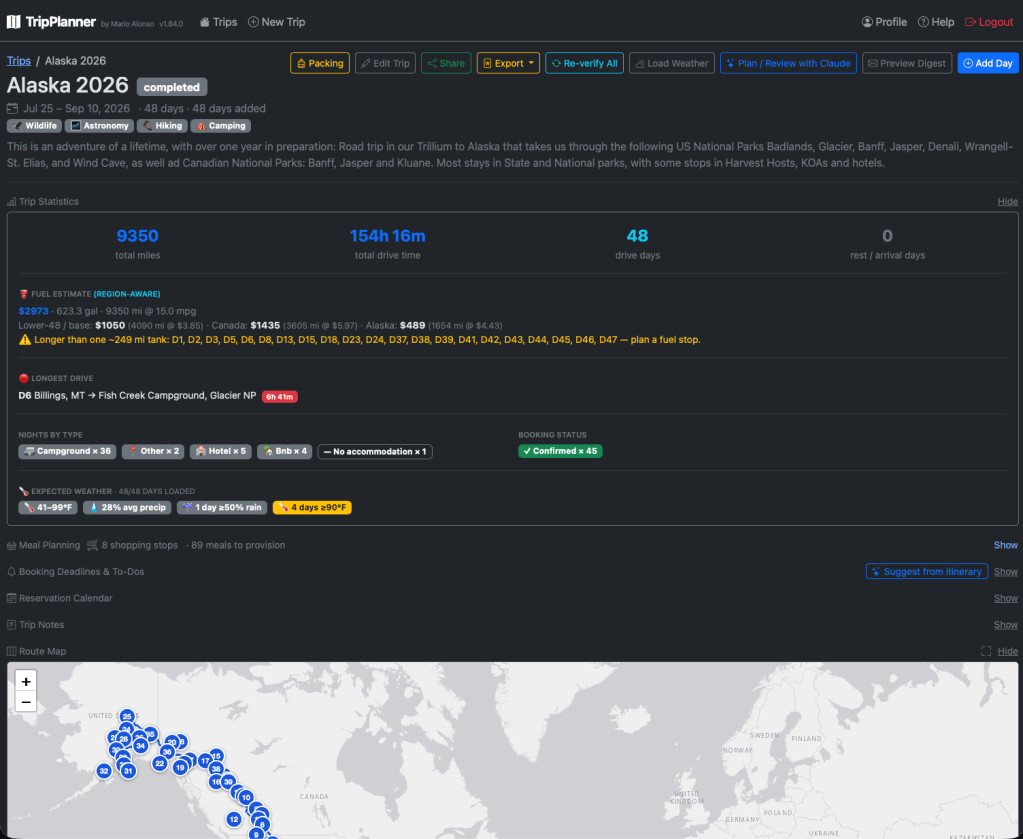
Out across the plains. Four days from Ohio to the Badlands, through a heat wave that hit 104°F and rewrote our camping plan on day three. South Dakota into Montana, and the first real mountains.
The Rockies, twice. Glacier, then across the border at Chief Mountain into Banff and Jasper and up the Icefields Parkway. Wildfire smoke out of Oregon followed us the entire way and sat over both parks. We saw a version of these mountains with the contrast turned down.
The long haul north. Dawson Creek, then the Alaska Highway: Buckinghorse River, Muncho Lake, Liard River Hot Springs, Watson Lake, Whitehorse, Kluane. This is the part nobody photographs and the part that changes you. Cell coverage disappears, Tim Hortons becomes the only option for a hundred miles, and you navigate on paper. Stone sheep on the road. Black bears working berry bushes at the treeline.
Alaska. Tok, then Denali, where we rode the East Fork transit bus twice and saw the mountain clear three times, which is more luck than we had any right to. Anchorage, the Russian River, Homer. A floatplane out to the Katmai coast for brown bears. The tidal bore at Turnagain Arm, which arrived on schedule and was worth the wait, though the belugas we had hoped to see with it never showed. Wrangell-St. Elias and Valdez in continuous rain.
Home. Leaving Alaska was harder than any of us expected, and the weather matched the mood. Back down through Yukon and northern BC, across Alberta, into Montana, and then a long run east through farmland that had felt full of promise on the way out and felt like distance on the way back. Wind Cave in South Dakota was the last park. Then Sioux Falls, Iowa, Illinois, and home.
What it was actually about
Looking back at seven weeks of notes, a few things repeat more than the scenery does.
Weather ran the trip, and the planning is what let us live with it. Heat cost us a campsite in the Badlands. Smoke cost us Moraine Lake. Rain gave us slow mornings at Muncho Lake and a wet pillow in Whitehorse when we left a window open. A great many days ended up different from how they had been drawn.
None of that is an argument against the seventeen months of planning. It is the argument for them. Planning without flexibility leads to frustration. Flexibility without planning leads to missing out. The plan is what gave us something to trade against when conditions turned, and knowing in advance what the alternatives were is why a scrapped Lake Louise sunrise turned into Johnston Canyon at 6:30 instead of a lost morning. The weather dictated a lot of changes. We made the most of them because we had somewhere to change to.
We got up early, often. 4:15 at Logan Pass. 5:00 at Badlands. 4:30 for the Denali bus. Dawn is when the light works and when animals move, and it is also the part of the day a senior bulldog can use. That coincidence made the whole trip possible.
Coffee is a ritual at home and something else entirely on the road. We sought out the independent place in every town that had one. Crooked Tree in Great Falls. Bear Paw Bread in Jasper. The Village Bakery in Haines Junction. Rustic Blends in Delta Junction, in a building that looks like an old chapel.
But the best of it was never in a town. Sandra and I say this to each other often: nothing tastes better than a latte early in the morning at some remote campsite, usually with classical music coming off the bluetooth speaker. The weather can be cold and we can be sore from the day before. In that moment we are sitting in the best coffee house in the world.
The parks got wilder as we went north. Banff is the most beautiful and the most managed. By Kluane and Denali and Wrangell-St. Elias you are somewhere that is not arranged for you at all. That progression is the single strongest impression of the trip.
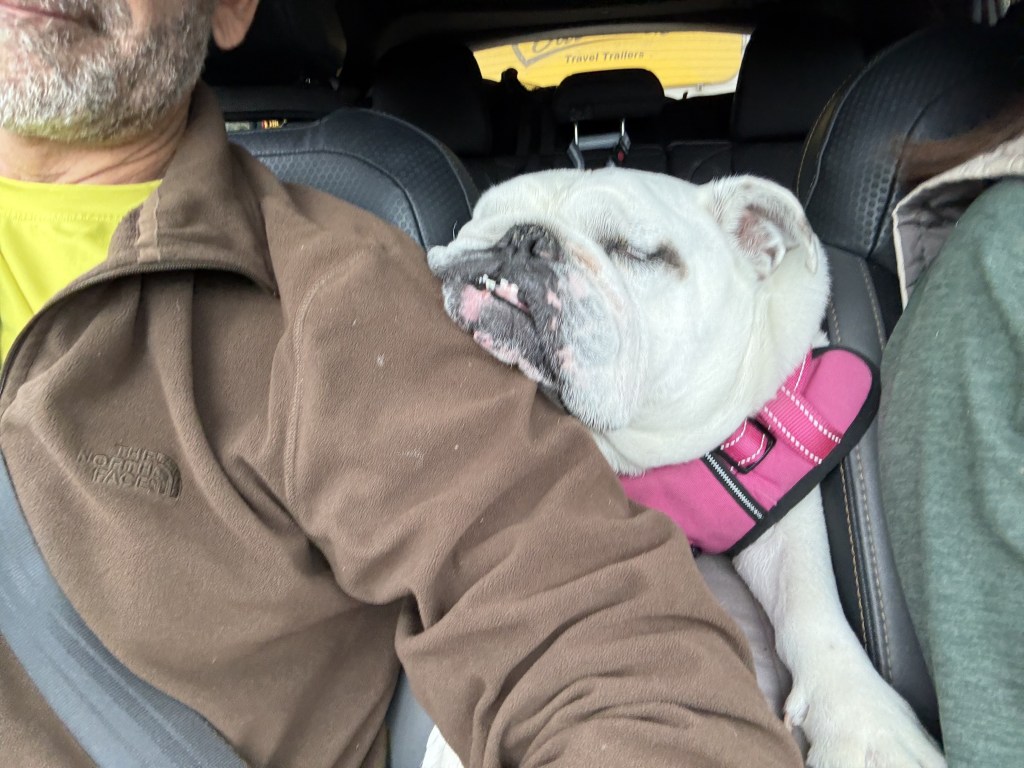
And Frida came to all of it. She could not walk the trails, and in the US parks she was not allowed to. What she could do was every campsite, every early morning, every evening, and every mile of the drive.
She rode in the back seat in a harness, latched in, and spent the day alternating between sleeping and standing up to wedge herself between the two front seats. Every single morning, somewhere in the first hour, she would lean forward, sniff my neck and give me a kiss, as if to say have a nice day. Forty-eight of those.
On our last morning in Banff a herd of elk walked past the camper while she slept through it. That is roughly the right summary of her contribution, and we would not have done the trip without her.
The park entries
- Traveling with a senior bulldog: the ground rules
- 01 Badlands National Park: Badlands / White River KOA
- 02 Glacier National Park: Fish Creek Campground
- 03 Banff National Park: Tunnel Mountain Trailer Court
- 04 Jasper National Park: Whistlers Campground
- 05 Kluane National Park: Kathleen Lake Campground
- 06 Denali National Park: Riley Creek Campground
- 07 Wrangell-St. Elias National Park
- 08 Katmai National Park: Homer Baycrest KOA
- 09 Wind Cave National Park: Elk Mountain Campground
The full gallery has the photographs.
 Looking 4 Nature
Leave a comment