This is one of nine park notes from a 48-day camper trip to Alaska and back. We traveled with Frida, our senior English Bulldog, and that shaped more of our decisions than the route did. See Traveling with a senior bulldog: the ground rules for the reasoning we applied everywhere.
What we made of the park
We arrived hesitant and left convinced.
Driving in from the south, the forest around the town is burned. Mile after mile of standing black trunks. We knew about the 2024 fire in the abstract, and seeing it is a different thing, and our first honest reaction was to wonder what three days here were going to be like.
That lasted about a day. Once we settled in and started talking to people, it became obvious that this is a wonderful place, transformed rather than diminished. The mountains are all still there and you can see more of them than you used to. The trails are open. The town is rebuilding and the people in it are getting on with it.
And the burn itself turned out to be one of the more interesting things we saw all trip. Walking through it two years on, with grasses and wildflowers already filling the ground between the black stumps, is a lesson in succession you cannot get from a book.
Go to Jasper. Do not wait for the trees to come back.
The stay
| Campground | Whistlers, Jasper National Park, AB |
| Site | 25D, rustic, no hookups |
| Nights | August 3, 4 and 5, 2026 |
| Reserved | Parks Canada reservation system |
| Arrival drive | Banff to Jasper via the Icefields Parkway, 182 miles, 3h 19m |
The Icefields Parkway
We did not set an alarm, which after nine days was its own kind of luxury. Breakfast in the camper, final packing, a second coffee in Banff town so I could get on wifi and push photo files up to Creative Cloud. The smoke had finally cleared and the town looked considerably better for it.
Then west on Highway 1 to pick up Alberta 93.
Two things stayed with me. The first is the wildlife overpasses on Highway 1, vegetated bridges built specifically so animals can cross without being killed. We love the care Canadians seem to take with this. It is expensive infrastructure built for something that cannot ask for it.
The second is the Parkway itself, which is something everyone should experience at least once. It runs like an endless series of postcards: dense forest, snowcapped mountains that defy logic, and rivers so bright blue they look artificial.
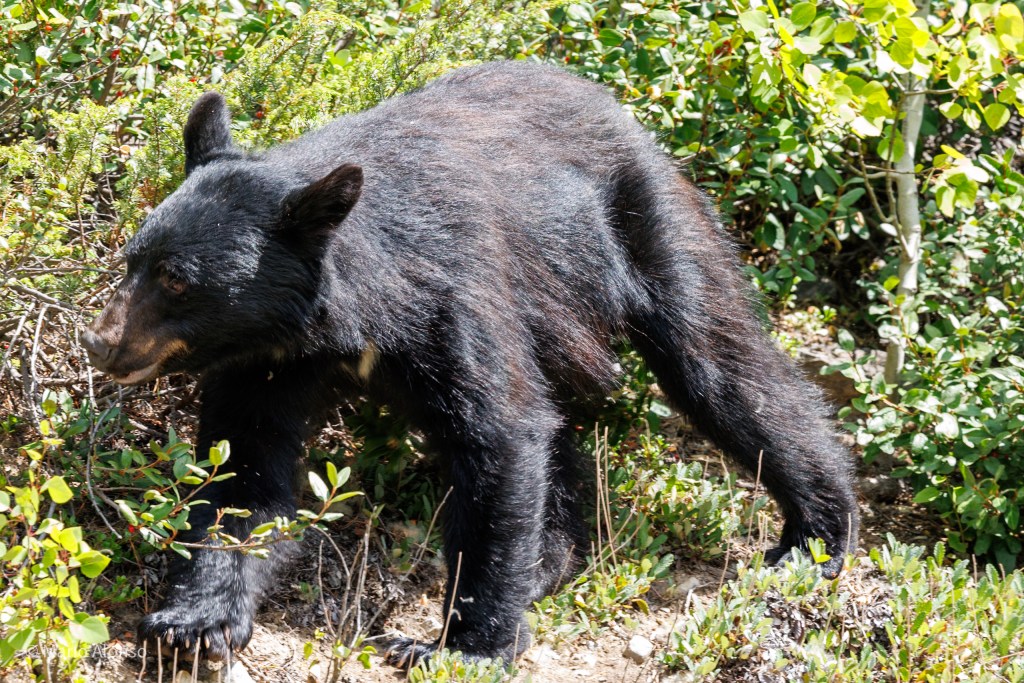
At one point traffic simply stopped. People were out with their phones pointed off the shoulder, and not thirty meters away an American Black Bear (Ursus americanus) was working a berry patch, entirely indifferent to the audience.
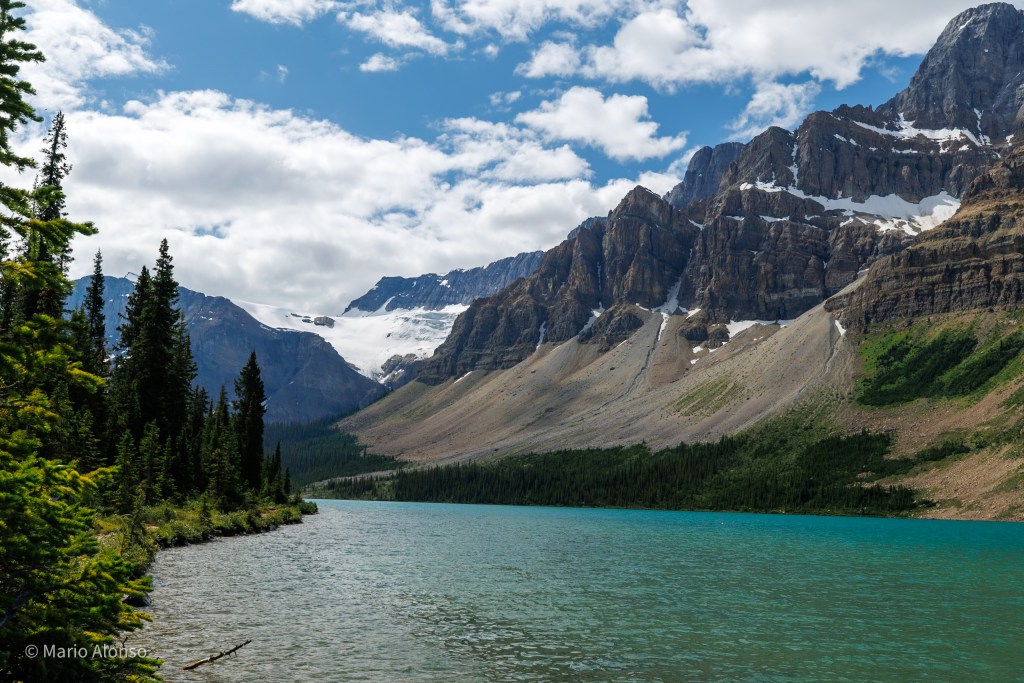
We stopped at Bow Lake, gorgeous and very crowded. Refueled and bought sandwiches at The Crossing, then had a riverfront picnic at a pullout with tables and a view of the Athabasca.
Driving to the campsite we passed a Coyote (Canis latrans) trotting along the road. A good sign for anyone who came here to be around animals, and also a reminder never to leave Frida outside unattended.
The photo tour
Latte and pancakes at 5:30, and at 6:00 Mike Gere, who owns Jasper Photo Tours, pulled up at our campsite.
The tour runs five hours with a two-hour extension available, at $200 plus GST, and Sandra was welcome to come along without being a paying photographer, which is not true of every operation. Mike drove us through several areas looking for megafauna and raptors.
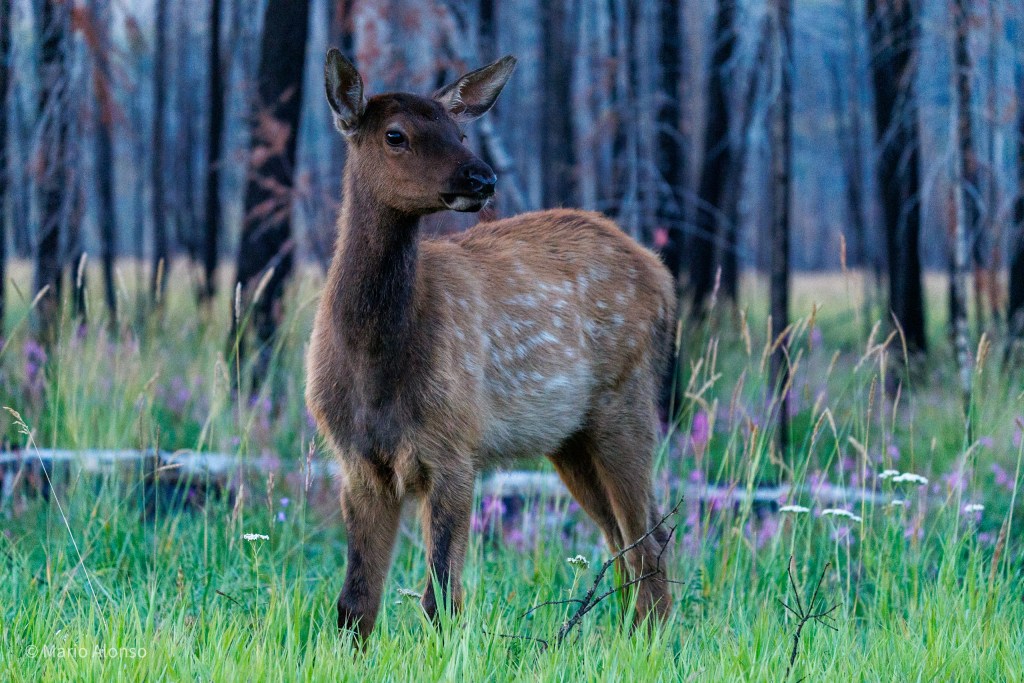
The first encounter was a herd of Elk (Cervus canadensis), including a couple of bulls carrying enormous antlers, along with does and fawns. We also had Bald Eagle (Haliaeetus leucocephalus), Osprey (Pandion haliaetus), loons and swallows.
And then nature declined to cooperate. Our target species were grizzly, moose, bighorn sheep and mountain goat, and we got none of the four. Mike is experienced and knowledgeable and it made no difference, which is worth saying plainly because guided wildlife tours are often sold as though the animals were on a schedule.
What we came away with instead was context: how the geology here works, where the water goes, what the fire did and did not do, how the town relates to the park. That turned out to be worth the fee on its own.
The afternoon went to errands, which on a 48-day trip are not optional: laundry, groceries, mail, and the mandatory coffee stop. After a good fajitas dinner we drove out to Athabasca Falls, which carries the largest torrent in Alberta and puts milky blue glacial water against a serious mountain backdrop.
Valley of the Five Lakes
Up at 5:30, coffee with muffins from Bear’s Paw Bakery, saw to Frida, and out to the trailhead. One other car in the lot.
We had intended to walk both the orange and green routes, but Parks Canada had the orange access closed with no explanation posted, so we did the green portion only. Trail closures are still common here as the recovery works through the park, and the Valley of the Five Lakes trail itself only reopened earlier this summer.
The trail is very nice, and I could only imagine how beautiful it was before the fire. The burnt stumps are unsettling at first. Then you start looking at the ground and it becomes fascinating instead. Succession is already well underway: grasses everywhere, wildflowers in quantity, and a great deal of fireweed (Chamerion angustifolium), which produces a striking purple flower and is named precisely for this, for being among the first things to colonize a burn.
Partway to the lakes we crossed a beaver pond, and it set off a question I could not answer standing there. What happens to beavers in a fire like this? The submerged lodge should keep them safe enough during the burn, but their building material and their winter food supply are gone with the forest.
I looked it up afterward, and the first half of that guess is better supported than I expected. Fairfax and Whittle published a study in Ecological Applications in 2020 with the excellent title “Smokey the Beaver,” comparing satellite vegetation data across five large western wildfires. Beaver-dammed riparian corridors stayed markedly greener through the fires than comparable corridors without beaver. The average drop in vegetation greenness in areas without beaver was about three times the drop in areas with them. Beaver ponds and the channels beavers dig spread water through the soil, and wet ground does not burn well, so the fire goes around. Those green ribbons become refuges for animals that cannot outrun a fire.
The second half of my question is less settled. The same study found that vegetation rebounded in the year after fire regardless of beaver activity, so the dams help a riparian corridor resist burning without necessarily speeding its recovery. What it costs a colony to rebuild a food cache in a burned watershed is a different question, and not one that paper set out to answer.
At Lake Five a pair of Common Goldeneye (Bucephala clangula) were making long foraging dives, and I got lucky and caught one exactly as it surfaced.
The campground
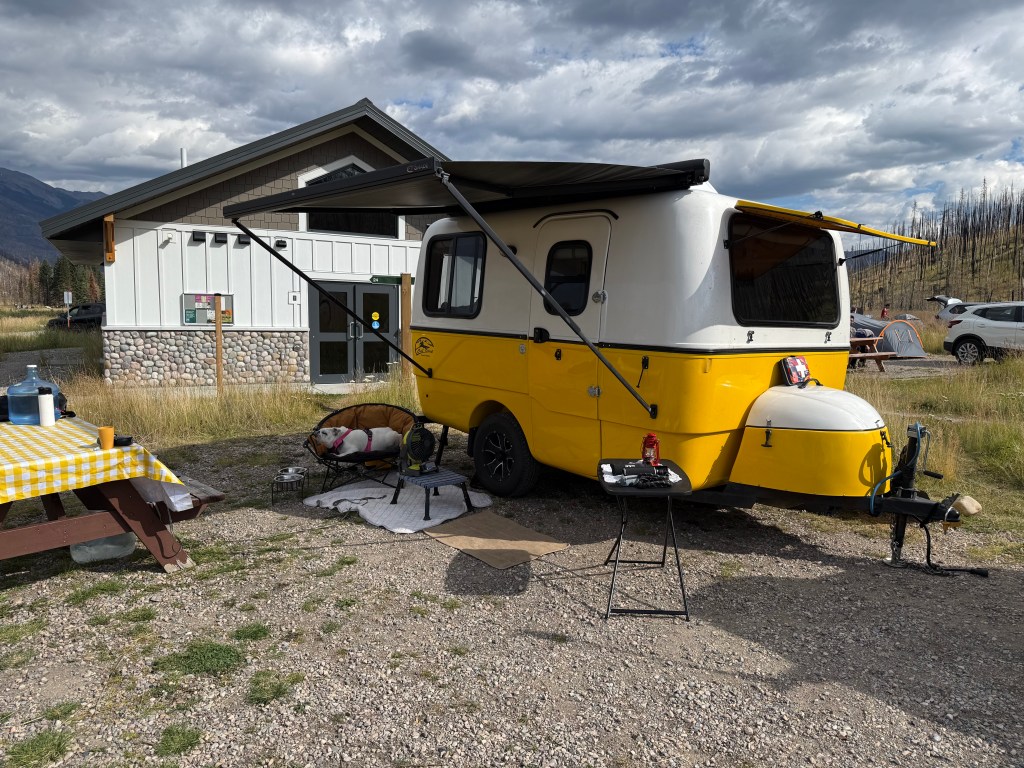
Whistlers, site 25D, rustic, three nights.
The facilities are brand new, and the reason is grim: the fire took 16 of the campground’s 72 structures and damaged eight more. What has gone back up is excellent. These were the best campground bathrooms we saw on the entire trip, and ours were a few meters from the site.
That produces an odd feeling and it is worth naming. You are camping in a landscape that has been through something catastrophic, in facilities nicer than anywhere else you will stay, and both of those are consequences of the same event.
The campground is rustic, with no hookups. In early August in the Athabasca valley that was a non-issue. There is a sani-dump, potable water, and the whole thing is a short drive from town.
Book through the Parks Canada system and check site availability carefully, because capacity here is still recovering. As of this summer roughly 80 sites had been newly reopened across Whistlers and Wapiti, which is progress rather than completion.
Traveling with Frida here
- Shade: Reduced, and honestly so. The fire took a lot of the canopy, and where trees used to screen sites from each other, many no longer do. Check your site before assuming shade.
- Cooling: Rustic, no hookups, battery only. Early-August temperatures in the valley made that comfortable.
- Where she could come: Parks Canada rules again, so most trails on leash, the campground, and the town.
- Where she could not: Left alone outside, ever. We saw a coyote on the campground road the day we arrived, and that settled the question for the rest of the stay.
- Dog care: Rover, and this time it worked. Xinhong J. covered two visits on the photo tour day, at 11 a.m. and 4 p.m., and one at 11 a.m. on the Five Lakes day. The contrast with Glacier, where Rover had no coverage at all, is the whole lesson: the platform works in towns and fails in the small places.
- The midday block: Not a heat constraint here. The constraint was a 6 a.m. pickup and a five-hour tour, which is a different problem and is what the sitter was for.
Verdict
The park. Three nights, and we would take four. Jasper after the fire is not a diminished version of Jasper, it is a different one, and parts of it are more interesting than what they replaced. The Icefields Parkway approach alone justifies the drive. Come with the understanding that some trails will be closed without notice and that the forest around town is black, and come anyway.
On whether it feels wilder than Banff: yes, though not in the way I expected. The infrastructure here is newer and better than Banff’s, not rougher. What makes it feel less curated is that the landscape is visibly not under anyone’s control. A coyote on the campground road, a bear on the Parkway, and a forest that is rebuilding itself on its own schedule.
The campground. Whistlers is the easy recommendation of the two Rockies parks. Rustic, so plan for no hookups, but the new facilities are genuinely excellent and the location works for both the town and the trailheads. Reserve early through Parks Canada and take shade into account when picking a site, because the fire removed a lot of it.
See more
- Photos from Jasper National Park in the gallery
- Traveling with a senior bulldog: the ground rules, the reasoning behind every camping decision in this series
 Looking 4 Nature
Leave a comment