Category: Trip report > Alaska 2026 > Campgrounds Tags: kluane-national-park, yukon, kathleen-lake, congdon-creek, snowshoe-hare, grizzly, st-elias, first-nations, camping-with-dogs, senior-dog
This is one of nine park notes from a 48-day camper trip to Alaska and back. We traveled with Frida, our senior English Bulldog, and that shaped more of our decisions than the route did. See Traveling with a senior bulldog: the ground rulesfor the reasoning we applied everywhere.
What we made of the park
We arrived without much idea of what to expect and drove away amazed by its beauty and its size, and delighted by Canadian hospitality. Kluane is where the trip stopped feeling like a tour of national parks and started feeling like being somewhere genuinely remote.
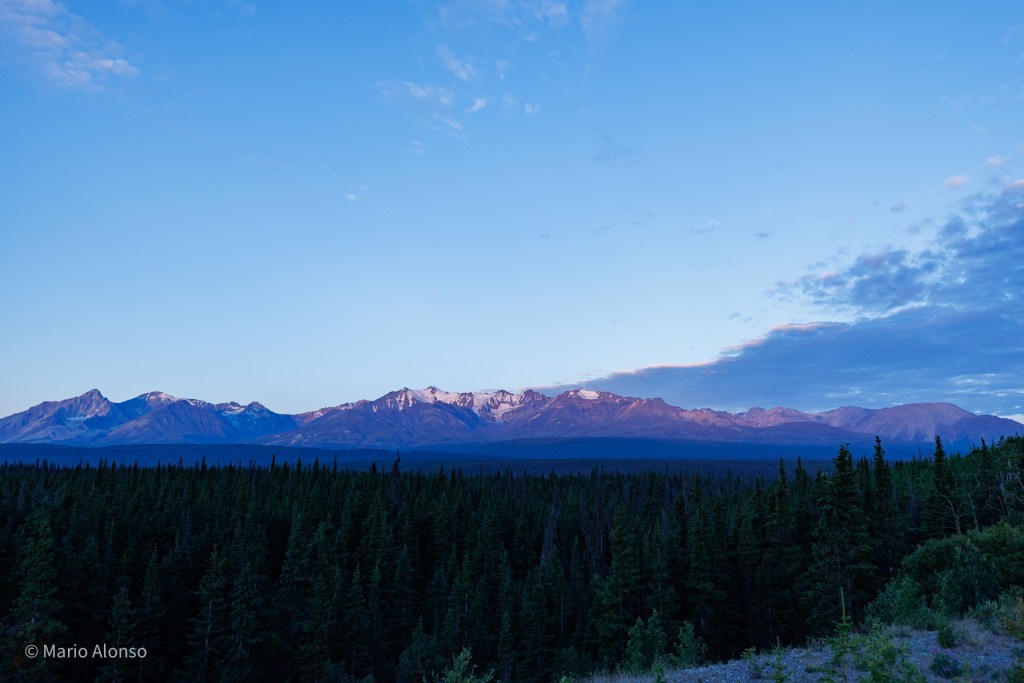
The beauty announces itself before you arrive. Driving west from Whitehorse the mountains get progressively taller and more serious, and somewhere along that road we saw the first snow-covered peaks of the whole trip. It was still summer. Coming back through two weeks later, the change was startling: almost every mountain had snow on it now.
Then there is the scale, which is genuinely hard to hold in your head. Driving from Kathleen Lake up to the northern end of the park takes about an hour, and from there the park runs deep to the west, into country with no roads in it at all. Seventeen of Canada’s twenty highest mountains are inside this park. Mount Logan is in there, 5,959 metres, the highest peak in Canada and the second highest in North America after Denali. We never saw it. You cannot see it from anywhere we could drive to. Maybe next time.
It does not stop at the border either. Kluane joins Wrangell-St. Elias and Glacier Bay in Alaska and Tatshenshini-Alsek in British Columbia to form a single UNESCO World Heritage Site of roughly 98,000 square kilometres, the largest internationally protected area in the world, holding the largest non-polar icefield on the planet. We would be standing on the other side of the same icefield ten days later at Wrangell-St. Elias, which has its own entry later in this series.
Two other things stood out immediately. The first is how seriously the park takes the Champagne and Aishihik First Nations, whose territory this is. The visitor centre is the Da Kų Cultural Centre, and the emphasis on recognizing and celebrating Indigenous peoples is clear from the moment you walk in rather than being a panel off to one side.
The second is that the animals here have right of way and everyone acts like it. The Slims River Valley road was closed while we were there because of wildlife activity, with no further explanation offered and none needed. We found fresh grizzly scat on a trail we were walking. Tent campers at Congdon Creek sleep inside an electrified fence.
But the moment that captured it best was much smaller. On our last morning, pulling out of Kathleen Lake, I spotted a dog-sized animal moving beside a drain pipe with two rangers standing nearby watching it. We stopped. It was a North American Porcupine (Erethizon dorsatum), entirely untroubled by its audience, and it was the first one either of us had ever seen. What made it better was the rangers. These are people who see wildlife in this place every day of their working lives, and they were just as delighted as we were.
The stay
| Campground | Kathleen Lake, Kluane National Park and Reserve, YT |
| Site | 32, rustic, no hookups |
| Nights | August 13, 14 and 15, 2026 |
| Reserved | Parks Canada reservation system |
| On the way home | Congdon Creek, Kluane Lake, one night, August 29 |
Arriving
Breakfast at Hidden Valley outside Whitehorse, then west. Kluane is barely two hours away, which is startling given how much further out it feels once you are there.
First stop was the visitor centre in Haines Junction, which shares a building with the Da Kų Cultural Centre of the Champagne and Aishihik First Nations. Worth the time. It is the cultural grounding the park deserves before you walk into it.
Then south to Kathleen Lake. The sun was out and bright, which meant the camper batteries and the external packs went to full on solar, a small thing that mattered more here than anywhere because these sites are rustic.
The afternoon hike was the Kathleen Lake Cottonwood Trail, 5.6 miles with 1,280 feet of climbing, and views of the lake and surrounding mountains that pay for the effort several times over.
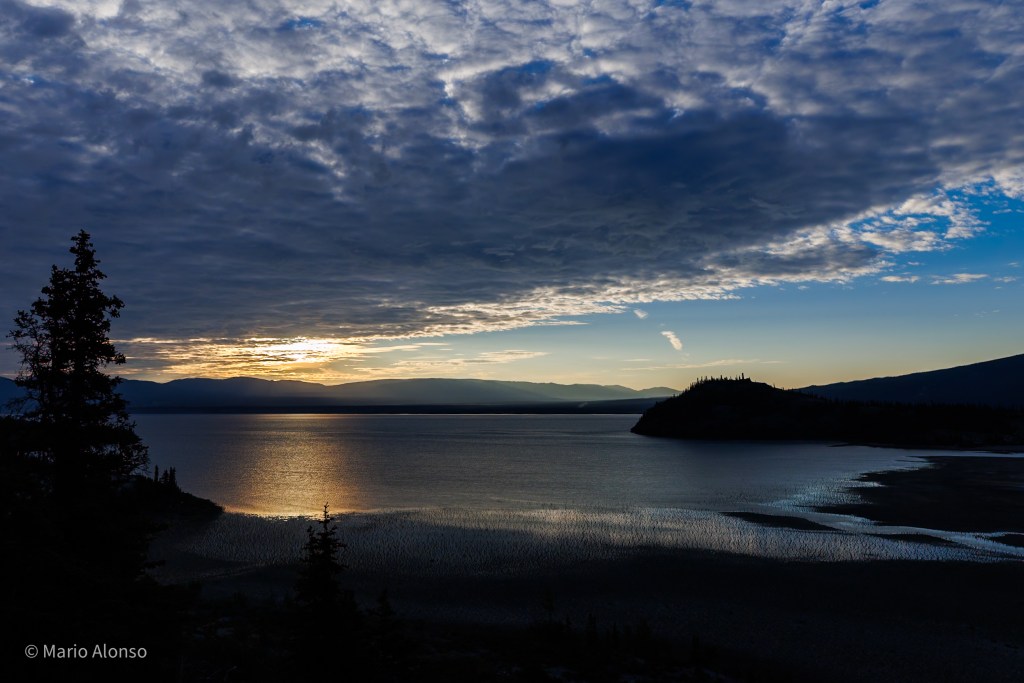
We also walked the beach to scout a Milky Way position. It was a new moon in a region with very dark skies, which is about as good as the conditions get. We found the spot. The forecast turned cloudy and we never got the shot. That is astrophotography.
The middle day
No alarm. We drove up to the Village Bakery in Haines Junction for a proper latte and a pastry, which became the reliable move for the whole Kluane stretch.
The Dezadeash River Trail came first, and here is the honest assessment: it would be a great trail almost anywhere else. At Kluane it was just okay. That is less a criticism of the trail than a statement about the company it keeps.
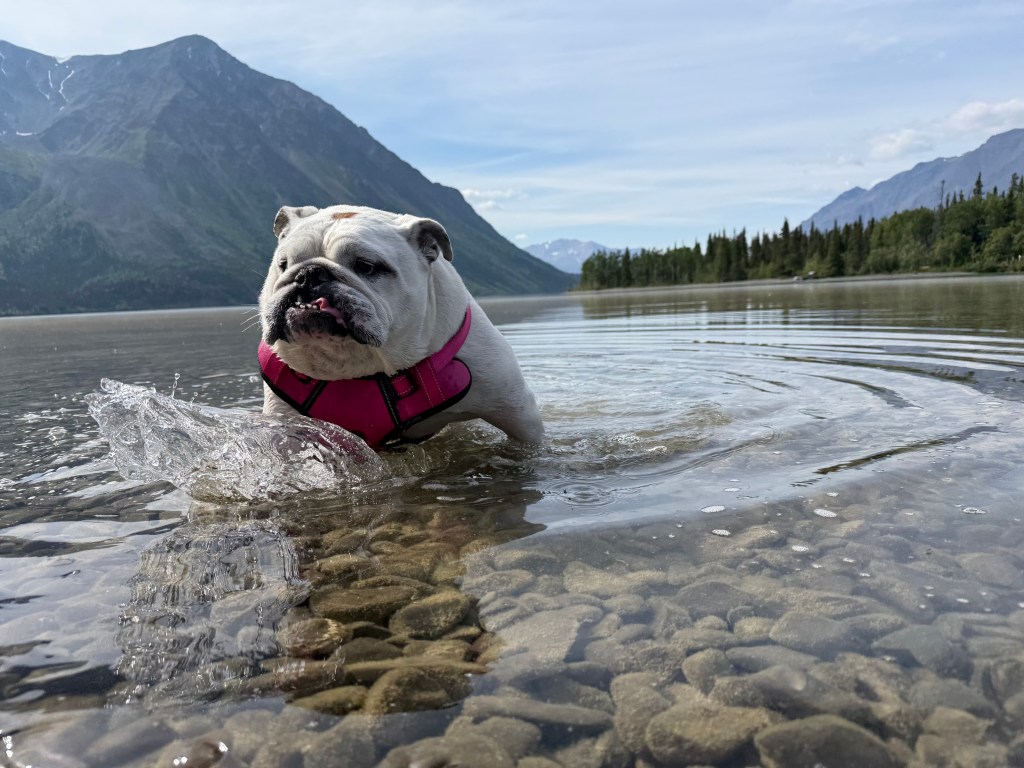
Back at camp we made sandwiches and spent the early afternoon on the Kathleen Lake beach with Frida. The water is far too cold to swim, but we waded and took pictures and had a genuinely relaxing couple of hours, which on a 48-day trip you have to schedule deliberately or never get.
We waited for the day to cool, left Frida in the camper, and hiked the Rock Glacier trail. This one is worth going out of your way for. You walk through forest for the first stretch, and then you come out and the name explains itself: a river of rock pouring down the mountainside. It was built by a fast-moving glacier dragging material downhill, and the ground it crossed is visibly wrinkled, the way a bedsheet wrinkles if you run your hand across it in one direction. The view of Dezadeash Lake from the top is excellent, especially as the sun drops behind the mountains.
The day that sampled the whole park
Up before sunrise, latte and toast, then northwest toward the Kluane Lake end of the park. The reasoning was ordinary: animals move at dawn and mountains look their best in the first light.
The mountains delivered. The wildlife mostly did not, with one very large exception.
Hares, in scores. On the highway and beside it, for miles, in the pre-dawn dark and the first light after it. I have never seen anything like that density of a single mammal. I did not photograph any of them, so treat the identification as tentative, but Snowshoe Hare (Lepus americanus) is the only hare that occurs in this part of the Yukon and there is not much else these could have been.
That is worth dwelling on, because of where we were. The boreal forest around Kluane Lake is the most intensively studied snowshoe hare population in the world. Researchers have been running continuous ecological work there since 1973, and the Kluane Boreal Forest Ecosystem Project is the study that pinned down how the classic hare cycle actually works. Hares here fluctuate on a nine to ten year cycle, in synchrony across southern Yukon, and as a keystone herbivore they drag the lynx, great horned owl and goshawk populations along behind them. Roughly 95 percent of snowshoe hares die as somebody’s meal.
Southern Yukon hares were at a low point in September 2021. On a nine to ten year cycle, that puts a peak somewhere in the middle of this decade. I cannot prove we drove through a peak year, but scores of hares on a single stretch of highway is exactly what a peak is supposed to look like, and it is a good feeling to drive through a textbook.
Otherwise: Common Raven (Corvus corax), and a Golden Eagle (Aquila chrysaetos).
The Tachäl Dhäl visitor centre was still a couple of hours from opening, so we walked the short Soldier’s Summit trail while Frida waited in the car, and got a fine view of Kluane Lake and Mount Cairnes. We scanned the slopes for Dall sheep and found none.
The plan had been to work the Slims River Valley for wildlife, but the access road was closed for wildlife activity. That happens in national parks, where the animals have priority, and it is the right call even when it costs you your morning.
Back to Kathleen Lake with the sun higher, an early lunch at the Village Bakery again, and a slow afternoon of relaxing and starting to pack.
In the early evening we hiked the St. Elias Lake trail, about five miles climbing between hills to a beautiful small lake with a couple of Spotted Sandpiper (Actitis macularius) working the shore. On the way we found relatively fresh grizzly scat, full of berry pits, and moose scat alongside it. We spent the rest of that hike being conspicuously loud, and were pleased to meet neither producer.
Back at camp by nine, after a day that gave us a good sample of the whole park.
The campground
Kathleen Lake was one of our favourite campgrounds of the entire trip, and it got there without a single hookup.
The sites are rustic in the literal sense: no electric, no water. What they have instead is a layout that works. Sites are arranged on a loop around a central core holding the vault toilets and a potable water source. The toilets were very clean, which sounds like an oxymoron applied to a vault toilet and was not. There are complimentary firewood stations every few sites, so you are never hauling wood across the campground. There is an amphitheatre in the middle where rangers give a talk every evening. And the lake is right there, a short walk from anywhere in the loop.
That combination is the argument for it. Rustic camping usually means trading convenience for setting. Kathleen Lake gives you the setting and then quietly hands most of the convenience back.
Our sites got enough direct sun to keep the camper batteries and the external packs full on solar for three days, which at a no-hookup site is the difference between managing power and forgetting about it.
Leaving
We got up with no hurry on the last morning, finished packing, hooked up the trailer, and started out of the loop.
On the way out I noticed a dog-sized animal moving beside a drain pipe with two rangers standing there watching it. We stopped. A North American Porcupine (Erethizon dorsatum), our first ever, going about its business with no apparent concern for the three humans and one bulldog observing it. The rangers were as pleased as we were, which was somehow the best part.
A proper breakfast at the Village Bakery, and then northwest one more time on the road we had driven the day before, to the visitor centre at the north end of the park. The ranger on duty pointed us at a large group of Dall Sheep (Ovis dalli) on a hillside four or five hundred meters off. We had scanned those same slopes the previous morning and found nothing. One more box ticked on the local species bingo card, and a good argument for asking a ranger rather than trusting your own eyes.
With the St. Elias mountains behind us, we decided to recreate the Looking4Nature logo in real life. A young woman visiting the park kindly took the photograph: the three of us in front of the camper, with those mountains at our backs.
We left Kluane very satisfied.
The road out
The stretch of the Alaska Highway between Kluane and the border is another story entirely, and anyone driving it with a trailer should know what is coming.
As you go, the pavement gives way to gravel for longer and longer stretches, and where there is pavement it can carry sudden waves and frost heaves that will work over both your vehicle and whatever you are towing. A friend had warned me about these beforehand, which helped, though not as much as I would have liked.
Somewhere in that stretch the left camper tire decided it had had enough and began to deflate. We only caught it because we pulled over to swap drivers. We tried putting air back in and could hear it hissing straight back out, so it came off and the spare went on at the side of the road. We drove the rest of the way slower still.
We crossed at Port Alcan, where the border agent was thoroughly friendly, and the road did not meaningfully improve until we were close to Tok.
Two practical lessons, both obvious in hindsight. Check your tires every time you stop, because on that surface a slow leak is a matter of when rather than if. And carry a spare you have actually confirmed is roadworthy, because there is nowhere on that road to buy one.
Coming back through: Congdon Creek
Two weeks later we came the other way, and it was a harder day.
Leaving Alaska is difficult, and the cold rain matched the mood. The Alcan between Tok and Beaver Creek is the same white-knuckle stretch in reverse: frost heaves, potholes in quantity, and long sections of gravel. We handled it better than we had going the other way, which mostly means we kept all four tires inflated this time.
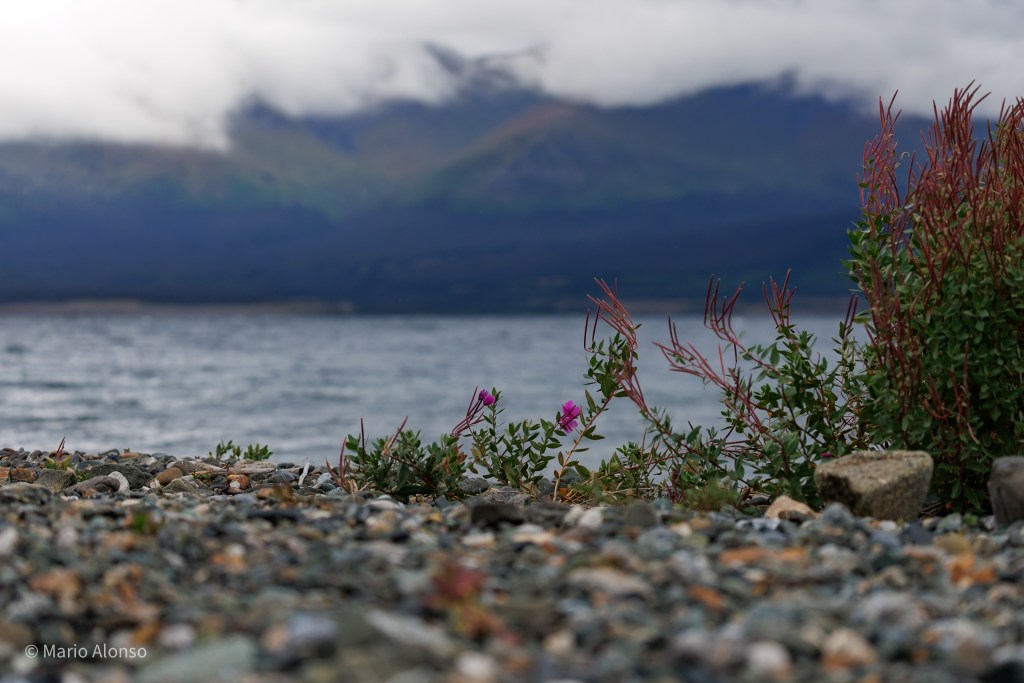
Congdon Creek sits on Kluane Lake, and it has a history. The campground was closed for a period because of excessive grizzly activity, and even now tent campers sleep inside an electrified compound. We had a lake-facing site and took a long walk on the beach with bear spray in hand throughout. The rain broke for long enough to get a fire going and cook dinner over it.
It is a good campground in a serious place, and both halves of that sentence matter.
Traveling with Frida here
- Shade: Good at Kathleen Lake, which is forested. Congdon Creek’s lakefront sites are more open.
- Cooling: Rustic at both, so solar only. Kluane in mid-August was comfortable, and the bright days kept the camper and the external packs topped up without effort.
- Where she could come: Parks Canada rules, so most trails on leash, plus the campground and the Kathleen Lake beach, where she had one of her better afternoons of the trip.
- Where she could not: Practically rather than legally. She waited in the car for Soldier’s Summit and stayed in the camper for Rock Glacier and St. Elias Lake, which were longer and steeper than she should be doing.
- Dog care: None arranged, and none needed. Nothing here required a full day away.
- The midday block: Not the constraint. The constraint was pre-dawn starts and evening hikes in grizzly country, which is a different reason to leave a dog at camp and a more serious one.
A word on that last point. This is bear country in a way the Rockies parks were not, and we carried spray on every walk including the beach. A dog that is not with you is a dog that cannot startle a bear at close range, and at Kluane that reasoning felt less like caution and more like arithmetic.
Verdict
The park. Three nights, and they were well used. Kluane is the first park on this route that feels genuinely remote, and the trails are excellent. Do the Rock Glacier. Get up early and drive the Kluane Lake end for the light even if the animals do not show. Stop at Da Kų before you do anything else.
If you are chasing dark skies, come at a new moon and accept that you may not get it. We had perfect timing and lost it to cloud.
The campgrounds. Kathleen Lake is the one to book, and it is among our favourites of the whole trip. Rustic, so bring your own power and water, but the loop layout, the clean central facilities, the free firewood, the nightly ranger talks and the lake on your doorstep add up to something better than most serviced campgrounds manage. Reserve through Parks Canada.
Congdon Creek is a good one-night stop further north on Kluane Lake, with lake-facing sites and a real grizzly history behind the electrified tent compound. It sits alongside the national park rather than inside it, in the same lake basin and the same ecosystem. Bring bear spray and treat the place seriously. The setting is worth the stop.
See more
- Photos from Kluane National Park in the gallery
- Traveling with a senior bulldog: the ground rules, the reasoning behind every camping decision in this series
 Looking 4 Nature
Leave a comment