This is one of nine park notes from a 48-day camper trip to Alaska and back. We traveled with Frida, our senior English Bulldog, and that shaped more of our decisions than the route did. See Traveling with a senior bulldog: the ground rulesfor the reasoning we applied everywhere.
What we made of the park
Katmai was the most awe-inspiring experience of my life, and my only regret is that Sandra was not standing next to me for it.
If you lay the parks on this trip along a line running from manicured to genuine wilderness, Katmai sits at the far end of it. There is no road. There is no campground we could reach. You land a floatplane on an unnamed lake, you walk to a creek, and there are bears everywhere, doing what bears do when nothing has ever taught them to be afraid of you.
I spent about two hours there. I came home with a thousand photographs and a plan to go back for longer.
This entry covers four days rather than one, because the bears escalate. It runs from the Russian River, through Homer, to Moraine Creek, and the distance between us and a brown bear goes from five meters in the dark to two meters in daylight over the course of it.
The stay
| Base for Katmai | Homer Baycrest KOA, Homer, AK, full hookup |
| Nights | August 23, 24 and 25, 2026 |
| The night before | Russian River Campground, Cooper Landing, site 039, rustic |
| The park itself | Reached only by floatplane. Emerald Air Service, 8 a.m. to 4 p.m. |
Russian River: the salmon
We left Anchorage after a very good breakfast and drove two hours south. The road along the north side of Turnagain Arm brought back our first visit to Alaska, which is the trip that made me fall in love with this place.
Once the highway picks up the Kenai River you are unmistakably in fishing country. In Cooper Landing every shop seems to exist for anglers. We stopped at Dreamy Moose Coffee for a mid-morning cappuccino and then checked into the Russian River Campground, which is run by the US Forest Service inside the Chugach National Forest. Rustic in the full sense: no electric, no water lines, no drainage, pit toilets only. It is also beautiful, and it sits in the middle of bear country.
We hiked the Russian River Falls trail, and within about ten minutes the whole economy of the place made sense.
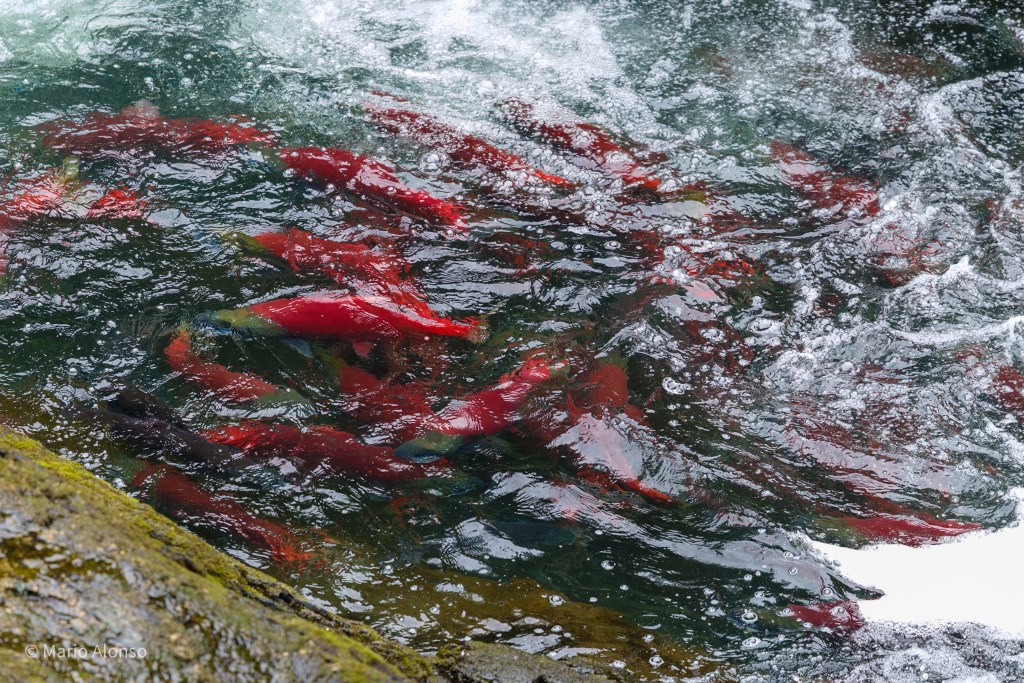
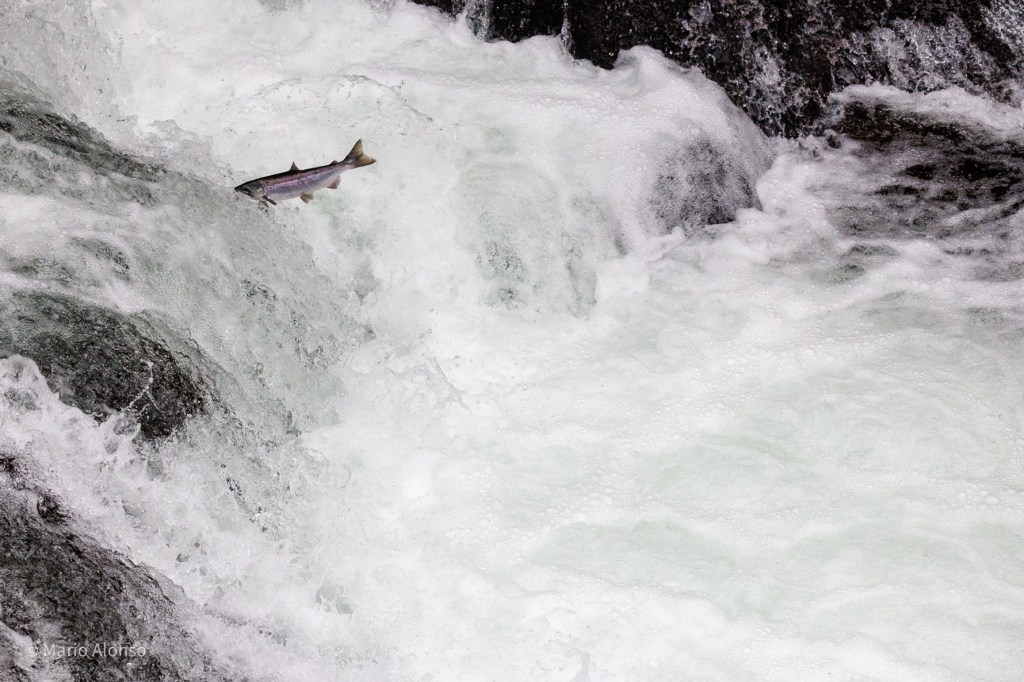
There were hundreds of Sockeye Salmon (Oncorhynchus nerka) below the falls, packed in and swimming furiously against the current, and every few seconds one would launch itself at a step in the water and sometimes clear it. I have watched this in documentaries my whole life. Watching it in person was one of the most extraordinary things I have ever seen. Every one of those fish hatched in that gravel four or five years ago, went to sea, and has come back to the exact place it was born in order to spawn and then die.
No bears at the falls. We did not mind.
After dinner we walked down to the river where the anglers gather. There is signage about bear activity, and beneath it people had been writing in by hand when and where they had seen one. There was an entry for every day of the previous week. Exciting, and slightly unnerving.
Fifteen or twenty anglers were standing in the middle of the river surrounded by fish. We talked to a few and every one of them had seen bears in the past few days. That evening, nothing. We also had Black-billed Magpie (Pica hudsonia), a Bald Eagle (Haliaeetus leucocephalus), a great many gulls, and some mergansers.
We agreed to come back at first light.
Russian River: five meters
Up at five, coffee and toast, down at the river by six. The sun was not up yet but there was enough light to walk by.
We went carrying bells, deliberately, to avoid surprising anything. Unlike the previous evening there were no fishermen out yet. We walked away from the confluence and turned in at the first access point to look for sign.
There was none. And as I was turning back, something moved in the ferns beside us.
Before we could do anything an adult brown bear came out of the ferns with three cubs behind her and went straight into the river, no more than five meters away. They were not moving toward us. I had the 600mm f/4 on the body because it was dark, which was luck disguised as foresight, and I got a few frames of the four of them coming out of the water on the far side.
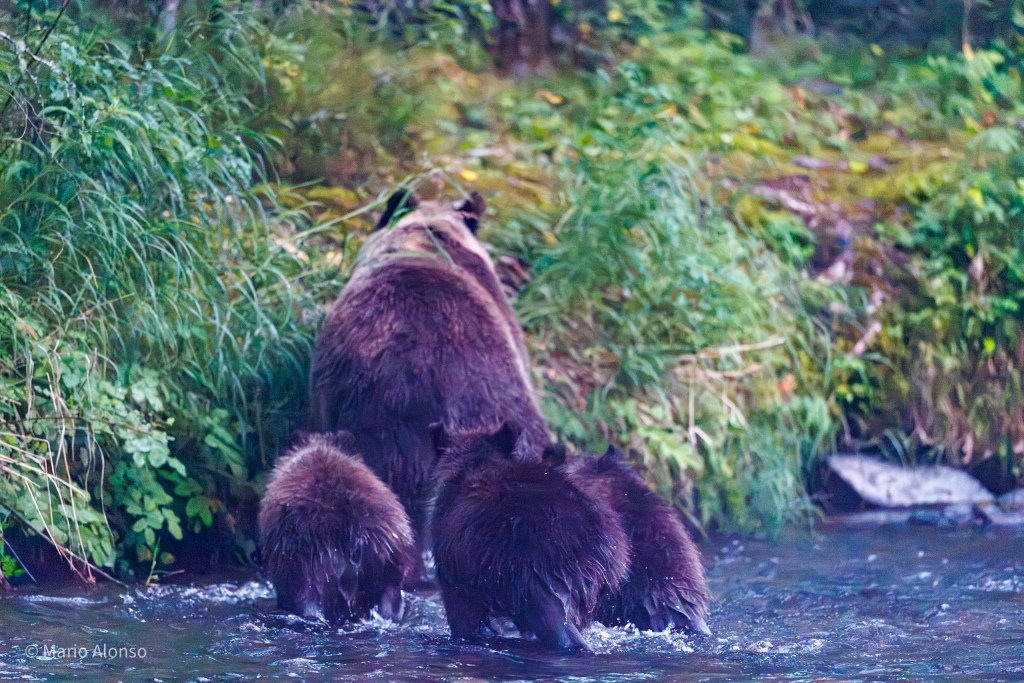
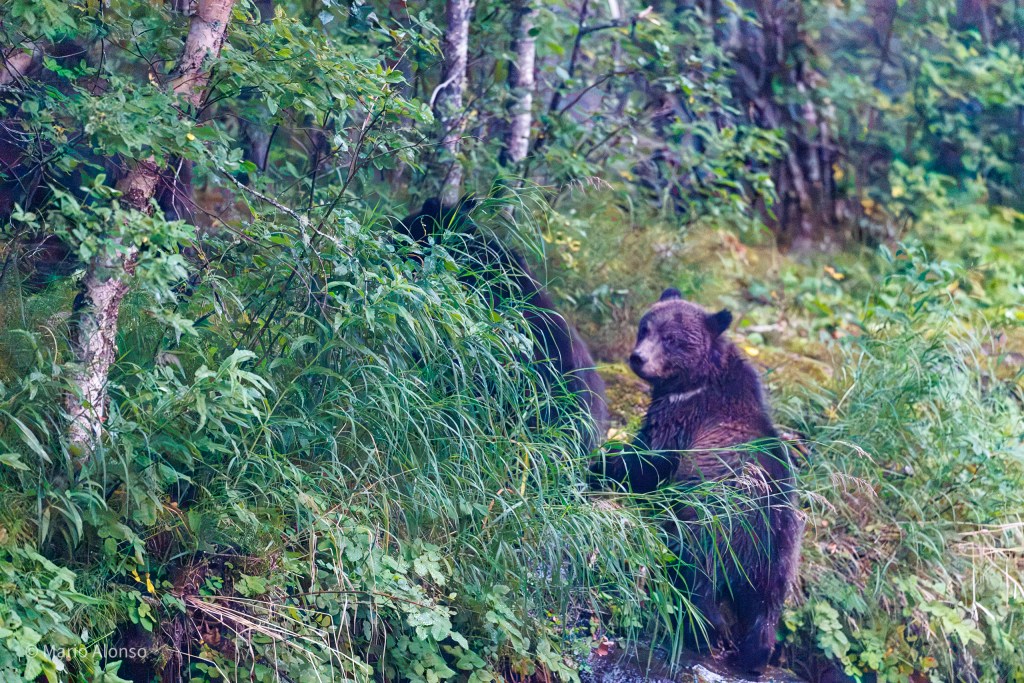
We walked on with our hearts going, found nothing else, and went back to the camper entirely satisfied.
A word on whether that was sensible, because it is a fair question. These bears live alongside anglers who stand in the middle of that river every day of the season, far more exposed than we were, without incident. We carried bells the whole way. My read is that the bears knew exactly where we were, which is why they were sitting in the ferns, and they left when we got closer than they wanted. The encounter happened because we walked past them, not because we found them.
Then we packed and drove to Homer.
Homer
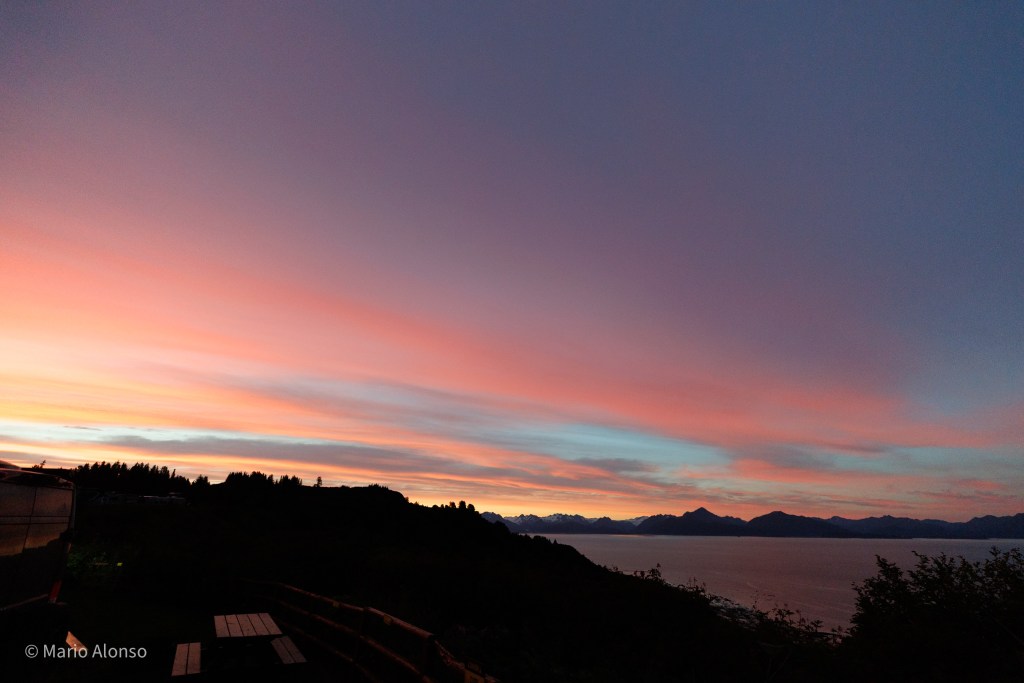
The Baycrest KOA turned out to be very nice, set high with a genuinely spectacular view of the bay.
We spent the afternoon on the Spit, the long thin strip of land reaching out into Kachemak Bay, which is full of shops and restaurants. Lunch at the Harbor Grill, where the bisque was excellent and so was the halibut ceviche. Gelato, espresso, a few stores, a walk on the beach.
We went to bed early because both of us were starting to feel unwell, almost certainly courtesy of the passengers sitting behind us on the Denali East Fork bus, who had spent the morning coughing and sneezing into the back of our heads.
Katmai
This was the one thing on the entire trip that we decided I would do on my own. The tour runs on a small floatplane with a handful of seats, and it was the day Sandra and Frida spent together in Homer.
A gorgeous sunrise, breakfast, and then Emerald Air Service, a safety briefing, and being fitted with waders and boots. We took off from Beluga Lake, out over Kachemak Bay, past Augustine Island, which is an active volcano that last erupted in 2006, and on across the water.
The pilot made a reconnaissance pass while the guide looked for bears, then put us down on a small unnamed lake near Moraine Creek. Eight of us and one guide.
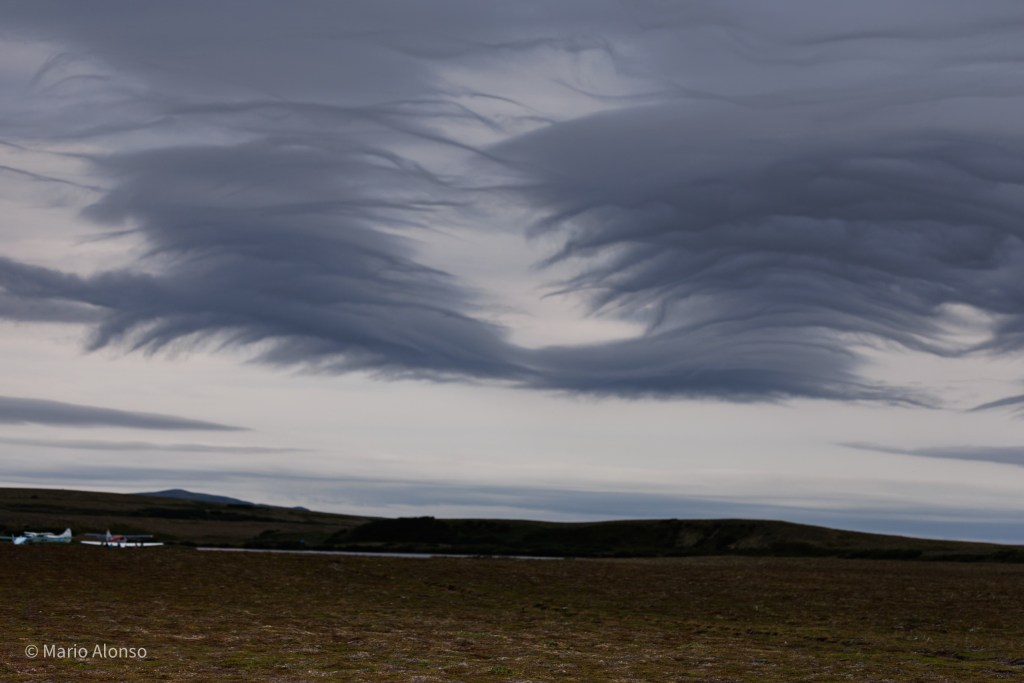
The first thing I photographed there was not a bear. It was the sky.
Above the low brown hills the whole cloud deck had organised itself into enormous stacked lenses and curling waves, layer folded over layer, edges sharp as if cut. These are lee wave clouds, the standing pattern that forms downwind when a strong flow is lifted over a mountain range and keeps oscillating on the far side. The Aleutian Range does that to Pacific air constantly, and Katmai sits in the lee of it. Understanding the mechanism does not reduce the effect in the slightest.
Two floatplanes sat on the shoreline underneath it, and that was the whole of human presence in the frame.
I found myself thinking that even the clouds are wilder here.
We walked toward the creek, which sits about five meters below the bank you approach it on, and when we reached the edge there were more than ten bears in view at once. A mother with two cubs was driving off an adult on one side. Two juveniles, maybe three years old, were directly below us. A large male was working a smaller channel alone. Three more were scattered further out.
On the way in the guide had explained that Katmai’s bears behave differently from the ones you meet elsewhere, and that the reason is abundance. When there is this much food, there is very little worth fighting over, including you. The rules were simple. Stay together as a group, always. If a bear approaches, sit or crouch. And never, ever run, because they are still bears and a running animal is a prey animal.
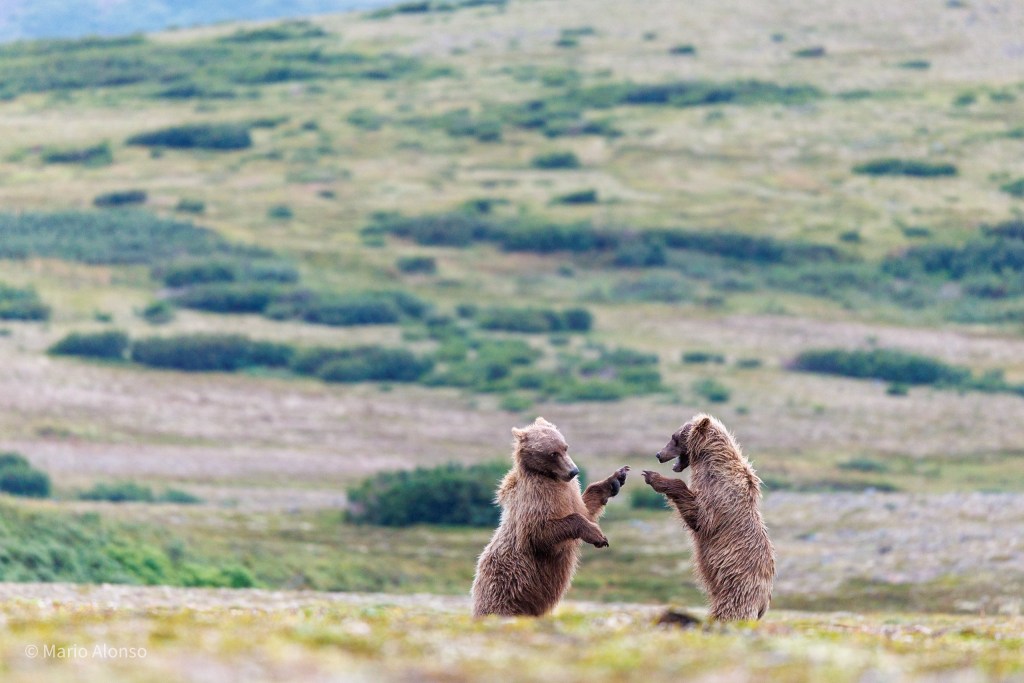
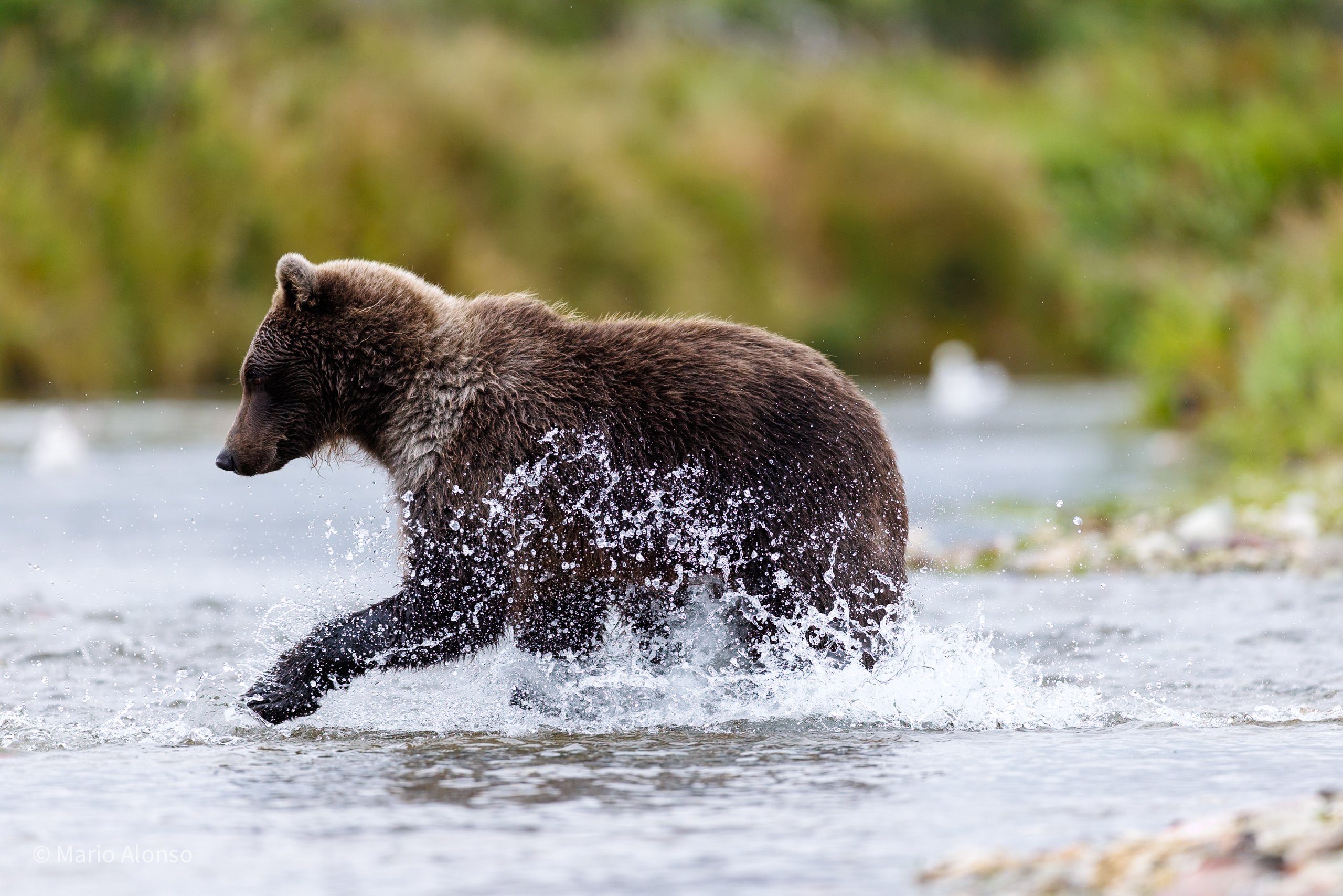
We got to test that immediately. The two juveniles, almost certainly siblings, were wrestling below us and decided to come up the bank in our direction. At one point one of them was standing no more than two meters in front of us, looking at us with what I can only describe as curiosity. There was nothing in its posture that suggested threat. After a few seconds, which felt considerably longer, its sibling walked between us and it, heading away, and the two of them went straight back to playing. They kept at it for a good while, as though demonstrating how it is done.
The guide then walked us down into the creek and across it as a group, everyone holding the backpack of the person in front, like ducklings behind a mother. The current was fast and hip-deep at the worst of it. On the far side I swapped the 100-500mm for the 600mm and got the best frames of the day.
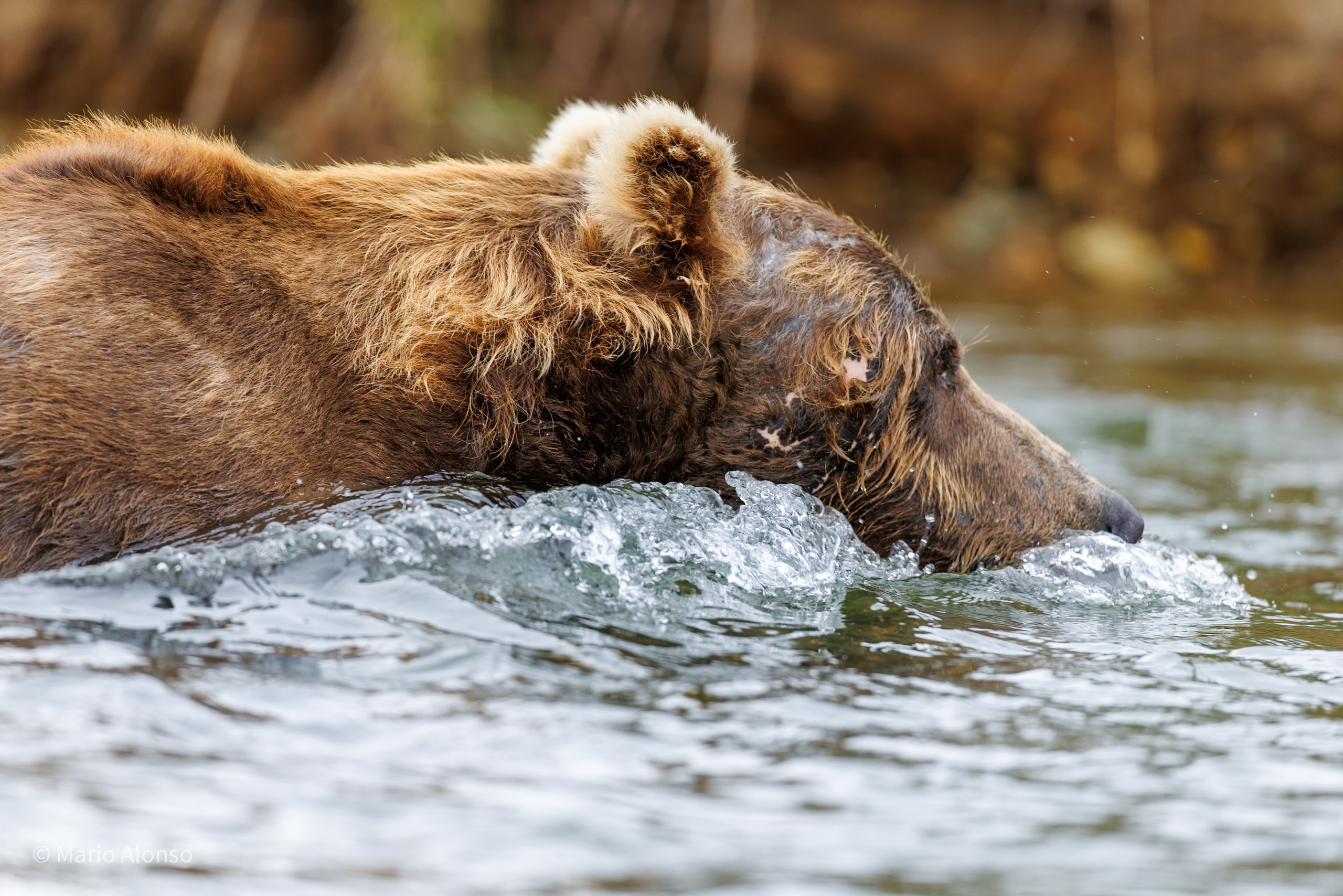
In total we must have seen at least twenty individual bears, some as young as four months, several of them serious contenders for the Fat Bear title Katmai hands out every autumn.
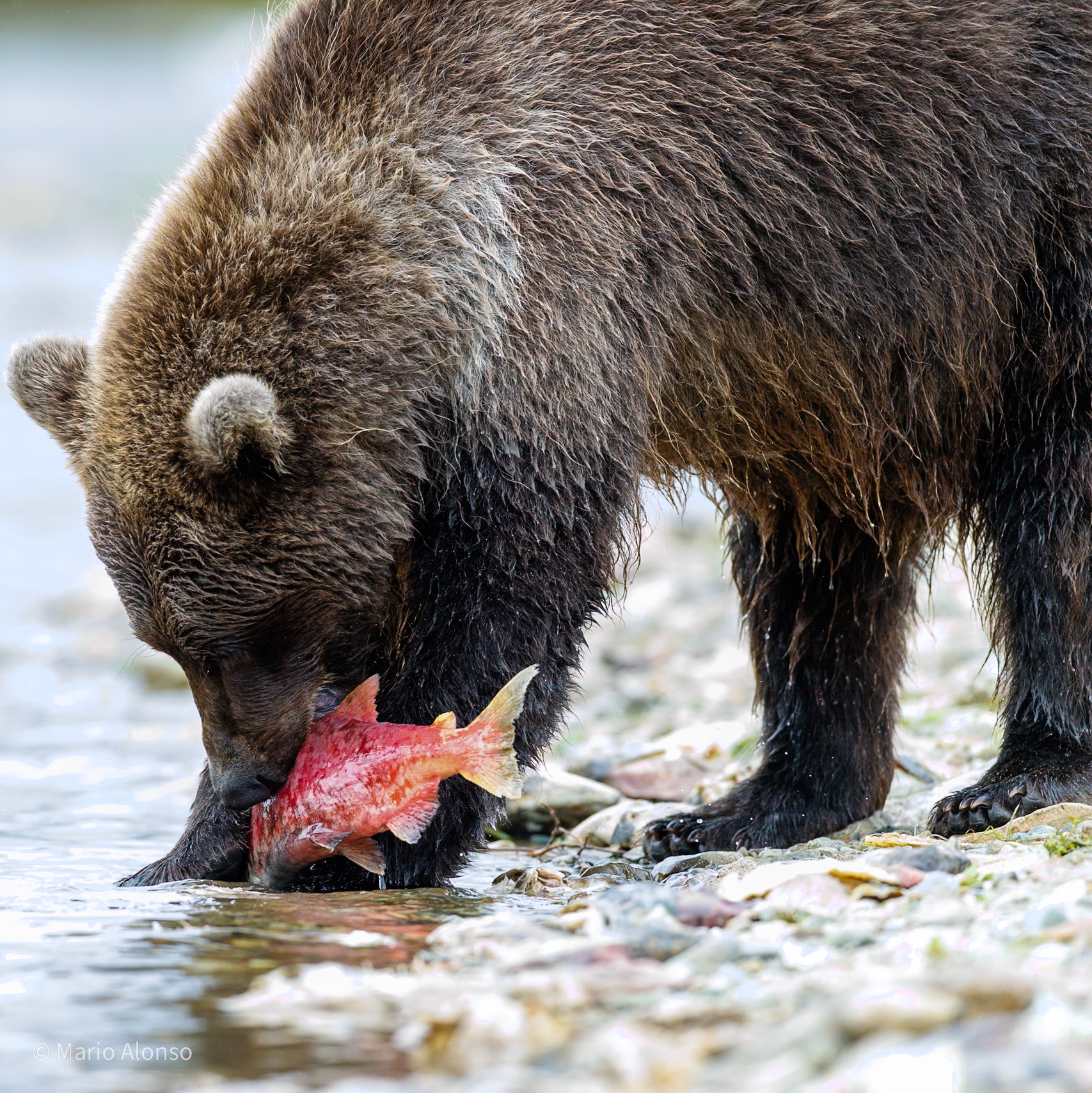
The size is not an illusion. I had been told at Denali that Katmai’s bears can be twice the size of the ones there, and the reason is entirely dietary: these are coastal brown bears with access to salmon, and a mature male here can approach 900 pounds. At the height of the run a bear may take up to forty salmon in a day, something like a hundred pounds of fish and a hundred thousand calories.
It is worth knowing what those fish have done to get there. Sockeye reaching Moraine Creek have come in from Bristol Bay, up the Alagnak, through Kukaklek Lake and on up the creek, well over 150 miles of upstream swimming without eating a thing since they left the sea. By the time the bears meet them they are red and green, humped, exhausted, and very close to dead anyway. The whole system runs on animals arriving at the end of their lives in enormous numbers at a predictable place and time.
You can see that abundance in their table manners. Bears were catching a salmon, eating the skin and part of the head, discarding the rest and going back for another. There is a term for it: high grading. When fish are limitless the efficient strategy is to eat only the fattest parts, the skin, the brain and the roe, and leave the fillet behind. Every discarded carcass feeds gulls, eagles and eventually the forest.
We hiked and watched for about two hours, and then it was over. On the flight back they asked whether anyone wanted the copilot’s seat, and my hand went up before they finished the sentence.
Which is how I came to be looking down at what the pilot called the most beautiful lake he knows.
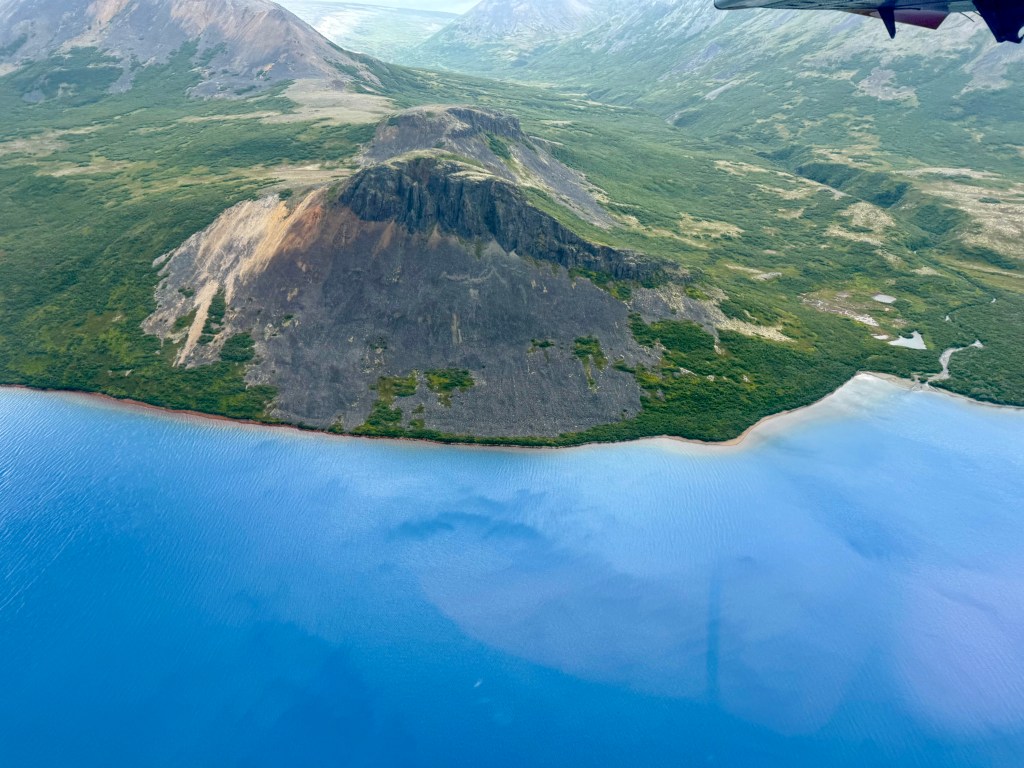
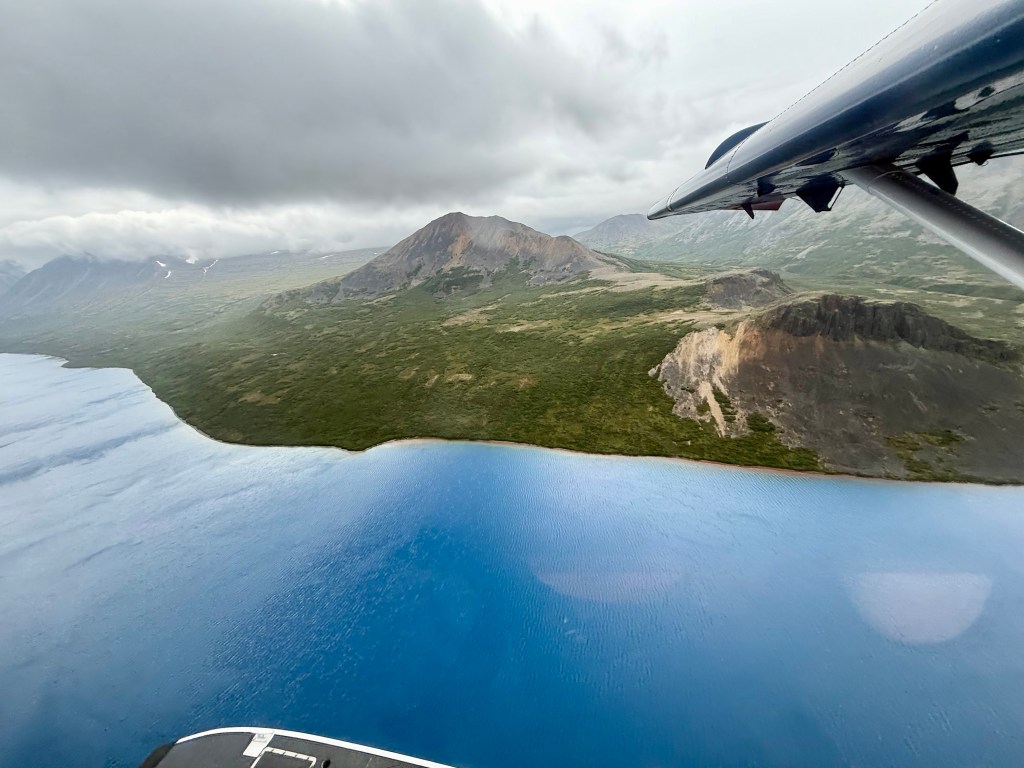
Battle Lake, at the eastern edge of the park’s lake country. It sits below a dark volcanic bluff that drops straight into the water, scree fanning down one flank, tundra running green to the edge of it in every other direction. The water is a blue that does not look real: pale and almost milky over the shallow shelf near the shore, then deepening into something saturated and electric further out. Glacially fed lakes in this country get that colour from rock flour, the powder a glacier grinds off bedrock and delivers in suspension, fine enough to stay put in the water column and scatter the blue end of the spectrum straight back at you.
It also connects to where we had just been, though not directly. Battle Lake drains west down Battle Creek into Narrow Cove on Kukaklek Lake. Moraine Creek reaches the same lake by its own route. From there it all becomes the Alagnak, a designated Wild and Scenic River, and runs on to Bristol Bay. The water under the floats and the water the bears were standing in that morning end up in the same place.
That is the mechanism and the geography. Neither explains why a pilot who flies over this country all summer picks that one lake out.
Sandra and Frida were waiting at the dock when we landed, which is the detail I remember best.
Back at the campground I downloaded over a thousand photographs and started working out how to come back for longer. From the floatplane I had seen a campsite down there, a cluster of tents inside an electrified fence. That is the version of this trip I want next.
The spare day
The following day was rain, and it existed as insurance in case the Katmai flight had been weathered out. Since it had not been, we had a free day.
Kayaking looked unappealing in that weather, so we booked a wildlife boat tour with Bay Excursions a few hours before it ran, early enough in the morning that nobody was there to read the booking. The pickup got sorted out and they arrived slightly early for a rescheduled 11:30.
We were the only two passengers, so it became a private tour.
Gulls of several kinds, kittiwakes, murres, which really do look like small penguins, cormorants, and a young Bald Eagle standing beside its nest and not yet able to fly. The stars were the puffins, both Horned Puffin (Fratercula corniculata) and Tufted Puffin (Fratercula cirrhata). A Harbor Seal (Phoca vitulina) we failed to photograph, and several Sea Otter (Enhydra lutris) including a very small pup.
One bird defeated our guides entirely, so we chased it down for a usable frame. Merlin later suggested a juvenile Sabine’s Gull (Xema sabini), which would make sense for late August on that coast.
Back in port we stopped at Coal Point Trading Company, which is a fish market with a small bar attached serving a short lunch menu. The chowder is outstanding. Go.
The KOA had arranged a dog walker while we were out, but we wanted to be back with Frida, so we went to camp and spent the afternoon on housekeeping and getting ready to leave. We lit a fire and cooked halibut fillets bought at Coal Point. The sky cleared as if on cue, so we ate with the full view of the bay, and a Bald Eagle flew over carrying a stick for its nest.
The one thing we did not do and wish we had was cross to Seldovia. Another reason to come back.
The campgrounds
Homer Baycrest KOA. Full hookups, and the facilities near the office are very nice. But the reason to stay here is the view: the campground sits above the town with the whole of Kachemak Bay laid out in front of it, and eating dinner looking at that is worth more than any amenity. They also arranged a dog walker for us on short notice, which for a full-day excursion out of Homer is exactly the service you need and is worth asking about.
Russian River Campground. Forest Service, inside Chugach National Forest, and genuinely rustic: no electric, no water hookups, no drainage, pit toilets. It is also beautiful and it sits in the middle of a salmon run that draws both anglers and bears in quantity. Use proper food storage. Read the handwritten bear log by the river before you go down there at six in the morning.
Traveling with Frida here
- Shade: Adequate at Baycrest, open and breezy above the bay. Russian River is forested.
- Cooling: Full hookups at Baycrest. Rustic at Russian River, but the Kenai in late August needed nothing.
- Where she could come: The campgrounds, the Spit, the beach, the roads. The Homer stretch was one of her easier passages.
- Where she could not: Katmai, obviously. Also the Bay Excursions boat, and the Russian River pre-dawn walk, which was not a place to take a dog under any circumstances.
- Dog care: Arranged through the KOA office for the boat day, at short notice. Katmai was an eight-hour day and Sandra stayed behind with her anyway.
- The midday block: Not a factor. The constraints here were a full-day flight and a boat, and one of us being with her covered most of it.
A note on dogs and bear country, since this entry is full of bears. At the Russian River there is salmon in the water, bears on the bank and anglers in between, and a dog is a genuinely bad idea in that combination regardless of the rules. We left her at the site and did not think twice.
Verdict
The park. Go. If you can only do one wildlife thing in Alaska, do this one.
It is not cheap and it is not casual. You fly in, you walk where a guide tells you to walk, and you do it entirely on the animals’ terms. But the experience of standing two meters from a wild brown bear that has simply decided you are not interesting is not available anywhere else I have been, and the reason it is available here is that Katmai’s bears have never had to compete with anything for food, including us.
Bring two bodies or accept that you will be changing lenses at the wrong moment. Bring more memory than you think. And if this is a day you want to share with someone, look at how each operator gets you there before you book, because it varies: some fly small floatplanes, some use larger aircraft, and some run from the water. The bears are the same. The journey to them is not, and it is worth choosing the one that gets your whole party onto the creek bank together.
The campgrounds. Homer Baycrest KOA is the base for this, and a good one, mostly for the view and for being able to arrange dog care on a day’s notice. Russian River is the one to add if you have a night spare, for the salmon run alone.
See more
- Photos from Katmai National Park in the gallery
- Traveling with a senior bulldog: the ground rules, the reasoning behind every camping decision in this series

 Looking 4 Nature
Leave a comment