This is one of nine park notes from a 48-day camper trip to Alaska and back. We traveled with Frida, our senior English Bulldog, and that shaped more of our decisions than the route did. See Traveling with a senior bulldog: the ground rulesfor the reasoning we applied everywhere.
What we made of the park
Denali is just amazing. By the end of our first full day we were already saying out loud that we had a contender for our favourite National Park, and three days later nothing had changed our minds.
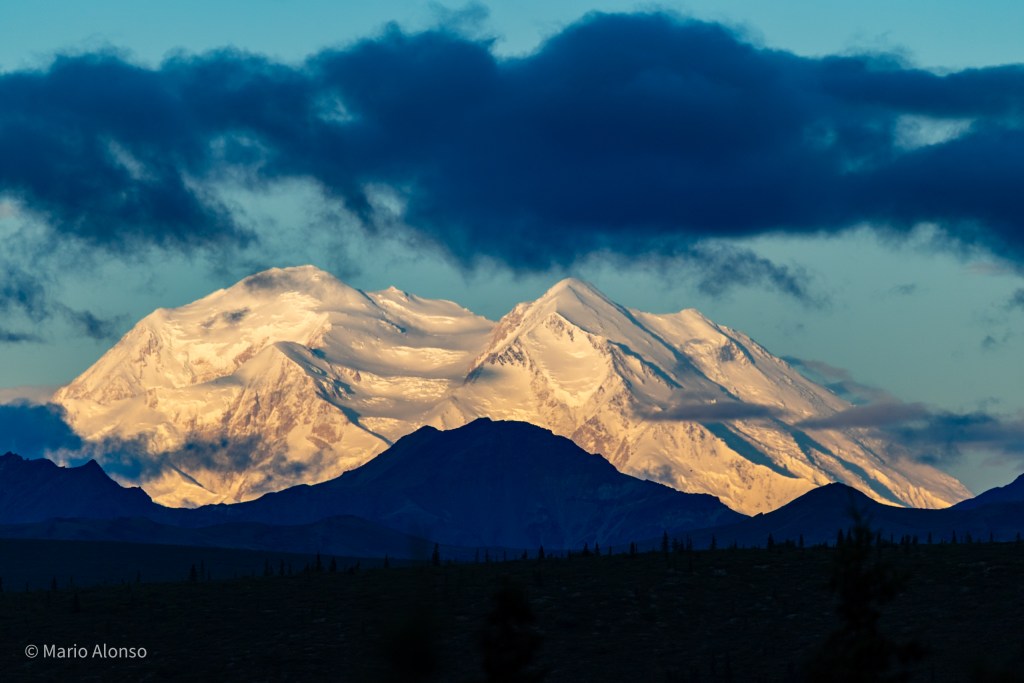
Part of that is luck. Roughly two thirds of visitors never see the mountain, and we saw it clearly on three consecutive days. Part of it is the wildlife, which arrived in a volume and at a proximity we had not experienced anywhere else on this trip. And part of it is something harder to describe, which is that most of Denali has no trails in it at all. You get off the bus and you walk on braided gravel bars and social trails and through waist-high scrub, and there is no infrastructure anywhere telling you where to go or protecting you from your own decisions.
We will be back. The west half of the park road has been closed since 2021, and it reopens to buses in 2027.
The stay
| Campground | Riley Creek, Denali National Park, AK, Loop B |
| Nights | August 18, 19 and 20, 2026 |
| Hookups | None, anywhere in Denali |
| Night before | Denali RV Park and Motel, Healy, full hookup, August 17 |
| Arrival drive | Tok to Healy, 315 miles, 5h 12m |
Getting there, and a tire
We left the Tok RV park around 7:30, refuelled, and made the first stop at Rustic Blends in Delta Junction, an independent coffee shop in a building that looks like an old chapel, serving good espresso.
Then Fairbanks, to replace the spare we had burned on the Alcan and to restock the pantry. The Walmart auto centre did not have the tire: hunting season was coming and people were fixing up their campers, which the woman behind the counter delivered as a complete explanation and, once you have been in Alaska a few days, is one.
I ended up at Giant Tire, which looked distinctly sketchy from the outside. A small office, a shop, and a row of shipping containers holding the stock. They did the job properly and told me the belt had broken from impact damage. Thank you, Alcan.
Then south, with the scenery getting steadily more serious until it resolved into Denali.
The pet-sitting problem, and how we solved it
This deserves its own section, because it is the single hardest logistical problem the whole trip presented and it took months to solve.
The Denali plan was built around two transit bus days, each of them eight hours or more out of camp with no possibility of returning early. Frida could not come. We had a reserved site at Riley Creek, and we could not find anyone in the area to look after her.
Rover had nothing. We tried for months.
The workaround was to split the stay. We booked the first night outside the park at the Denali RV Park and Motel in Healy, a private campground that offers pet sitting as a service, and moved into Riley Creek the following day. It is a nicer property than most private RV parks we stayed at, and we were still glad to be moving into the park.
Then, a couple of weeks before we left home, I finally found a local sitter through the town of Healy’s Facebook page. Liz Hummel covered an hour at ten in the morning on each of our two Riley Creek days. The RV park’s own service covered the first bus day with three thirty-minute visits.
Two things worth taking from that. Local Facebook groups reached where the national platform did not, which is the second time on this trip that has been true. And a private campground that offers pet care can be worth a night of your in-park reservation, purely as a solution to a problem that has nothing to do with camping.
Why the road stops at mile 43
The Denali Park Road runs 92 miles. Private vehicles may drive the first 15, to Savage River. Beyond that you take a bus.
In August 2021 a long-creeping landslide at a place called Pretty Rocks, near mile 45 in the Polychrome Pass area, accelerated from inches per day to inches per hour and took the road with it. Everything west of mile 43 has been closed since. Buses turn around at the East Fork of the Toklat River.
That is what we rode: the East Fork Transit, booked months in advance, 6 a.m. out of Riley Creek.
The fix is a 475-foot steel truss bridge spanning the active slide, fifty feet tall, anchored with 23 thermosiphons to keep the permafrost beneath its eastern footing frozen. It cost about $230 million and took five years. It opened to hikers and cyclists on August 27, 2026, which was a week after we drove out, and full bus service to Eielson, Wonder Lake and Kantishna is expected to resume for the 2027 season.
So we saw the short version of Denali. We would like the long one.
Bus day one
Up at 4:30, breakfast, walked Frida, and a fifteen-minute drive to the bus depot with half an hour in hand. The depot has a Starbucks concession that opens at 5 a.m., which is the sort of detail you do not expect from a wilderness park and are grateful for at four in the morning.
Not knowing how cramped the bus windows would be, I went with the 100-500mm and a wide angle.
The mountain appeared early, framed in cloud, from more than fifty miles out. Even at that distance it is preposterous. We got better looks later as the bus worked in to around twenty-five miles.
Then the wildlife took its turn.
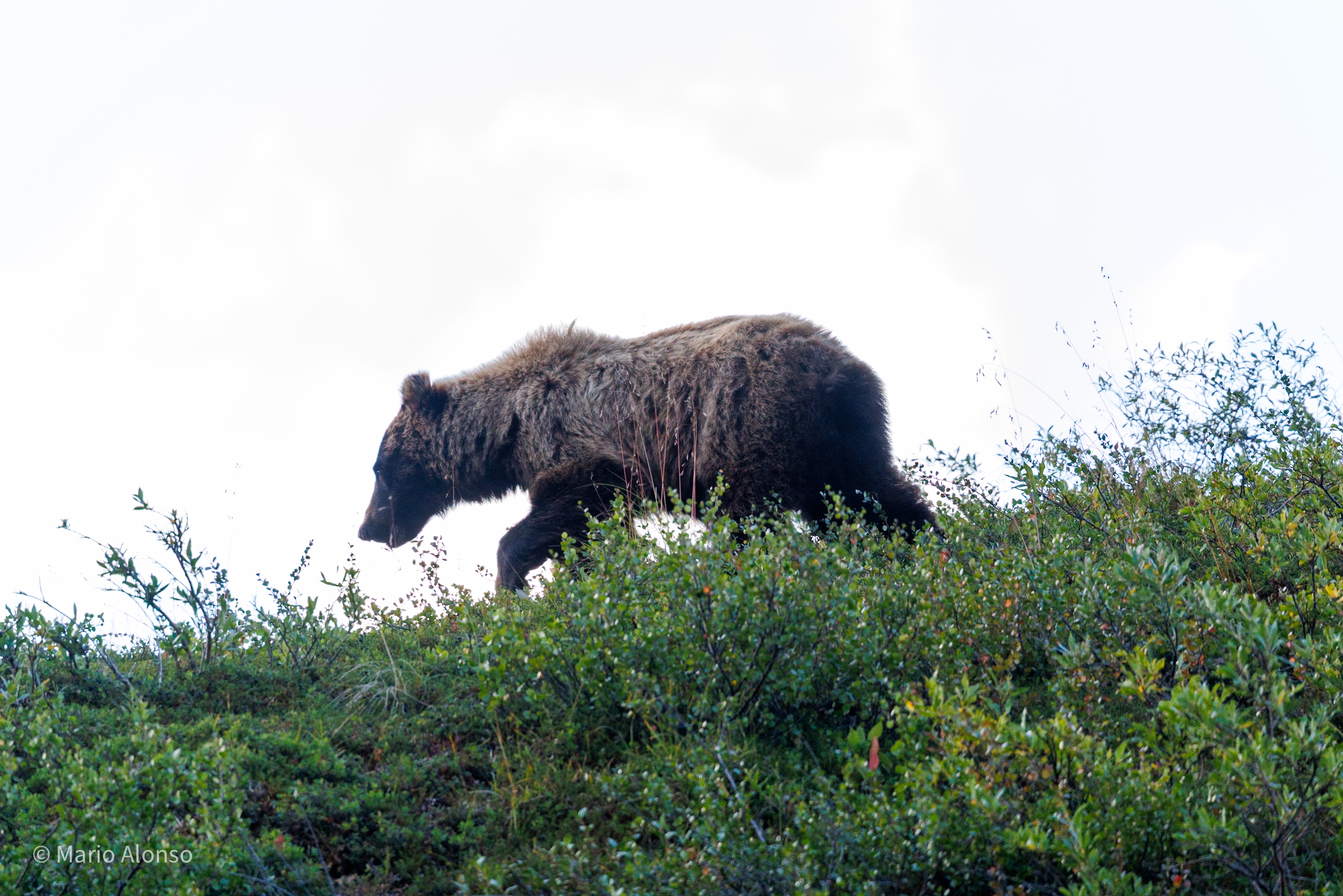
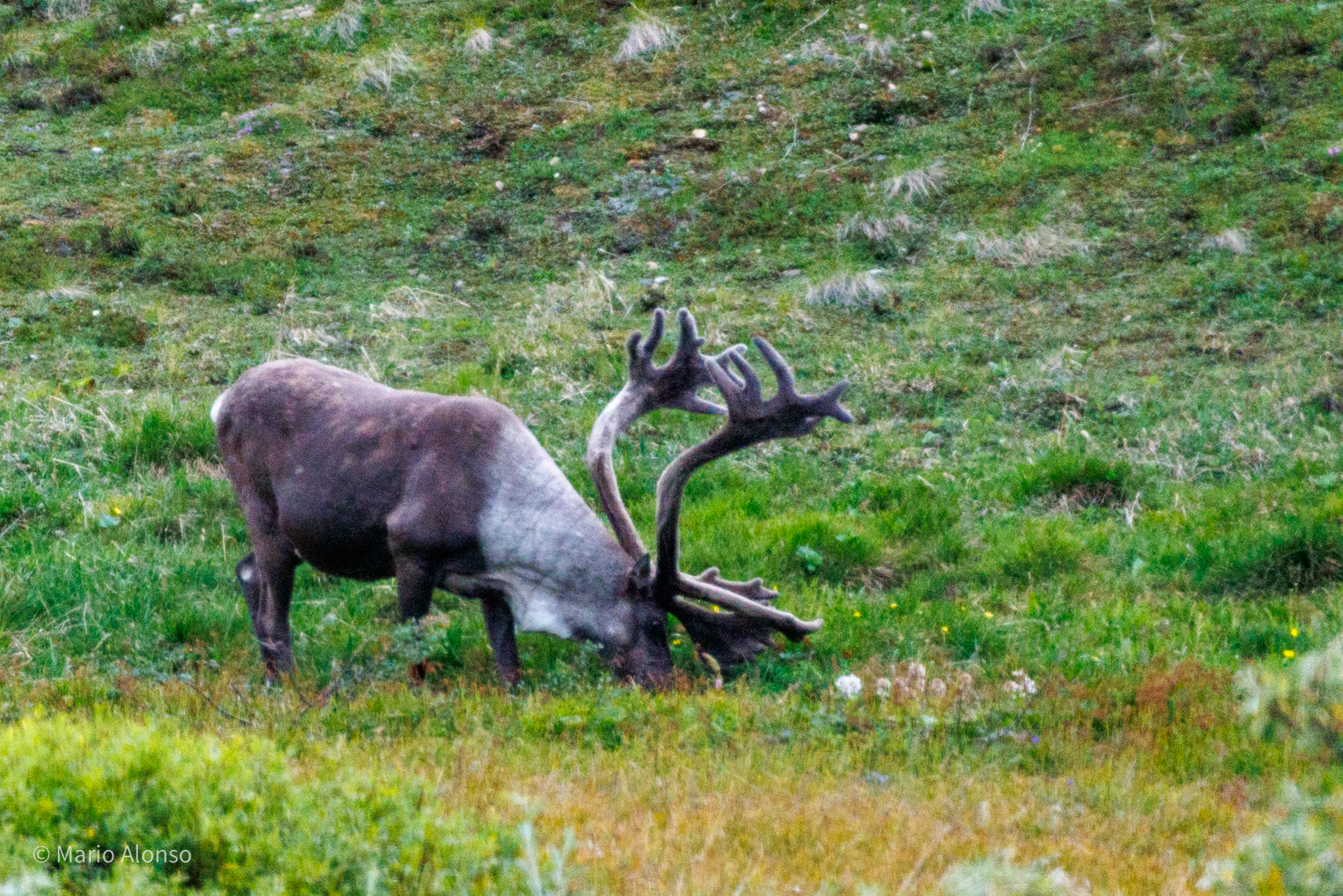
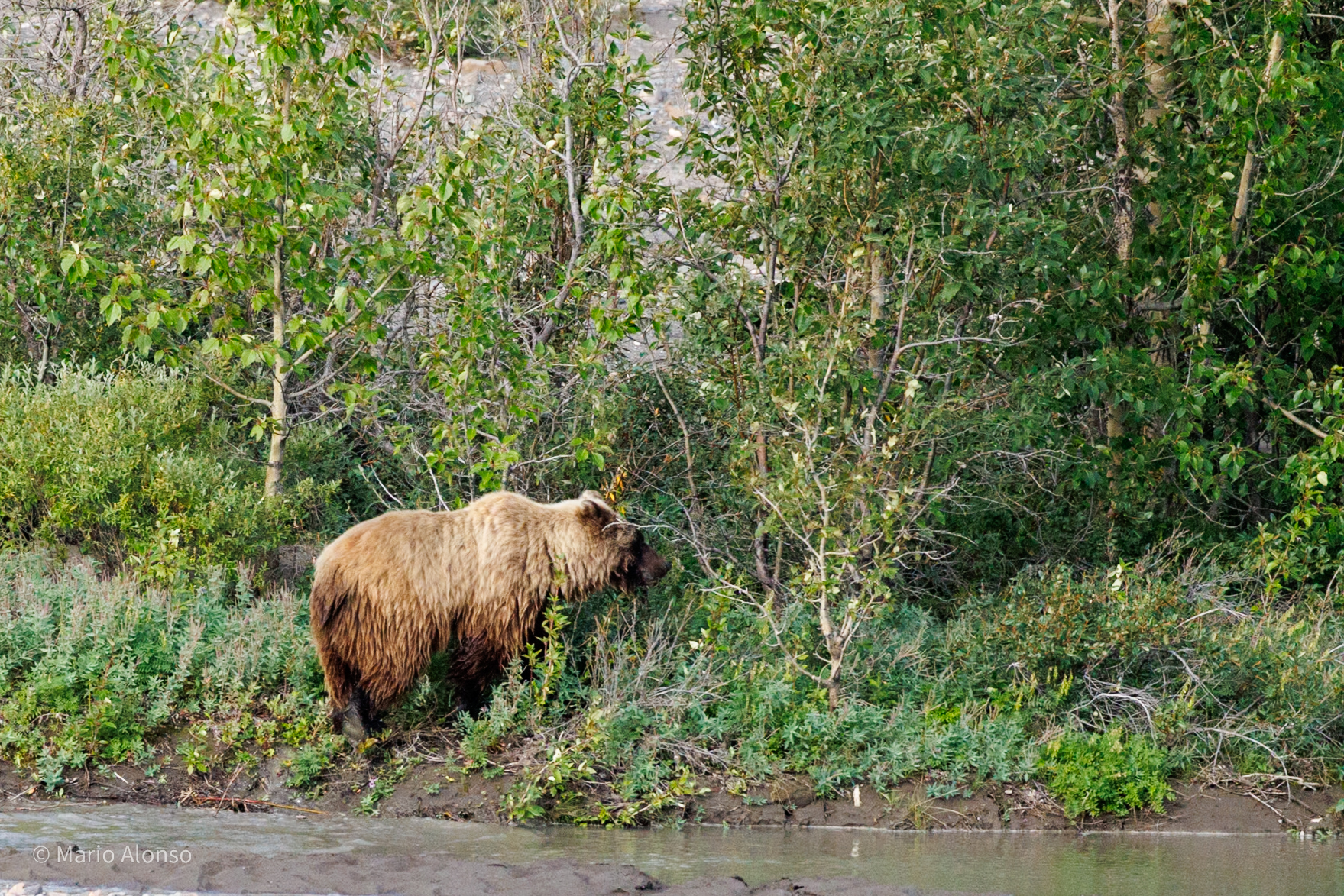
Caribou (Rangifer tarandus) first, at distance. Then a Grizzly Bear (Ursus arctos horribilis) roughly fifty meters from the bus, working a berry patch and entirely unbothered. A second grizzly further out on a hillside. Multiple Dall Sheep (Ovis dalli). Willow Ptarmigan (Lagopus lagopus), the Alaska state bird.
We got off at East Fork, where the buses turn around, and here is the thing about Denali that no other park on this trip prepared us for: across most of the park there are no maintained trails at all. You are welcome to walk on social trails or simply to bushwhack. That is the whole system.
We wanted to head north toward the new bridge. That access was closed for bear activity, so we walked east along the river bank instead, which I will admit was nerve-wracking. The brush was high and heavy with berries before we reached open gravel. When we came out we were told that area had also just been closed for bear activity.
We took the next bus a few miles back down and walked a stretch of the road. A third grizzly was on a hillside four or five hundred meters off, eating berries, and it moved parallel to us for at least a mile before we got back on a bus.
Frida was fine, watered and happy, when we collected her. We hooked up the trailer and moved into Riley Creek.
The day in between
Drizzle, so we took it slowly: latte, croissants, walk the dog.
The Savage River Alpine trail was closed for bear activity, so we walked the Savage River Loop, an easy 2.2 miles up one bank and down the other, and extended it on a social trail to about four. On the way out the mountain was clear again. Two days running.
Afternoon was the Triple Lakes trail, 6.4 miles on the AllTrails route, which is a partial version of a trail closer to ten. It begins unpromisingly beside the highway and actually passes underneath it, then pulls away from the road and the noise and becomes genuinely beautiful, with the Nenana River below you and three lakes strung along the route. We saw almost nobody.
Bus day two
We had 7:30 tickets and talked our way onto the 6 a.m. bus, for the light and for the animals.
The mountain was clear again, a third straight day, at which point I started to doubt the statistic.
I looked into that afterward, and the statistic survives. The commonly cited figure is that about 30 percent of visitors see Denali. But that is per visitor, and most visitors are there for one day. If each day is roughly an independent 30 percent chance, then three days gives you about a two in three chance of seeing it at least once, which is a very different proposition. Seeing it on all three days is genuinely lucky: on those odds, under three percent. The lesson for anyone planning is not that the number is wrong. It is that the single best thing you can do to improve your odds is stay longer.
This time I brought the 600mm. That paid off on a grizzly up a hillside and on caribou, and it paid off most at the river overlook, where a grizzly and her cub were working the gravel about three hundred meters out. I got good frames of each of them and never managed both in one.
The cost of that choice showed up too: ptarmigan turned up right beside the bus and were far too close for the long lens. There is no correct answer to that problem, only a bet you place before you board.
With Frida covered again, we hiked after the bus rather than before. Horseshoe Lake is short and startlingly biodiverse. A Muskrat (Ondatra zibethicus), extensive beaver sign, the lake itself owing part of its existence to a large American Beaver (Castor canadensis) dam, several woodpeckers we took for American Three-toed (Picoides dorsalis), and a Belted Kingfisher (Megaceryle alcyon).
We spent the afternoon at camp with Frida, went to the visitor centre to use the wifi and push photo files to Creative Cloud, ate at the cafeteria, and packed.
Leaving
Out at six, with one last stop at the bus depot for a latte for the road.
We took our two-hour driver swap at the Mt. McKinley Princess Wilderness Lodge, which turned out to be run by Princess Cruises as a place to funnel passengers toward Denali. It has the full cruise-ship atmosphere, which is fine if that is your thing.
The campground
Riley Creek sits just inside the park entrance and is the largest campground in Denali, 142 sites in spruce forest near the Nenana River, spread across several loops. We were in Loop B.
No hookups. There are none anywhere in Denali, so this is not a shortcoming of Riley Creek, it is the park.
What Riley Creek does have is everything else. Flush toilets and potable water on the loops, and the Riley Creek Mercantile nearby with a shower house, paid laundry, camping supplies, groceries and beer. There is a dump and fill station. A free shuttle runs to the visitor centre and the bus depot, and you can walk to the depot in about ten minutes, which matters a great deal when your bus leaves at six. Generators are permitted 8 to 10 a.m. and 4 to 8 p.m.
Sites are wooded and reasonably separated. All are back-in, and rigs are limited to 40 feet. Reserve six months out.
For our purposes it was close to ideal. Being able to walk to the bus depot before dawn, and to come back to the site in the middle of the day, is worth more here than a hookup would have been.
Traveling with Frida here
- Shade: Good. Riley Creek is spruce forest and the sites are wooded.
- Cooling: No hookups, so battery and solar. Late August at Denali does the work for you: highs in the 60s, nights down into the 30s. Heat was not a consideration for the first time on this trip.
- Where she could come: The campground, the park road corridor, parking areas, the car.
- Where she could not: The trails, and the transit buses. Both bus days were complete days away.
- Dog care: The Denali RV Park’s own service for the first bus day, three thirty-minute visits. Liz Hummel, found through the Healy community Facebook page, for an hour at 10 a.m. on each of the two Riley Creek days.
- The midday block: Irrelevant here. The constraint was two eight-hour-plus absences that could not be shortened once the bus pulled out, which is a harder problem than heat and the reason this stop took months to arrange.
Verdict
The park. Three full days and we would take more. Denali gave us the best wildlife of the trip at that point, and the mountain three times over, and it is the first place on this route where stepping off a bus means stepping into country with nothing built in it.
Stay longer than you think you need to, for the mountain odds alone. Book the transit bus months ahead. Accept that trails and whole valleys close for bear activity with no notice, because that is the park working as intended. And if you are going in 2027 or later, you will get the fifty miles we did not.
The campground. Riley Creek is the practical choice and a good one. No hookups anywhere in the park, so plan for that, but the walk to the bus depot, the mercantile, the showers and the free shuttle make it the easiest base in Denali. Reserve six months out and take a wooded site.
If your trip depends on someone watching a dog, solve that before you book anything else here. It is the hardest thing to arrange in this part of Alaska.
See more
- Photos from Denali National Park in the gallery
- Traveling with a senior bulldog: the ground rules, the reasoning behind every camping decision in this series
 Looking 4 Nature
Leave a comment