This is one of nine park notes from a 48-day camper trip to Alaska and back. We traveled with Frida, our senior English Bulldog, and that shaped more of our decisions than the route did. See Traveling with a senior bulldog: the ground rulesfor the reasoning we applied everywhere.
What we made of the park
The last park of the trip, and the one that closed a circle we had not planned.
Six weeks earlier we had started in the Badlands, three hundred miles east of here: mixed-grass prairie, prairie dog towns everywhere you looked, burrowing owls, a black-footed ferret we never found, and heat that ran the day. At Wind Cave we got all of it again. Same grassland, same prairie dogs, same heat, and a ranger who dispatched the ferret question with the best line of the trip.
Wind Cave is small, on the order of 34,000 acres, and it is easy to treat it as a cave with some grass on top. That is backwards. It protects one of the largest surviving stretches of mixed-grass prairie in the entire National Park System, and it carries a bison herd of real scientific importance. The cave is extraordinary and unlike any other cave I have been in. The prairie above it is arguably the rarer thing.
Two nights and a cave tour is enough to see it. It deserves a bit more.
The stay
| Campground | Elk Mountain, Wind Cave National Park, SD |
| Site | C45, rustic, no hookups |
| Nights | September 6 and 7, 2026 |
| Arrival drive | Garryowen, MT to Wind Cave, 297 miles, 4h 30m |
Arriving
We left the ranch in Montana around nine and headed east. We tried to stop for lunch on the way and discovered that a good many small-town restaurants do not open on a Sunday afternoon, or at least did not on this one.
We reached the park about two and went straight to the visitor centre, which is where we learned the first practical thing about Wind Cave: same-day cave tickets were long gone. Two hundred spots are released first come, first served each morning at eight. Plan around that or you do not go underground.
We also asked where to find things, and got the most entertaining wildlife briefing of the trip. Bison on the north side. Prairie dogs everywhere. Burrowing owls near the prairie dogs, though most have probably gone by now. Elk somewhere. Badgers and coyotes near the prairie dogs. And black-footed ferrets, who cares, you won’t find them.
Six weeks after missing the same species in the Badlands, I appreciated the candor.
Ninety degrees
Then the unpleasant surprise. We had come down out of Alaska and northern Canada, where we had been reaching for jackets in the evenings, into a place where summer was still in full swing at over 90°F.
It is a genuinely disorienting thing. The whole trip had been trending colder for weeks, we had watched the snow line come down over Kluane, and here was the Great Plains in September acting like the Great Plains in July.
We had lunch at the site and then sat out the worst of the afternoon waiting for it to cool, which it declined to do. So instead of leaving Frida in a hot camper, we put her in the car and drove the loop that runs the perimeter of the park, about an hour.
Countless prairie dogs. And a herd of bison, which looked exactly as the literature had promised: noticeably smaller than the wood bison we had been photographing in the Yukon.
The bison are the point
That size difference is real and it is the reason the Wind Cave herd matters.
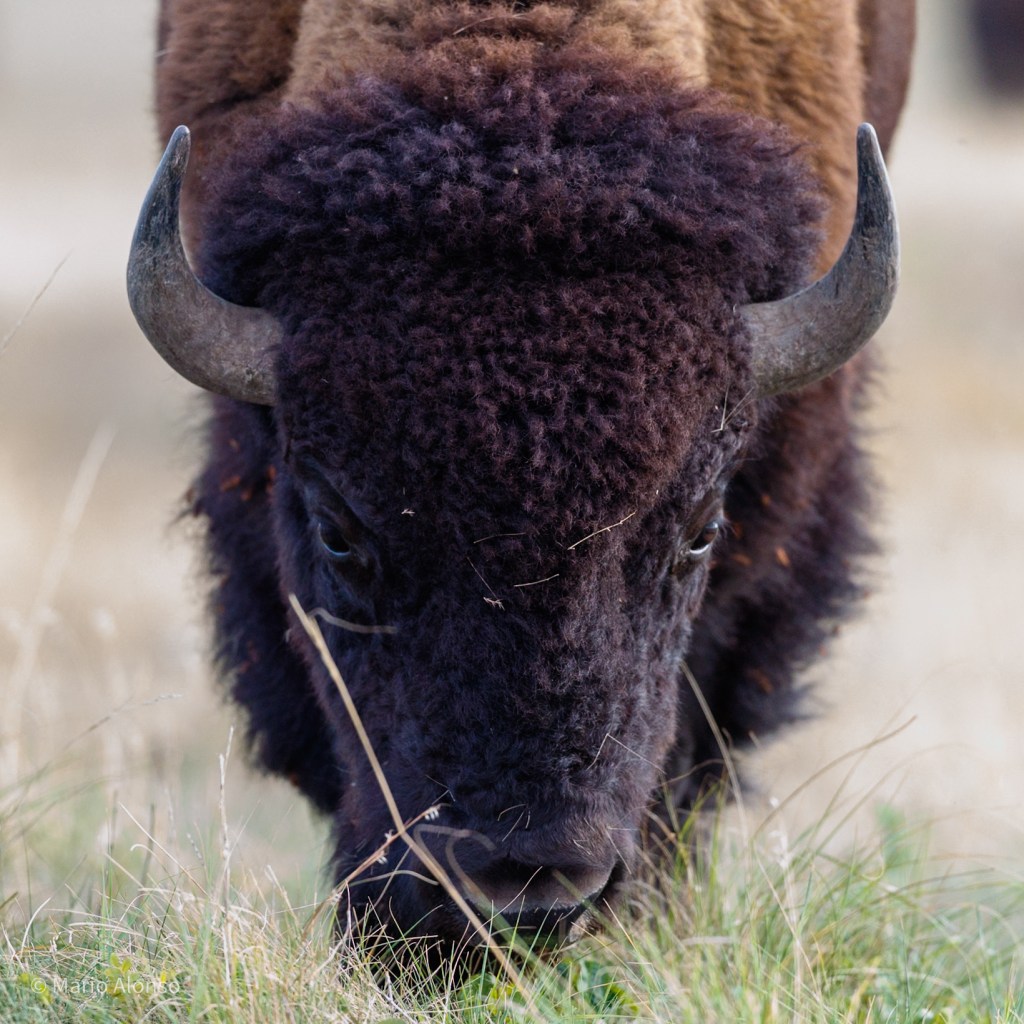
What we had seen in Yukon were Wood Bison (Bison bison athabascae), the larger northern subspecies. What was in front of us here were Plains Bison (Bison bison bison). Having seen both within three weeks, the difference in build is obvious rather than academic.
But the interesting part is invisible. When bison were hunted down to a few hundred animals in the 1880s, ranchers crossbred the survivors with cattle, and those cattle genes spread into most public herds when animals were moved around to found new populations. Genetic testing has since found cattle introgression almost everywhere it has looked. Of the federal herds, Wind Cave and Yellowstone are the only two that appear to be free of it.
The Wind Cave herd was established in 1913 by the American Bison Society, with fourteen animals shipped in by rail from the New York Zoological Park, which is to say the Bronx Zoo. Today it runs somewhere around 350 to 400 animals, free of cattle genes and free of brucellosis, and it has become a genetic source herd for conservation projects elsewhere. Six of The Nature Conservancy’s thirteen bison herds were founded with Wind Cave stock.
So the ordinary-looking animals grazing beside a park road in South Dakota are, genetically, about as close as anything alive gets to the bison that covered this continent.
The cloud they both wear
There is one more thing the two herds had in common, and I only noticed it properly once I was looking at the frames.
Get close enough to a bison’s face, in the Yukon or in South Dakota, and it is covered in flies. Dozens of them, crawling across the eyelid, clustered at the corner of the eye, working the muzzle. A wood bison in British Columbia and a plains bison in South Dakota, two and a half thousand miles apart, wearing the same cloud.
These are face flies (Musca autumnalis), and they do not bite. They drink the fluid around the eyes and nose, and the irritation of all that traffic makes the animal produce more of it, which draws more flies. It is a loop that runs all summer with nothing to break it.
It is not only an annoyance either. Face flies move Moraxella bovis from one eye to the next as they work through a herd, and that bacterium causes infectious keratoconjunctivitis, pinkeye, which ulcerates the cornea and can end in blindness. Every one of those flies is a vector walking from face to face.
Nothing that large stands out in open grassland without something making a living off it.
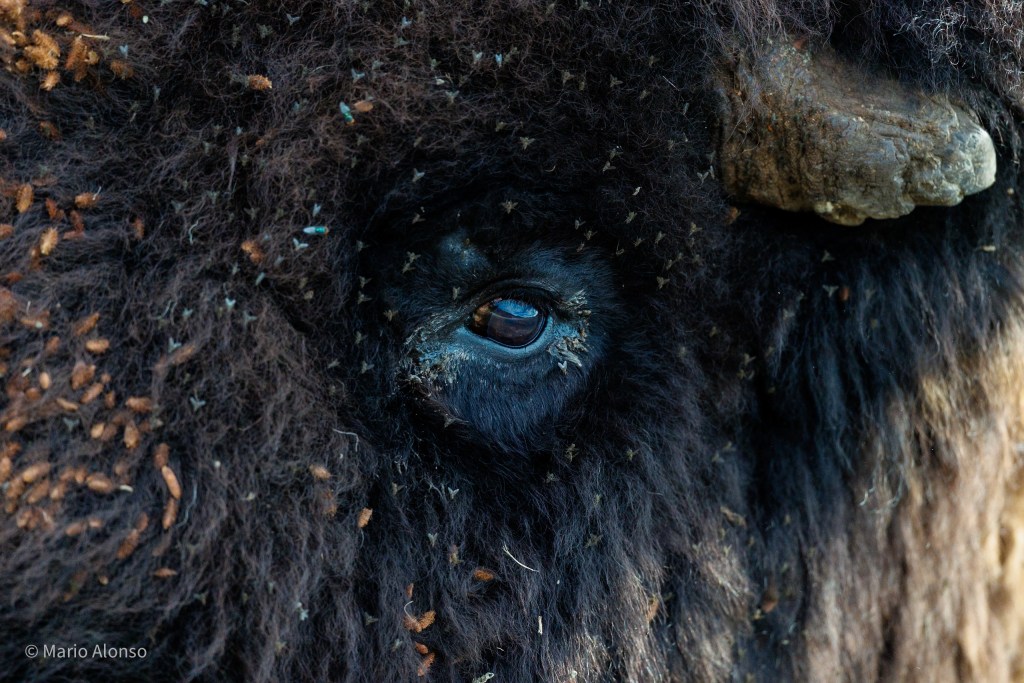
And there is a wrinkle worth knowing, given where I was standing. The face fly is not American. It comes from Europe and central Asia and arrived here sometime around the Second World War, first confirmed in Nova Scotia in 1952, then spreading across temperate North America in about twenty years. So the most genetically intact plains bison herd left on the continent, descended from animals that were rescued before the century turned, is standing in its own prairie wearing an insect that got here after the Korean War.
The storm
In the eastern part of the park we drove through a stand where a great many trees were snapped off or pulled out of the ground. We assumed a severe storm, and moved on.
That image came back to us in the middle of the night, when a powerful thunderstorm rolled straight over the campground. The camper shook, the lightning was close and continuous, and we lay there thinking about those trees.
Nothing happened. But it was a reminder that a small trailer on an exposed prairie is a small trailer on an exposed prairie.
Getting into the cave
Up at six, at the visitor centre by seven, and I was number twenty in the queue. Then it was simply a matter of waiting for eight o’clock, which is where the folding chair I had thrown in the car earned its place on the entire trip.
I took the nine o’clock Natural Entrance tour, the longest one at ninety minutes. It is not strenuous.
And the cave is not like other caves. I have been in Mammoth Cave and in the Grutas de Cacahuamilpa in Mexico, and both of those give you enormous chambers hung with stalactites and built up with stalagmites. Wind Cave has almost none of that, because it was not made the same way. There was never much flowing water in here. The passages formed as acidic water dissolved limestone along fractures in the rock, and the result is a dense three-dimensional maze rather than a set of caverns. Something like 145 miles of passage are mapped beneath barely more than a square mile of surface, and the people who work on it believe that is around five percent of what is down there.
Three formations were worth the ticket on their own.
Boxwork, which is what Wind Cave is famous for and which is genuinely rare: roughly 95 percent of all the boxwork known in the world is in this cave. It looks like a honeycomb of thin blades standing out from the ceiling, and the sequence that produced it runs backwards from what you expect. The calcite fins came first, filling cracks in the limestone. Then the acidic water dissolved the limestone away from around them. The boxwork is not something that grew on the rock. It is what was left when the rock went.
Cave popcorn, knobby clusters on the walls.
Frostwork, fine needle-like sprays of aragonite that look exactly like their name.
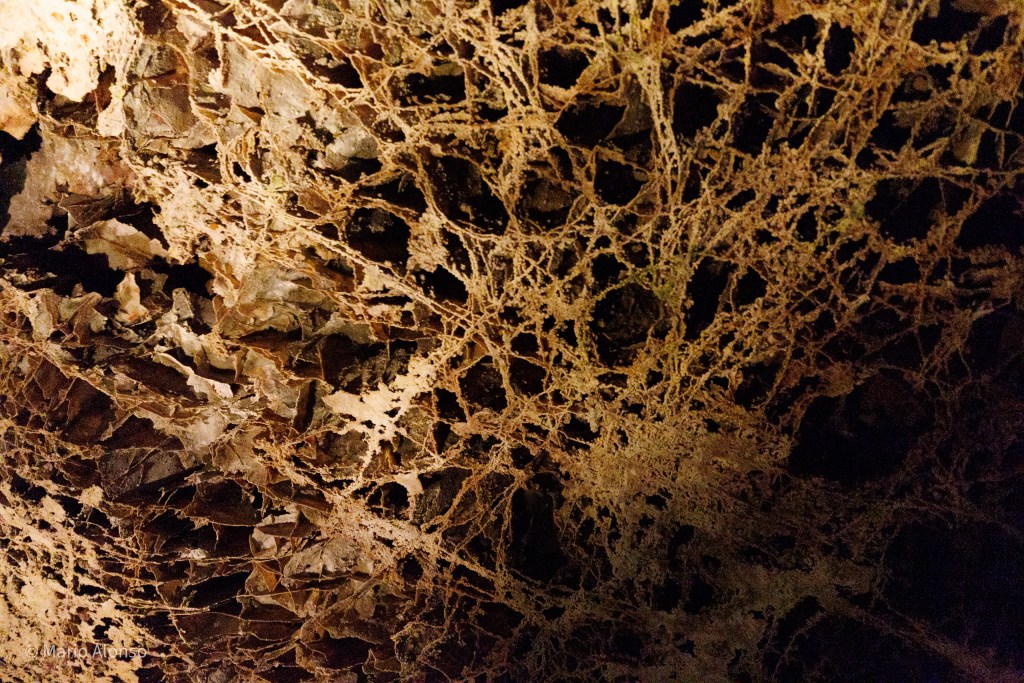
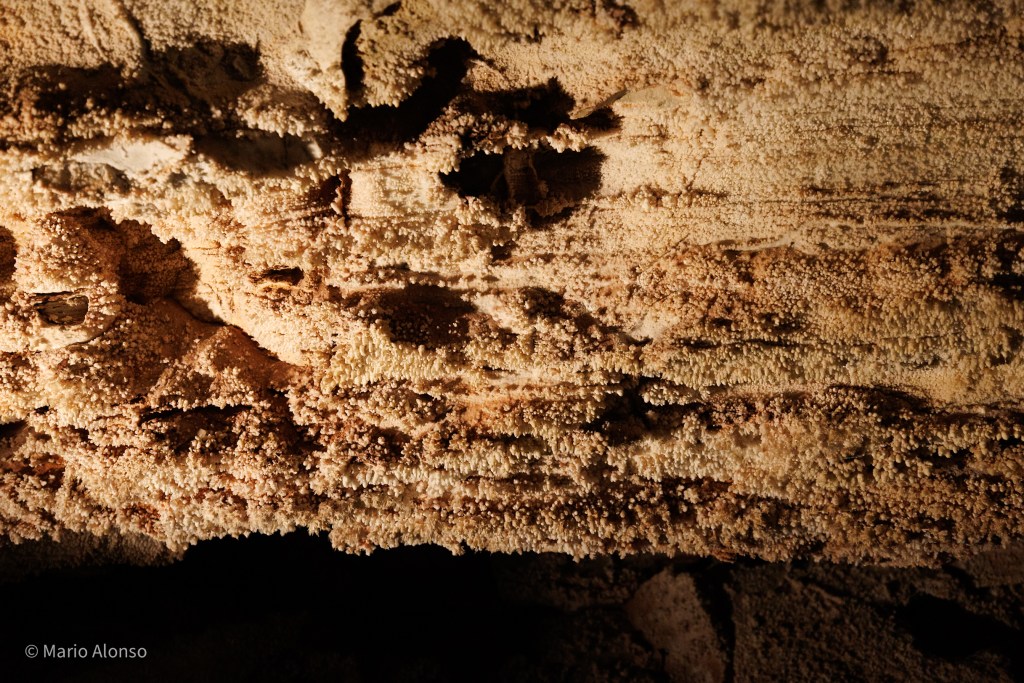
The cave sits at a constant 54°F, which after the week we had just had was its own reward.
Leaving
We came out, and the day was already heating up. Our solar batteries were low enough that we could not run the camper’s air conditioning, which meant we could not leave Frida in it while we hiked.
So we made the call and left. That is the honest end of this trip: on the last park day, the dog’s requirements and the state of charge decided what we did, exactly as they had at the Badlands on day three.
We drove to Sioux Falls and took a hotel. And somewhere on that drive we decided to break the planned two-day run home into three, to make it easier on all of us and particularly on Frida.
Forty-eight days, and the last decision of the trip was the same kind of decision as the first one.
The campground
Elk Mountain is inside the park, which is the main argument for it, and on a park this compact that means you are minutes from the visitor centre and the trailheads and can be first in the ticket queue without setting a four o’clock alarm.
It is rustic, with no hookups. In early September that was a problem in a way it had not been anywhere in Alaska, because at 90°F with no shore power you are entirely dependent on your batteries to cool the trailer, and if you have been running them hard you will not have the margin. We did not.
Ponderosa pine and open grassland, with the prairie right there. Take the exposure seriously if a storm is forecast.
Traveling with Frida here
- Shade: Partial. Ponderosa pine, but this is prairie country and the sites are not deeply shaded.
- Cooling: Rustic, no hookups, and this is where that bit. Over 90°F with depleted batteries meant the camper was not a place we could leave her.
- Where she could come: The campground, the roads, the perimeter loop drive, which is what we did instead of hiking on the first afternoon.
- Where she could not: The cave, obviously, and the trails, under the usual National Park rules.
- Dog care: None arranged. One of us could always be with her, and on the cave morning Sandra was.
- The midday block: Back in force after a month of not mattering. September on the northern plains is still summer, and we planned around the same 10 to 4 window we had used in the Badlands in July.
There is a neat symmetry in that. The first entry in this series is about heat deciding where we slept. The last one is about heat deciding what we did with our final afternoon. Everything in between, all the sitters and the bus schedules and the bear country, was the middle of the story.
Verdict
The park. Small, underrated, and worth more than the single cave tour most people give it. Go into the cave, because boxwork essentially does not exist anywhere else on the planet in this quantity. Then stay above ground and give the prairie an evening, because a mixed-grass prairie at this scale is rarer than the cave is.
Get to the visitor centre by seven for tickets. Bring a chair.
The campground. Elk Mountain is the right choice for its location, and it is rustic, so plan your power. If you are arriving in late summer with depleted batteries and no hookup, understand that a hot afternoon will decide your itinerary for you.
See more
- Photos from Wind Cave National Park in the gallery
- Traveling with a senior bulldog: the ground rules, the reasoning behind every camping decision in this series

 Looking 4 Nature
Leave a comment