Forty-eight days, a small camper, and Frida, our senior English Bulldog.
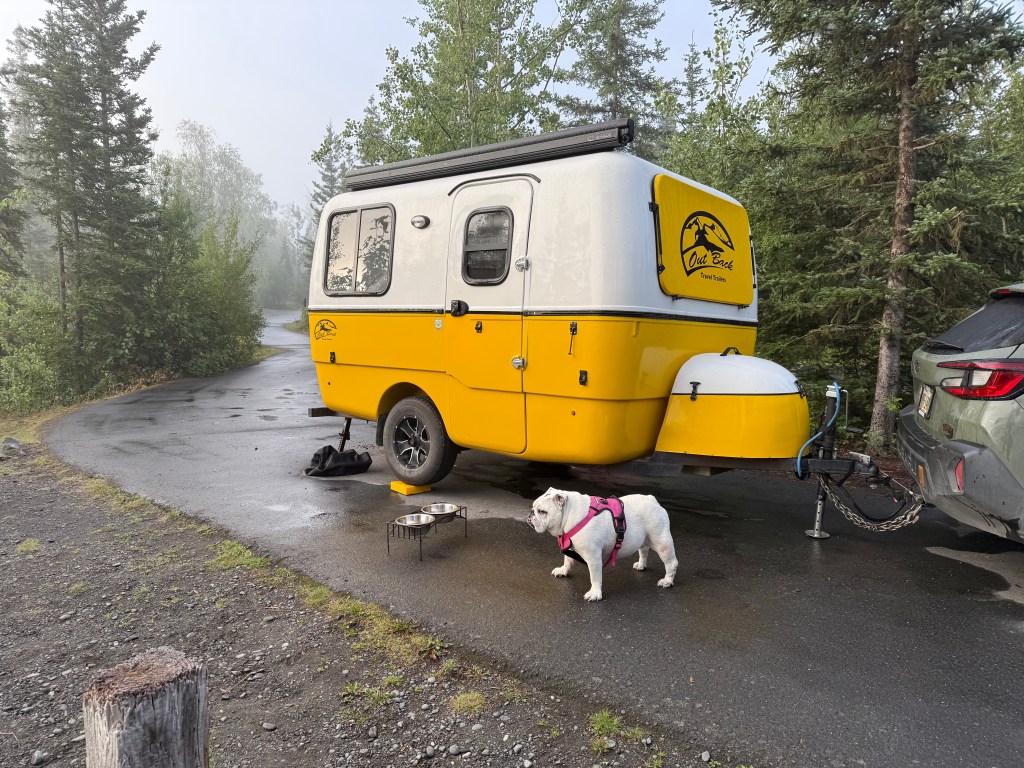
We chose to bring her. She was good company for every mile of it and the trip was better for her being there. But she also shaped more of our decisions than the route did, and the campground notes in this series keep running into the same handful of rules. Rather than re-argue them eight times, here they are once.
None of this is a complaint. It is the reasoning, written down, in case you are weighing a similar choice.
Why a brachycephalic senior changes the calculus
Dogs do not sweat to any useful degree. They cool by panting, moving air across the moist surfaces of the upper airway. A brachycephalic dog has the same soft tissue as any other dog packed into a much shorter skull, so that airway is crowded and panting is far less efficient. A senior brachycephalic has that, plus age.
The numbers are worth knowing because they are not what most owners assume. The VetCompass study of heat-related illness in UK dogs reviewed the records of 905,543 dogs under primary veterinary care in 2016 and found an event fatality rate of 14.18 percent. The significant risk factors included breed, with Bulldog and French Bulldog named explicitly, higher bodyweight relative to the breed and sex mean, brachycephalic skull shape, and being over two years of age.
The companion analysis of triggers is the one that changed how we planned. Across 1,259 heat-related illness events, exertion accounted for 74.2 percent. Environmental heat accounted for 12.9 percent. Confinement in a vehicle, the risk everybody knows about, accounted for 5.2 percent. And within those categories, older dogs and dogs with respiratory compromise had the greatest odds of the environmental type.
So the famous danger is the smallest category, the walk is by far the largest, and the specific profile of a senior bulldog loads onto ambient heat rather than onto any dramatic single event. That is not the mental model most people carry, and it is the one worth carrying.
The temperature rule we settled on
When the forecast high is above roughly 85°F, we do not camp anywhere the cooling depends on something that can run out.
We arrived at that on day three, in the Badlands, at 104°F, holding a reservation for a rustic site inside the park with no hookup. Running the air conditioner off the solar battery for two afternoons in that heat was going to be marginal. We let the reservation go and took an air-conditioned cabin outside the park instead.
Two honest caveats. This is a rule of thumb, not a clinical threshold, and we picked the number for a specific dog. Humidity and exertion both matter more than the air temperature alone, which is why a 78°F hike can be worse than a 90°F afternoon spent lying still in shade. Use the number as a trigger to think, not as a substitute for thinking.
Shore power versus battery
The solar setup is genuinely good and it carried us most of the trip. Air conditioning in extreme heat is where it stops being enough, and that is the one load you cannot defer.
This produced a paradox we did not expect. At Fish Creek in Glacier, our site was deep under conifers, which was ideal for Frida and poor for the panels. Shade and solar pull in opposite directions, and if you are relying on battery at a rustic site, the site that is best for the dog is the one that charges worst.
Where it decided a booking, it decided it on price too, and not in the direction you would guess. Two nights at Fish Creek cost $60. Two nights in the cabin outside Badlands cost $238.23. Camping inside a National Park is inexpensive. What you buy outside the gate is infrastructure, and the only question on a given day is whether you need it.
The midday block
Roughly 10 a.m. to 4 p.m. was written off on hot days. All three of us.
Planning around that window rather than fighting it is the single change that made the trip work, and it turned out to cost us almost nothing. Dawn is when the light is best and when animals move. The hours a bulldog cannot use are largely the hours a wildlife photographer does not want anyway. Our alarm went off at 4:15 for Logan Pass, and we were back in camp by nine with the best morning of the trip already on the cards.
Treat the block as a planning unit, not a loss. It is the nap, the pool, the long lunch, the card offload, the drive between parks.
Pet care, and where the platforms do not reach
We default to Rover. At Glacier, Rover had nothing.
That is worth planning for. National platforms thin out exactly where you most need them, which is small mountain towns in peak season. We found a local operator instead, and the arrangement worked well.
Two things we learned doing it. First, book on the same horizon as the campsite. We signed the service agreement in February, roughly six months out, which is also the window on which most in-park campgrounds release sites. Second, book it before you know where you are sleeping. Our February agreement named a campground we ended up not using, because we had not yet secured the in-park site. When the site came through we amended the agreement. Dog care is easier to move than to find late.
Expect a cancellation term of at least 24 hours. We cancelled a second visit inside that window and paid for it, which was our error and a fair term.
National Park pet rules are stricter than you think
This is the constraint no equipment solves, and it is not negotiable.
In US National Parks generally, and at every park on our route, pets are allowed in developed areas: campgrounds, picnic areas, parking areas, along roads, and in your vehicle. They are not allowed on trails, in the backcountry, along lake shores outside developed areas, or inside any building. Leash of six feet or shorter. Pets may not be left tied and unattended, which is the clause that turns “we will just leave her at the site” into a non-option. Glacier issues citations starting at $75.
Then you cross into Canada and it reverses. In the Parks Canada system, dogs are welcome on most trails on leash, with local exceptions for wildlife activity and watershed protection. Coming straight from Glacier this is a genuine surprise.
The practical upshot: plan the US parks around arranged care, and plan the Canadian parks around bringing her.
What we gained
She was there for all of it.
She was there for the creek running past the site at Fish Creek, for the porch during a Badlands thunderstorm, for the cool early hours that turned out to be the best hours anyway. Every rule above is a rule we adopted so that she could come, and none of them cost us a park, a species, or a photograph we actually wanted.
If you are deciding whether to bring an old dog on a long trip, that is the honest summary. It costs planning, it costs some money, it costs the middle of some days. It does not cost the trip.
How to read the campground entries
Each entry in this series closes with the same block, so you can skip to it:
- Shade at the site
- Cooling, and whether it depended on shore power or battery
- Where she could come
- Where she could not
- Dog care, if we arranged any
- The midday block, and what it actually cost us there
Each entry also closes with links to the gallery filtered for that park, and back to this post.

 Looking 4 Nature
Leave a comment